Department of Bio and Health Informatics, Technical University of Denmark, Kgs. Lyngby, DK 28002, Denmark.
Instituto de Investigaciones Biotecnológicas, Universidad Nacional de San Martín, Buenos Aires, BA 16503, Argentina.
Nucleic Acids Res. 2020 Jul 2;48(W1):W449-W454. doi: 10.1093/nar/gkaa379.
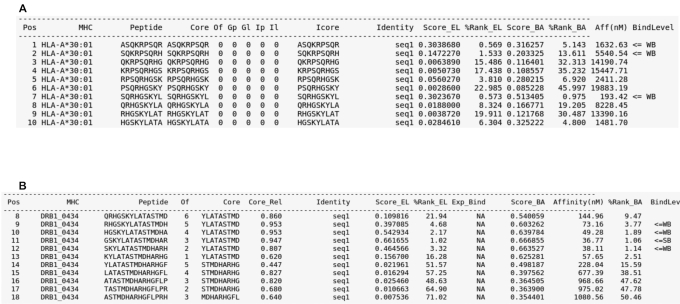
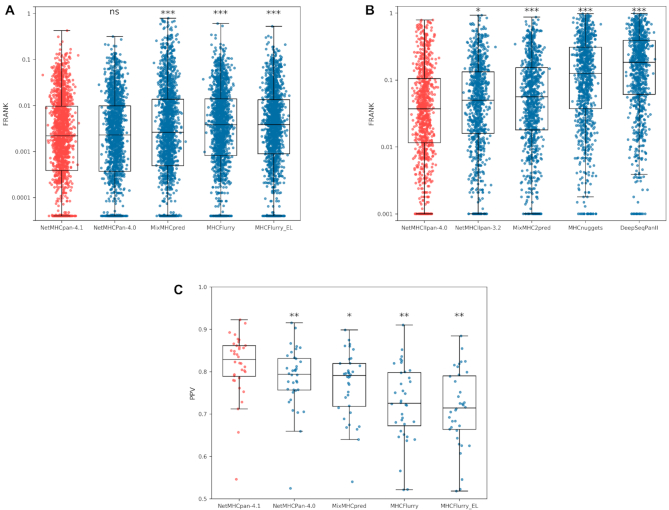
Major histocompatibility complex (MHC) molecules are expressed on the cell surface, where they present peptides to T cells, which gives them a key role in the development of T-cell immune responses. MHC molecules come in two main variants: MHC Class I (MHC-I) and MHC Class II (MHC-II). MHC-I predominantly present peptides derived from intracellular proteins, whereas MHC-II predominantly presents peptides from extracellular proteins. In both cases, the binding between MHC and antigenic peptides is the most selective step in the antigen presentation pathway. Therefore, the prediction of peptide binding to MHC is a powerful utility to predict the possible specificity of a T-cell immune response. Commonly MHC binding prediction tools are trained on binding affinity or mass spectrometry-eluted ligands. Recent studies have however demonstrated how the integration of both data types can boost predictive performances. Inspired by this, we here present NetMHCpan-4.1 and NetMHCIIpan-4.0, two web servers created to predict binding between peptides and MHC-I and MHC-II, respectively. Both methods exploit tailored machine learning strategies to integrate different training data types, resulting in state-of-the-art performance and outperforming their competitors. The servers are available at http://www.cbs.dtu.dk/services/NetMHCpan-4.1/ and http://www.cbs.dtu.dk/services/NetMHCIIpan-4.0/.
主要组织相容性复合体 (MHC) 分子表达在细胞表面,在那里它们向 T 细胞呈递肽,这使它们在 T 细胞免疫反应的发展中起着关键作用。MHC 分子有两种主要变体:MHC 类 I (MHC-I) 和 MHC 类 II (MHC-II)。MHC-I 主要呈递来自细胞内蛋白质的肽,而 MHC-II 主要呈递来自细胞外蛋白质的肽。在这两种情况下,MHC 与抗原肽之间的结合是抗原呈递途径中最具选择性的步骤。因此,预测肽与 MHC 的结合是预测 T 细胞免疫反应可能特异性的有力工具。通常,MHC 结合预测工具是基于结合亲和力或质谱洗脱配体进行训练的。然而,最近的研究表明,整合这两种数据类型如何可以提高预测性能。受此启发,我们在此展示了 NetMHCpan-4.1 和 NetMHCIIpan-4.0,这两个网络服务器分别用于预测肽与 MHC-I 和 MHC-II 之间的结合。这两种方法都利用了定制的机器学习策略来整合不同的训练数据类型,从而实现了最先进的性能,并优于其竞争对手。服务器可在 http://www.cbs.dtu.dk/services/NetMHCpan-4.1/ 和 http://www.cbs.dtu.dk/services/NetMHCIIpan-4.0/ 访问。