VA RR&D Center for Neurorestoration and Neurotechnology, Providence VA Healthcare System, Providence, Rhode Island, USA.
Department of Psychiatry and Human Behavior, Alpert Medical School of Brown University, Providence, Rhode Island, USA.
J Trauma Stress. 2022 Feb;35(1):101-108. doi: 10.1002/jts.22686. Epub 2021 May 11.
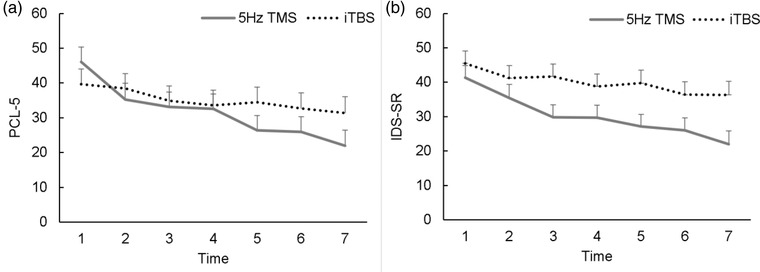
Transcranial magnetic stimulation (TMS) is increasingly being used to treat posttraumatic stress disorder (PTSD) comorbid with major depressive disorder (MDD). Yet, identifying the most effective stimulation parameters remains an active area of research. We recently reported on the use of 5 Hz TMS to reduce PTSD and MDD symptoms. A recently developed form of TMS, intermittent theta burst stimulation (iTBS), appears noninferior for treating MDD. Because iTBS can be delivered in a fraction of the time, it provides significant logistical advantages; however, evaluations of whether iTBS provides comparable PTSD and MDD symptom reductions are lacking. We performed a retrospective chart review comparing clinical outcomes in veterans with PTSD and MDD who received iTBS (n = 10) with a matched cohort that received 5-Hz TMS (n = 10). Symptoms were evaluated using self-reported rating scales at baseline and every five treatments for up to 30 sessions. Both protocols were safe and reduced symptoms, ps < .001, but veterans who received iTBS reported poorer outcomes. These results were observed using mixed-model analyses, Group x Time interaction: p = .011, and effect sizes, where 5 Hz TMS demonstrated superior PTSD and MDD symptom improvement, ds = 1.81 and 1.51, respectively, versus iTBS, ds = 0.63 and 0.88, respectively. Data from prior controlled trials of iTBS, with increased stimulation exposure, have appeared to provide comparable clinical outcomes compared with 5 Hz TMS. Prospective and controlled comparisons are required; however, the present findings provide important information for clinicians using TMS to treat these commonly comorbid disorders.
经颅磁刺激(TMS)越来越多地被用于治疗创伤后应激障碍(PTSD)合并重性抑郁障碍(MDD)。然而,确定最有效的刺激参数仍然是一个活跃的研究领域。我们最近报道了使用 5HzTMS 来减轻 PTSD 和 MDD 症状。一种新开发的 TMS 形式,间歇性 theta 爆发刺激(iTBS),在治疗 MDD 方面似乎不劣于 5HzTMS。由于 iTBS 可以在更短的时间内完成,因此它提供了显著的后勤优势;然而,缺乏关于 iTBS 是否能提供类似 PTSD 和 MDD 症状减轻的评估。我们进行了一项回顾性图表审查,比较了接受 iTBS(n=10)和接受 5HzTMS(n=10)的 PTSD 和 MDD 退伍军人的临床结果。使用自我报告的评定量表在基线和最多 30 个疗程的每五次治疗时评估症状。两种方案均安全有效,p<0.001,但接受 iTBS 的退伍军人报告的结果较差。这些结果是通过混合模型分析观察到的,组 x 时间交互作用:p=0.011,效应大小,其中 5HzTMS 分别显示出 PTSD 和 MDD 症状改善的优势,ds=1.81 和 1.51,而 iTBS 的 ds 分别为 0.63 和 0.88。具有增加刺激暴露的 iTBS 的先前对照试验的数据似乎提供了与 5HzTMS 相当的临床结果。需要进行前瞻性和对照比较;然而,目前的研究结果为使用 TMS 治疗这些常见共病障碍的临床医生提供了重要信息。