Department of Endocrinology and Metabology, The First Affiliated Hospital of Shandong First Medical University & Shandong Provincial Qianfoshan Hospital, Shandong Key Laboratory of Rheumatic Disease and Translational Medicine, Shandong Institute of Nephrology, Ji-nan, Shandong 250014, China.
Department of Endocrinology and Metabology, Shandong Provincial Qianfoshan Hospital, Shandong University, Shandong Key Laboratory of Rheumatic Disease and Translational Medicine, Shandong Institute of Nephrology, Ji-nan, Shandong 250014, China.
Aging (Albany NY). 2021 May 11;13(9):12748-12765. doi: 10.18632/aging.202945.
To investigate the efficacy and safety of SGLT-2 inhibitors as an add-on treatment for metformin between Asian and non-Asian T2DM.
A systematic literature search of PubMed, EMBASE, and the Cochrane Library was performed through August 2020 with the following keywords: Sodium-Glucose Transporter 2 Inhibitors, Sodium Glucose Transporter 2 Inhibitors, SGLT2 inhibitor, SGLT-2 inhibitors, type 2 diabetes, and randomized controlled trials. Double-blinded RCTs comparing SGLT-2 inhibitors as an add-on treatment for metformin and metformin monotherapy in adults with type 2 diabetes were included. A random effects model was used to calculate overall effect sizes.
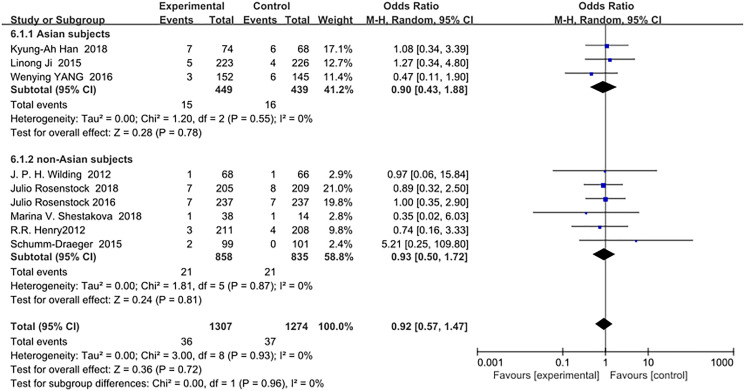
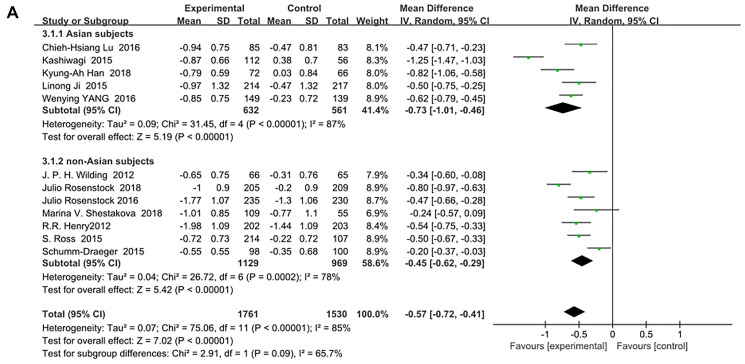
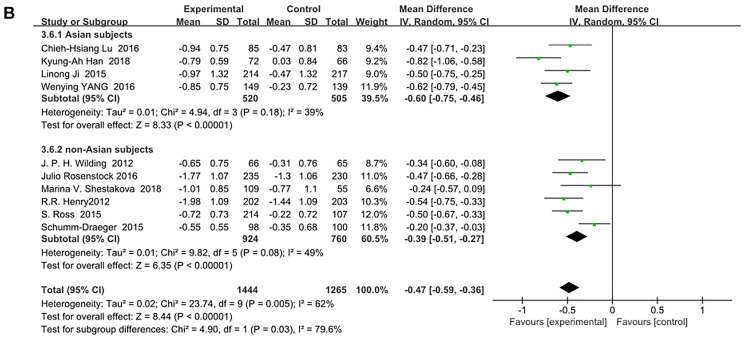
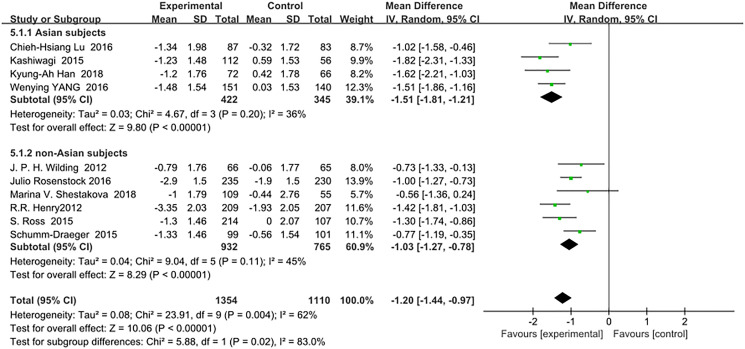
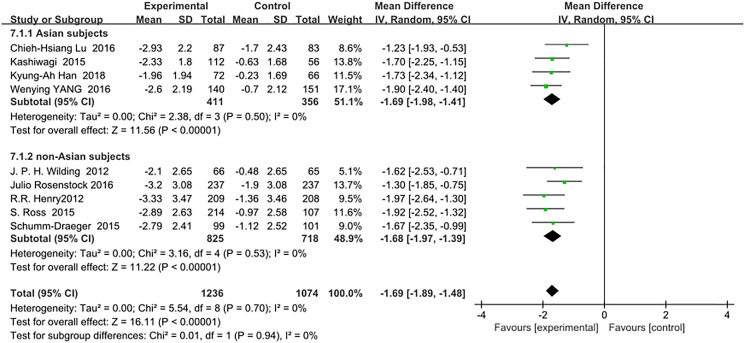
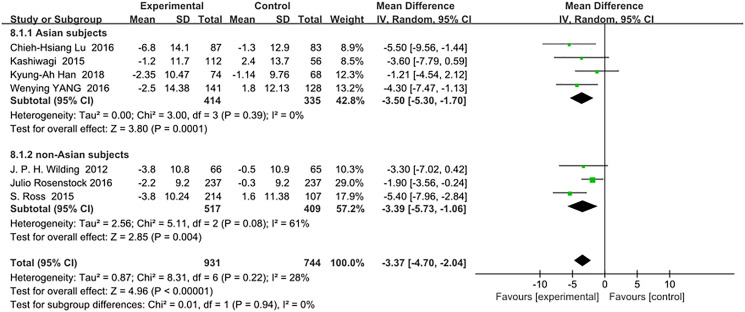
5 RCTs with 1193 Asian patients and 7 RCTs with 2098 non-Asian patients were investigated. The improvement in HbA1c and fasting blood glucose in the Asian patients (WMD, -0.73%; 95% CI, -1.01% to -0.46%, < 0.01; WMD, -1.51; 95% CI, -1.81 to -1.21, < 0.01, respectively) were both significantly better than in the non-Asians (WMD, -0.45%; 95% CI, -0.62% to -0.29%, < 0.01; WMD, -1.03; 95% CI, -1.27 to -0.78, < 0.01, respectively). The effect of weight loss was similar in the non-Asian patients and Asian patients. There was little difference in the improvement of systolic blood pressure between them. The risk of serious adverse events was not significantly increased between the Asian and non-Asian patients.
SGLT-2 inhibitors as an add-on treatment for metformin are more efficacious in East Asian T2DM patients than in non-Asian T2DM patients without an additional risk of severe adverse events.
研究 SGLT-2 抑制剂作为二甲双胍的附加治疗在亚洲和非亚洲 2 型糖尿病患者中的疗效和安全性。
通过PubMed、EMBASE 和 Cochrane 图书馆系统地检索了截至 2020 年 8 月的文献,使用的关键词包括:钠-葡萄糖共转运蛋白 2 抑制剂、钠葡萄糖共转运蛋白 2 抑制剂、SGLT2 抑制剂、SGLT-2 抑制剂、2 型糖尿病和随机对照试验。纳入了比较 SGLT-2 抑制剂作为二甲双胍附加治疗与二甲双胍单药治疗成人 2 型糖尿病的双盲 RCT。使用随机效应模型计算总体效应量。
共纳入 5 项包含 1193 例亚洲患者的 RCT 和 7 项包含 2098 例非亚洲患者的 RCT。亚洲患者的 HbA1c 和空腹血糖改善(WMD,-0.73%;95%CI,-1.01%至-0.46%,<0.01;WMD,-1.51;95%CI,-1.81 至-1.21,<0.01)均显著优于非亚洲患者(WMD,-0.45%;95%CI,-0.62%至-0.29%,<0.01;WMD,-1.03;95%CI,-1.27 至-0.78,<0.01)。非亚洲患者和亚洲患者的体重减轻效果相似。他们之间的收缩压改善程度也没有差异。严重不良事件的风险在亚洲和非亚洲患者之间没有显著增加。
SGLT-2 抑制剂作为二甲双胍的附加治疗在东亚 2 型糖尿病患者中的疗效优于非东亚 2 型糖尿病患者,且不会增加严重不良事件的风险。