Department of Pediatric Surgery and Pediatric Urology, University Children's Hospital, Hoppe-Seyler-Strasse 3, 72076, Tübingen, Germany.
Department of Diagnostic Radiology, University Hospital, Hoppe-Seyler-Strasse 3, 72076, Tübingen, Germany.
Arch Orthop Trauma Surg. 2022 Aug;142(8):1903-1910. doi: 10.1007/s00402-021-03917-w. Epub 2021 May 11.
Pediatric radial neck and head fractures are rare, accounting for only 1% of all fractures in children. The aim of this study is to describe the management and results of the respective fracture types and different injury characteristics.
This study performs a retrospective data analysis of 100 consecutive patients with a fracture of the proximal radius treated in a single high-volume pediatric trauma center.
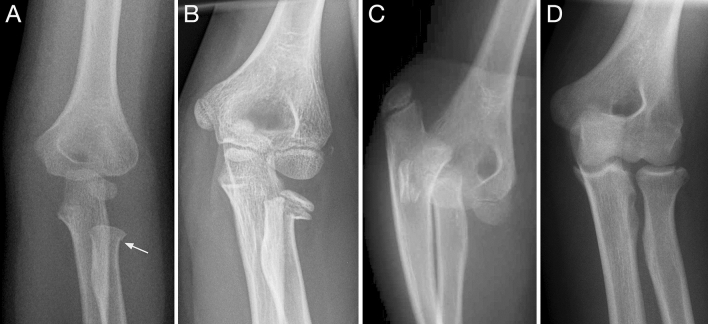
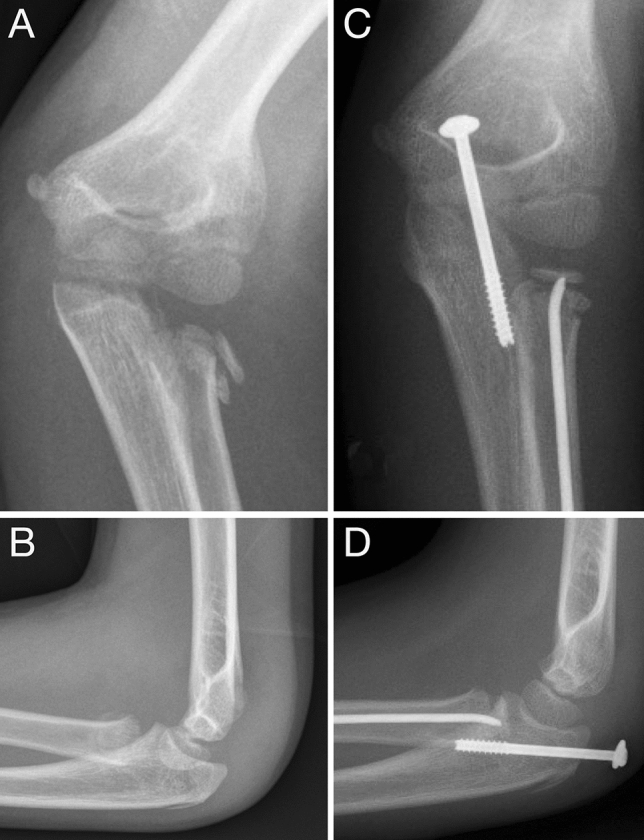
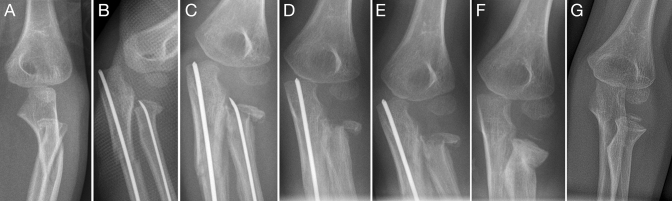
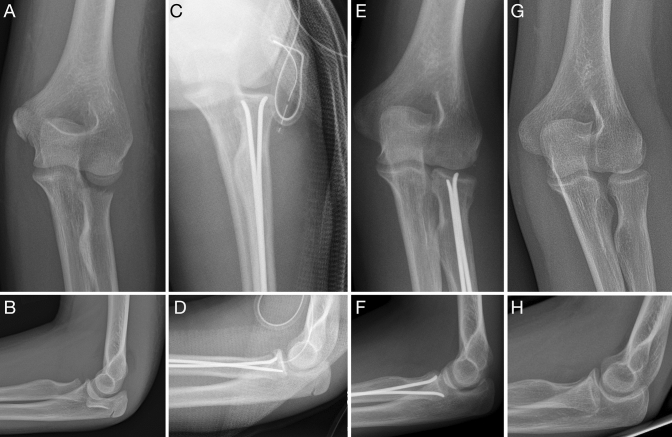
One hundred patients [mean age 7.5 years (1-15)] were documented with a fracture of the proximal radius between 3/2011 and 12/2019. The gender distribution was 62 girls and 38 boys. Twenty-seven patients had concomitant injuries. Conservative treatment was performed in 63 patients (Judet I = 27; II = 30; III = 6; Mason I = 2) using an above-the-elbow cast for 21 days (6-35). Surgical treatment was performed in 37 patients (Judet II = 3; III = 22; IV = 5; V = 7) using elastic stable intramedullary nailing (ESIN). Open reduction was necessary in five cases, and additional immobilization was performed in 32 cases. Six complications occurred: loss of implant stability (n = 2), healing in malalignment, pseudarthrosis, radioulnar synostosis, and a persisting hypoesthesia at the thumb. As a result, two ESIN osteosynthesis were revised, and one radial head resection was performed. Loss of movement was seen in 11% of cases, overall Mayo elbow performance index (MEPI) was 99.8 (90-100), and none of the patients experienced negative impacts on activities of daily life.
Proximal radial fractures occur predominately without dislocation. Good results are obtained with conservative treatment throughout. In cases with displacement exceeding growth-related correction, ESIN is the undisputed treatment of choice. Open surgery and long immobilization periods should be avoided whenever possible.
小儿桡骨颈和头部骨折较为少见,仅占儿童所有骨折的 1%。本研究旨在描述不同骨折类型和不同损伤特征的治疗方法和结果。
本研究对 2011 年 3 月至 2019 年 12 月在一家高容量小儿创伤中心治疗的 100 例连续桡骨近端骨折患者进行回顾性数据分析。
100 例患者[平均年龄 7.5 岁(1-15 岁)]存在桡骨近端骨折。性别分布为 62 例女孩和 38 例男孩。27 例患者合并损伤。63 例患者采用保守治疗(Judet I = 27;II = 30;III = 6;Mason I = 2),使用肘上石膏固定 21 天(6-35 天)。37 例患者采用弹性稳定髓内钉(ESIN)行手术治疗(Judet II = 3;III = 22;IV = 5;V = 7)。5 例患者需要切开复位,32 例患者需要额外固定。发生 6 例并发症:植入物稳定性丧失(n = 2)、愈合不良、假关节形成、尺桡骨融合和拇指持续感觉减退。因此,2 例 ESIN 骨合成术进行了修订,1 例桡骨头切除术。11%的病例出现运动受限,总体 Mayo 肘部活动指数(MEPI)为 99.8(90-100),无患者日常生活活动受到负面影响。
桡骨近端骨折主要为无脱位。保守治疗可获得良好效果。对于移位超过生长相关性矫正的病例,ESIN 是不可争议的首选治疗方法。应尽可能避免开放性手术和长时间固定。