School of Nursing, Biobehavioral Nursing and Health Informatics, University of Washington, 1959 NE Pacific Street, HSB T602 Box 357266, Seattle, WA, 98195-7266, USA.
J Behav Med. 2021 Oct;44(5):630-640. doi: 10.1007/s10865-021-00223-z. Epub 2021 May 11.
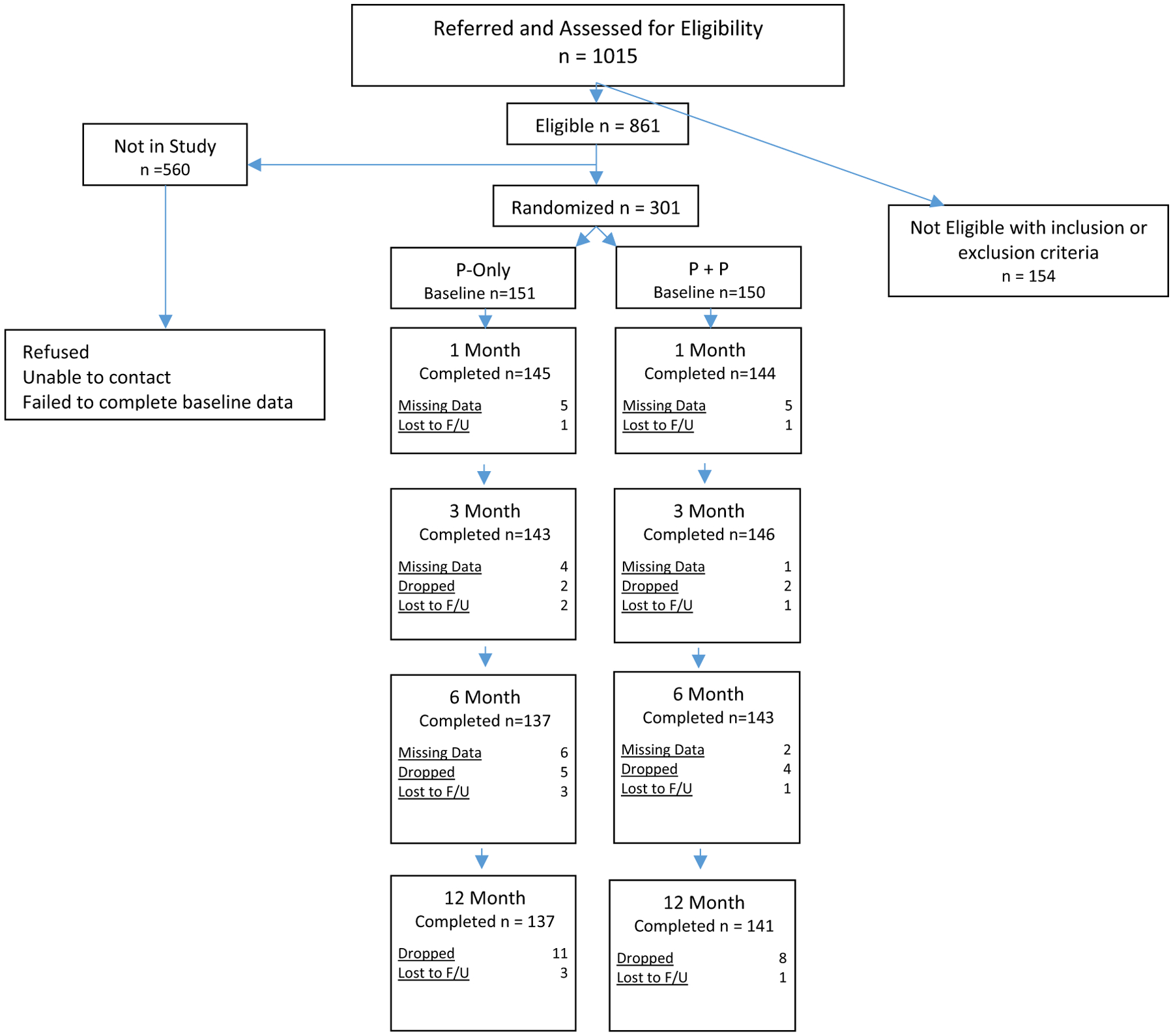
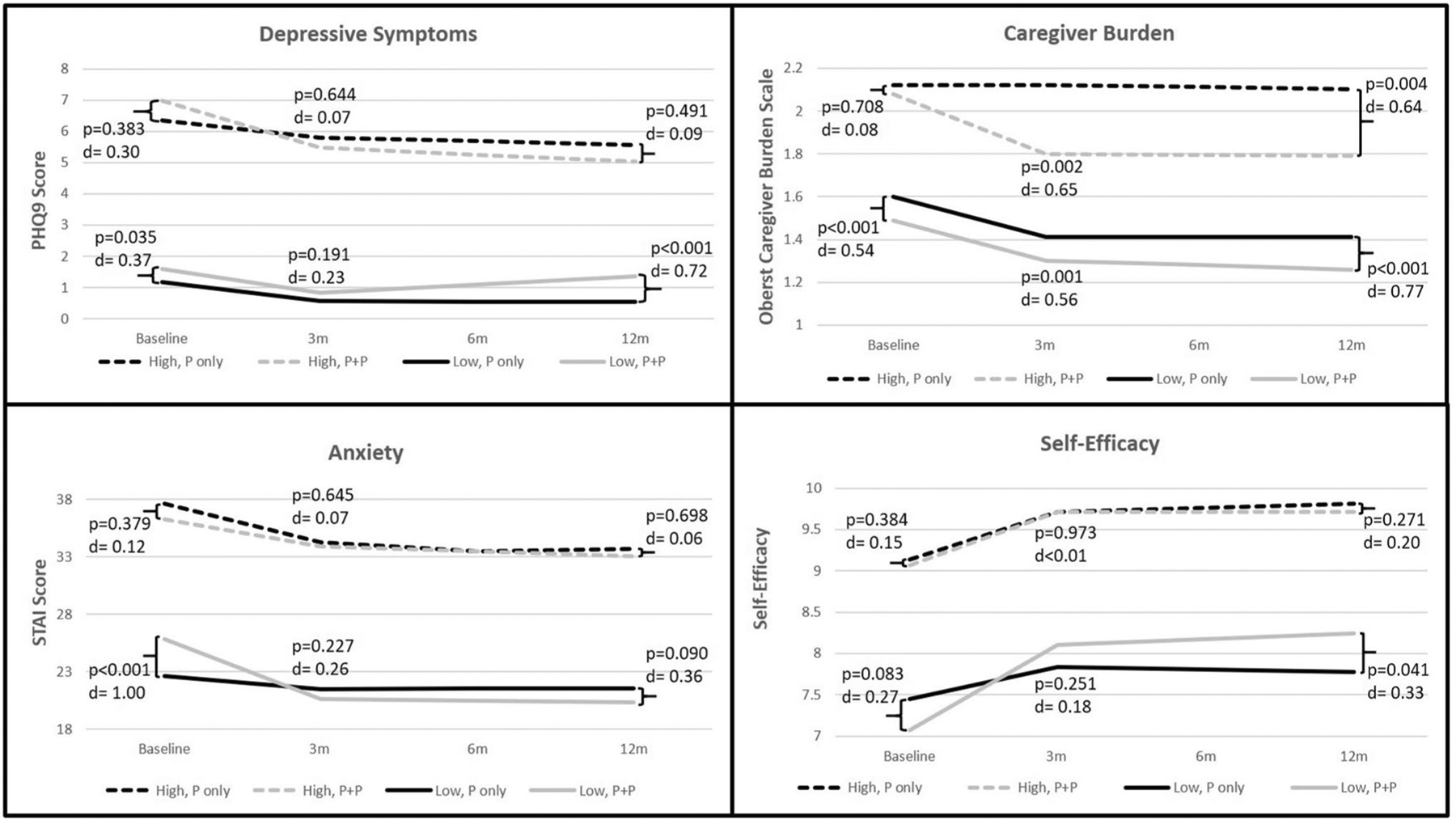
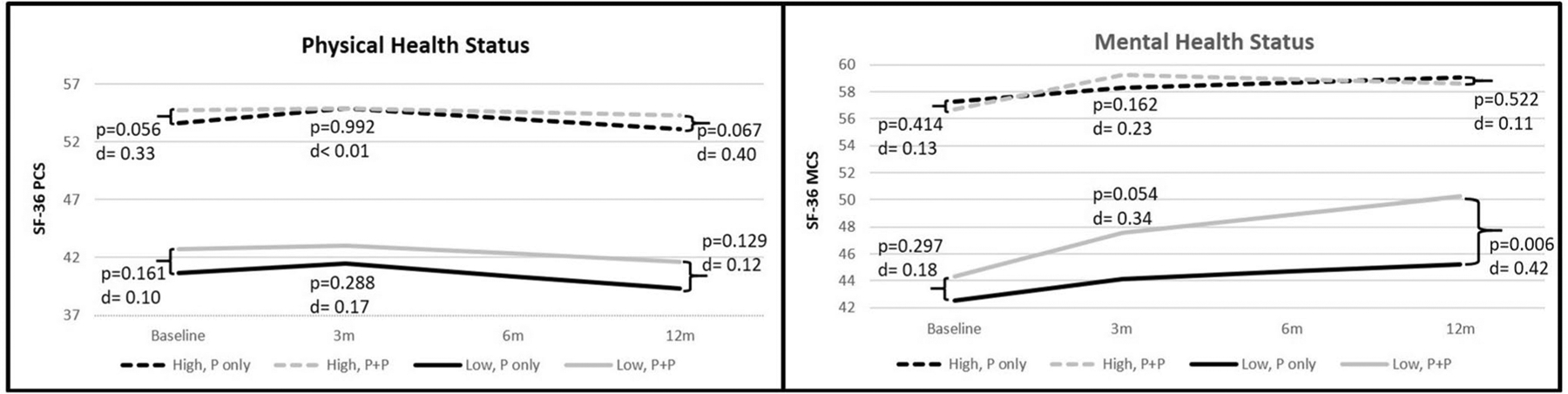
This study examined differential responses among partners who participated in a RCT designed to compare two social cognitive theory interventions, one designed for patients only (P-only) and one for patients and their intimate partners (P + P). The interventions were delivered following the patient receiving an initial ICD implant. Partner health outcomes were examined longitudinally from baseline at hospital discharge to 3, 6, and 12 months. Outcomes included 6 measures: partner physical and mental health status (Short-Form-36 PCS and MCS), depression (Patient Health Questionnaire-9), anxiety (State-Trait Anxiety Inventory), caregiver burden (Oberst Caregiver Burden Scale), and self-efficacy in ICD management (Sudden Cardiac Arrest Self-efficacy scale). Growth mixture and mixed effect modeling were used to identify and compare trajectories of 6 health outcomes within the P-only and P + P arms of the study. Partners (n = 301) were on average 62 years old, female (74.1%) and Caucasian (83.4%), with few co-morbidities (mean Charlson Co-morbidity index, 0.72 ± 1.1). Two types of profiles were observed for P-only and P + P, one profile where patterns of health outcomes were generally better across 12 months and one with outcome patterns that were generally worse across time. For PCS, no significant partner differences were observed between P-only or P + P in either the better (p = 0.067) or the worse (p = 0.129) profile types. Compared to P-only, partners in the worse profile improved significantly over 12 months in MCS (p = 0.006), caregiver burden P + P (p = 0.004) and self-efficacy P + P (p = 0.041). Compared to P-only, P + P partners in the low anxiety profile improved significantly (p = 0.001) at 3 months. Partners with more psychosocial distress at hospital discharge benefited most from the P + P intervention. Among partners with generally low levels of anxiety, those in the P + P intervention compared to P-only showed greater improvement in anxiety over 12 months.
本研究考察了参与一项 RCT 的伴侣之间的不同反应,该 RCT 旨在比较两种社会认知理论干预措施,一种仅针对患者(P-only),另一种针对患者及其亲密伴侣(P+P)。这些干预措施在患者接受初始 ICD 植入后进行。从医院出院时的基线开始,对伴侣的健康结果进行了纵向检查,时间为 3、6 和 12 个月。结果包括 6 项措施:伴侣的身体和心理健康状况(SF-36 PCS 和 MCS)、抑郁(PHQ-9)、焦虑(状态-特质焦虑量表)、照顾者负担(Oberst 照顾者负担量表)和 ICD 管理自我效能感(突发心脏病自我效能量表)。使用增长混合和混合效应模型来识别和比较研究中 P-only 和 P+P 臂的 6 项健康结果的轨迹。伴侣(n=301)平均年龄为 62 岁,女性(74.1%)和白种人(83.4%),合并症较少(平均 Charlson 合并症指数为 0.72±1.1)。在 P-only 和 P+P 中观察到两种类型的模式,一种模式是 12 个月内健康结果总体较好,另一种模式是随着时间的推移健康结果总体较差。在 PCS 方面,在更好(p=0.067)或更差(p=0.129)的模式类型中,P-only 或 P+P 之间的伴侣没有观察到显著差异。与 P-only 相比,在更差的模式中,伴侣在 MCS(p=0.006)、P+P 的照顾者负担(p=0.004)和 P+P 的自我效能(p=0.041)方面在 12 个月内显著改善。与 P-only 相比,在低焦虑模式下,P+P 伴侣在 3 个月时显著改善(p=0.001)。在出院时心理社会压力较大的伴侣中,P+P 干预获益最大。在焦虑水平普遍较低的伴侣中,与 P-only 相比,P+P 干预在 12 个月内焦虑程度有更大改善。