• 文献检索
  • 文档翻译
  • 深度研究
  • 学术资讯
  • Suppr Zotero 插件Zotero 插件
  • 邀请有礼
  • 套餐&价格
  • 历史记录
应用&插件
Suppr Zotero 插件Zotero 插件浏览器插件Mac 客户端Windows 客户端微信小程序
定价
高级版会员购买积分包购买API积分包
服务
文献检索文档翻译深度研究API 文档MCP 服务
关于我们
关于 Suppr公司介绍联系我们用户协议隐私条款
关注我们

Suppr 超能文献

核心技术专利:CN118964589B侵权必究
粤ICP备2023148730 号-1Suppr @ 2026

文献检索

告别复杂PubMed语法,用中文像聊天一样搜索,搜遍4000万医学文献。AI智能推荐,让科研检索更轻松。

立即免费搜索

文件翻译

保留排版,准确专业,支持PDF/Word/PPT等文件格式,支持 12+语言互译。

免费翻译文档

深度研究

AI帮你快速写综述,25分钟生成高质量综述,智能提取关键信息,辅助科研写作。

立即免费体验

一次扫描,多次分析:利用大型开放获取神经影像学数据集了解大脑。

Scan Once, Analyse Many: Using Large Open-Access Neuroimaging Datasets to Understand the Brain.

机构信息

School of Psychology, University of Nottingham, Nottingham, NG7 2RD, UK.

出版信息

Neuroinformatics. 2022 Jan;20(1):109-137. doi: 10.1007/s12021-021-09519-6. Epub 2021 May 11.

DOI:10.1007/s12021-021-09519-6
PMID:33974213
原文链接:https://pmc.ncbi.nlm.nih.gov/articles/PMC8111663/
Abstract

We are now in a time of readily available brain imaging data. Not only are researchers now sharing data more than ever before, but additionally large-scale data collecting initiatives are underway with the vision that many future researchers will use the data for secondary analyses. Here I provide an overview of available datasets and some example use cases. Example use cases include examining individual differences, more robust findings, reproducibility-both in public input data and availability as a replication sample, and methods development. I further discuss a variety of considerations associated with using existing data and the opportunities associated with large datasets. Suggestions for further readings on general neuroimaging and topic-specific discussions are also provided.

摘要

我们现在正处于脑成像数据易于获取的时代。现在,不仅研究人员比以往任何时候都更愿意分享数据,而且还在进行大规模的数据收集计划,期望未来有更多的研究人员可以使用这些数据进行二次分析。在这里,我将概述可用的数据集,并提供一些示例用例。示例用例包括研究个体差异、更可靠的发现、可重复性——既包括公共输入数据,也包括作为复制样本的可用性,以及方法开发。我还进一步讨论了使用现有数据的各种注意事项以及与大型数据集相关的机会。此外,我还提供了有关一般神经影像学和主题特定讨论的进一步阅读建议。
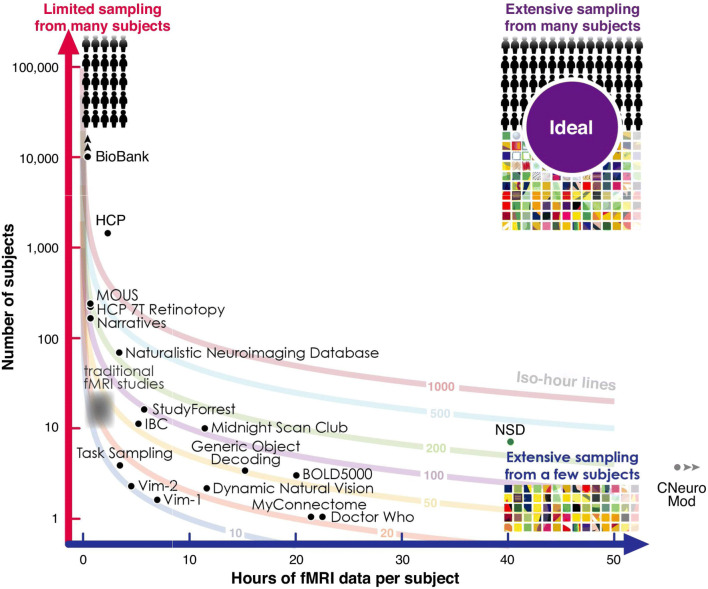
https://cdn.ncbi.nlm.nih.gov/pmc/blobs/db42/9537134/8a6c8012d219/12021_2021_9519_Fig11_HTML.jpg
https://cdn.ncbi.nlm.nih.gov/pmc/blobs/db42/9537134/c3916659206e/12021_2021_9519_Fig1_HTML.jpg
https://cdn.ncbi.nlm.nih.gov/pmc/blobs/db42/9537134/787b4ae96f43/12021_2021_9519_Fig2_HTML.jpg
https://cdn.ncbi.nlm.nih.gov/pmc/blobs/db42/9537134/186a17d75347/12021_2021_9519_Fig3_HTML.jpg
https://cdn.ncbi.nlm.nih.gov/pmc/blobs/db42/9537134/c1ae61785955/12021_2021_9519_Fig4_HTML.jpg
https://cdn.ncbi.nlm.nih.gov/pmc/blobs/db42/9537134/c116fc4ac141/12021_2021_9519_Fig5_HTML.jpg
https://cdn.ncbi.nlm.nih.gov/pmc/blobs/db42/9537134/f5286bd58b64/12021_2021_9519_Fig6_HTML.jpg
https://cdn.ncbi.nlm.nih.gov/pmc/blobs/db42/9537134/9f5d107acff4/12021_2021_9519_Fig7_HTML.jpg
https://cdn.ncbi.nlm.nih.gov/pmc/blobs/db42/9537134/12eb1b4201e5/12021_2021_9519_Fig8_HTML.jpg
https://cdn.ncbi.nlm.nih.gov/pmc/blobs/db42/9537134/cc08b43d9295/12021_2021_9519_Fig9_HTML.jpg
https://cdn.ncbi.nlm.nih.gov/pmc/blobs/db42/9537134/3fd70418fb7e/12021_2021_9519_Fig10_HTML.jpg
https://cdn.ncbi.nlm.nih.gov/pmc/blobs/db42/9537134/8a6c8012d219/12021_2021_9519_Fig11_HTML.jpg
https://cdn.ncbi.nlm.nih.gov/pmc/blobs/db42/9537134/c3916659206e/12021_2021_9519_Fig1_HTML.jpg
https://cdn.ncbi.nlm.nih.gov/pmc/blobs/db42/9537134/787b4ae96f43/12021_2021_9519_Fig2_HTML.jpg
https://cdn.ncbi.nlm.nih.gov/pmc/blobs/db42/9537134/186a17d75347/12021_2021_9519_Fig3_HTML.jpg
https://cdn.ncbi.nlm.nih.gov/pmc/blobs/db42/9537134/c1ae61785955/12021_2021_9519_Fig4_HTML.jpg
https://cdn.ncbi.nlm.nih.gov/pmc/blobs/db42/9537134/c116fc4ac141/12021_2021_9519_Fig5_HTML.jpg
https://cdn.ncbi.nlm.nih.gov/pmc/blobs/db42/9537134/f5286bd58b64/12021_2021_9519_Fig6_HTML.jpg
https://cdn.ncbi.nlm.nih.gov/pmc/blobs/db42/9537134/9f5d107acff4/12021_2021_9519_Fig7_HTML.jpg
https://cdn.ncbi.nlm.nih.gov/pmc/blobs/db42/9537134/12eb1b4201e5/12021_2021_9519_Fig8_HTML.jpg
https://cdn.ncbi.nlm.nih.gov/pmc/blobs/db42/9537134/cc08b43d9295/12021_2021_9519_Fig9_HTML.jpg
https://cdn.ncbi.nlm.nih.gov/pmc/blobs/db42/9537134/3fd70418fb7e/12021_2021_9519_Fig10_HTML.jpg
https://cdn.ncbi.nlm.nih.gov/pmc/blobs/db42/9537134/8a6c8012d219/12021_2021_9519_Fig11_HTML.jpg

相似文献

1
Scan Once, Analyse Many: Using Large Open-Access Neuroimaging Datasets to Understand the Brain.一次扫描,多次分析:利用大型开放获取神经影像学数据集了解大脑。
Neuroinformatics. 2022 Jan;20(1):109-137. doi: 10.1007/s12021-021-09519-6. Epub 2021 May 11.
2
Idiosynchrony: From shared responses to individual differences during naturalistic neuroimaging.非同步现象:自然神经影像学中的从共享反应到个体差异。
Neuroimage. 2020 Jul 15;215:116828. doi: 10.1016/j.neuroimage.2020.116828. Epub 2020 Apr 7.
3
Ten simple rules for predictive modeling of individual differences in neuroimaging.神经影像学个体差异预测建模的 10 个简单规则。
Neuroimage. 2019 Jun;193:35-45. doi: 10.1016/j.neuroimage.2019.02.057. Epub 2019 Mar 1.
4
Micapipe: A pipeline for multimodal neuroimaging and connectome analysis.Micapipe:一种用于多模态神经影像学和连接组学分析的管道。
Neuroimage. 2022 Nov;263:119612. doi: 10.1016/j.neuroimage.2022.119612. Epub 2022 Sep 5.
5
Brain structure-function associations identified in large-scale neuroimaging data.在大规模神经影像数据中识别出的脑结构-功能关联。
Brain Struct Funct. 2016 Dec;221(9):4459-4474. doi: 10.1007/s00429-015-1177-6. Epub 2016 Jan 9.
6
Connectomics reconciles seemingly irreconcilable neuroimaging findings.连接组学调和了看似不可调和的神经影像学发现。
Trends Cogn Sci. 2023 Jun;27(6):512-513. doi: 10.1016/j.tics.2023.04.005. Epub 2023 Apr 24.
7
The Human Connectome Project's neuroimaging approach.人类连接组计划的神经成像方法。
Nat Neurosci. 2016 Aug 26;19(9):1175-87. doi: 10.1038/nn.4361.
8
The Lifespan Human Connectome Project in Aging: An overview.衰老中的全生命周期人类连接组计划:概述。
Neuroimage. 2019 Jan 15;185:335-348. doi: 10.1016/j.neuroimage.2018.10.009. Epub 2018 Oct 15.
9
Person-specific and precision neuroimaging: Current methods and future directions.个体特异性和精准神经影像学:当前方法和未来方向。
Neuroimage. 2022 Nov;263:119589. doi: 10.1016/j.neuroimage.2022.119589. Epub 2022 Aug 24.
10
Data leakage inflates prediction performance in connectome-based machine learning models.数据泄露会夸大基于连接组学的机器学习模型的预测性能。
Nat Commun. 2024 Feb 28;15(1):1829. doi: 10.1038/s41467-024-46150-w.

引用本文的文献

1
Challenging the status quo: A guide to open and reproducible neuroimaging for early career researchers.挑战现状:早期职业研究人员的开放和可重复神经影像学指南。
Imaging Neurosci (Camb). 2025 Jun 24;3. doi: 10.1162/IMAG.a.21. eCollection 2025.
2
Automated quality control of T1-weighted brain MRI scans for clinical research datasets: methods comparison and design of a quality prediction classifier.用于临床研究数据集的T1加权脑磁共振成像扫描的自动质量控制:方法比较与质量预测分类器设计
Imaging Neurosci (Camb). 2025 May 28;3. doi: 10.1162/IMAG.a.4. eCollection 2025.
3
Measuring Arousal: Promises and Pitfalls.

本文引用的文献

1
The "Narratives" fMRI dataset for evaluating models of naturalistic language comprehension.用于评估自然语言理解模型的“叙事” fMRI 数据集。
Sci Data. 2021 Sep 28;8(1):250. doi: 10.1038/s41597-021-01033-3.
2
Tractography dissection variability: What happens when 42 groups dissect 14 white matter bundles on the same dataset?束追踪解剖变异性:当 42 个组在同一数据集上解剖 14 个白质束时会发生什么?
Neuroimage. 2021 Nov;243:118502. doi: 10.1016/j.neuroimage.2021.118502. Epub 2021 Aug 22.
3
Open science datasets from PREVENT-AD, a longitudinal cohort of pre-symptomatic Alzheimer's disease.
测量唤醒水平:前景与困境
Affect Sci. 2024 Dec 20;6(2):369-379. doi: 10.1007/s42761-024-00288-4. eCollection 2025 Jun.
4
Increasing the representation of minoritized youth for inclusive and reproducible brain-behavior associations.增加少数族裔青年在包容性和可重复的脑-行为关联研究中的代表性。
bioRxiv. 2024 Jun 28:2024.06.22.600221. doi: 10.1101/2024.06.22.600221.
5
Paving the Way for Alzheimer's Disease Prevention: A Systematic Review of Global Open-Access Neuroimaging Datasets in Healthy Individuals.为阿尔茨海默病预防铺平道路:全球健康个体的开放获取神经影像学数据集的系统评价。
J Alzheimers Dis. 2023;96(4):1441-1451. doi: 10.3233/JAD-230738.
6
Web-based processing of physiological noise in fMRI: addition of the PhysIO toolbox to CBRAIN.功能磁共振成像中基于网络的生理噪声处理:将PhysIO工具箱添加到CBRAIN中。
Front Neuroinform. 2023 Sep 27;17:1251023. doi: 10.3389/fninf.2023.1251023. eCollection 2023.
7
MISPEL: A supervised deep learning harmonization method for multi-scanner neuroimaging data.MISPEL:一种用于多扫描仪神经影像学数据的有监督深度学习协调方法。
Med Image Anal. 2023 Oct;89:102926. doi: 10.1016/j.media.2023.102926. Epub 2023 Aug 9.
8
Data management strategy for a collaborative research center.协作研究中心的数据管理策略。
Gigascience. 2022 Dec 28;12. doi: 10.1093/gigascience/giad049. Epub 2023 Jul 4.
9
Artificial intelligence tools in clinical neuroradiology: essential medico-legal aspects.临床神经放射学中的人工智能工具:重要的医学法律方面。
Neuroradiology. 2023 Jul;65(7):1091-1099. doi: 10.1007/s00234-023-03152-7. Epub 2023 May 9.
10
A new open, high-resolution, multishell, diffusion-weighted imaging dataset of the living squirrel monkey.活体松鼠猴的新型开放式、高分辨率、多壳层、弥散加权成像数据集。
Sci Data. 2023 Apr 20;10(1):224. doi: 10.1038/s41597-023-02126-x.
PREVENT-AD 纵向队列研究的阿尔茨海默病前期无症状患者的开放科学数据集。
Neuroimage Clin. 2021;31:102733. doi: 10.1016/j.nicl.2021.102733. Epub 2021 Jun 17.
4
The Amsterdam Open MRI Collection, a set of multimodal MRI datasets for individual difference analyses.阿姆斯特丹开放式磁共振成像数据集,一组用于个体差异分析的多模态磁共振成像数据集。
Sci Data. 2021 Mar 19;8(1):85. doi: 10.1038/s41597-021-00870-6.
5
Design issues and solutions for stop-signal data from the Adolescent Brain Cognitive Development (ABCD) study.用于青少年大脑认知发展研究(ABCD 研究)中停止信号数据的设计问题及解决方案。
Elife. 2021 Mar 4;10:e60185. doi: 10.7554/eLife.60185.
6
The Cuban Human Brain Mapping Project, a young and middle age population-based EEG, MRI, and cognition dataset.古巴人脑绘图计划,一个基于年轻和中年人群的 EEG、MRI 和认知数据集。
Sci Data. 2021 Feb 5;8(1):45. doi: 10.1038/s41597-021-00829-7.
7
PreQual: An automated pipeline for integrated preprocessing and quality assurance of diffusion weighted MRI images.PreQual:用于扩散加权磁共振成像(MRI)图像综合预处理和质量保证的自动化流程。
Magn Reson Med. 2021 Jul;86(1):456-470. doi: 10.1002/mrm.28678. Epub 2021 Feb 3.
8
The Open Brain Consent: Informing research participants and obtaining consent to share brain imaging data.开放大脑同意书:向研究参与者告知并获得同意以分享脑成像数据。
Hum Brain Mapp. 2021 May;42(7):1945-1951. doi: 10.1002/hbm.25351. Epub 2021 Feb 1.
9
A voxel-wise assessment of growth differences in infants developing autism spectrum disorder.对自闭症谱系障碍患儿生长差异的体素评估
Neuroimage Clin. 2021;29:102551. doi: 10.1016/j.nicl.2020.102551. Epub 2020 Dec 29.
10
Opportunities for increased reproducibility and replicability of developmental neuroimaging.提高发育神经影像学可重复性和可复制性的机会。
Dev Cogn Neurosci. 2021 Feb;47:100902. doi: 10.1016/j.dcn.2020.100902. Epub 2020 Dec 17.