ART Fertility Clinics, Abu Dhabi & Dubai and Muscat Royal Marina Village, Abu Dhabi, United Arab Emirates.
Medical Affairs Fertility, Endocrinology & General Medicine, Merck Serono GmbH (an affiliate of Merck KGaA, Darmstadt, Germany), Darmstadt, Germany.
Reprod Biol Endocrinol. 2021 May 11;19(1):68. doi: 10.1186/s12958-021-00744-x.
Individualization of the follicle-stimulating hormone (FSH) starting dose is considered standard clinical practice during controlled ovarian stimulation (COS) in patients undergoing assisted reproductive technology (ART) treatment. Furthermore, the gonadotropin dose is regularly adjusted during COS to avoid hyper- or hypo-ovarian response, but limited data are currently available to characterize such adjustments. This review describes the frequency and direction (increase/decrease) of recombinant-human FSH (r-hFSH) dose adjustment reported in clinical trials.
We evaluated the proportion of patients undergoing ART treatment who received ≥ 1 r-hFSH dose adjustments. The inclusion criteria included studies (published Sept 2007 to Sept 2017) in women receiving ART treatment that allowed dose adjustment within the study protocol and that reported ≥ 1 dose adjustments of r-hFSH; studies not allowing/reporting dose adjustment were excluded. Data on study design, dose adjustment and patient characteristics were extracted. Point-incidence estimates were calculated per study and overall based on pooled number of cycles with dose adjustment across studies. The Clopper-Pearson method was used to calculate 95% confidence intervals (CI) for incidence where adjustment occurred in < 10% of patients; otherwise, a normal approximation method was used.
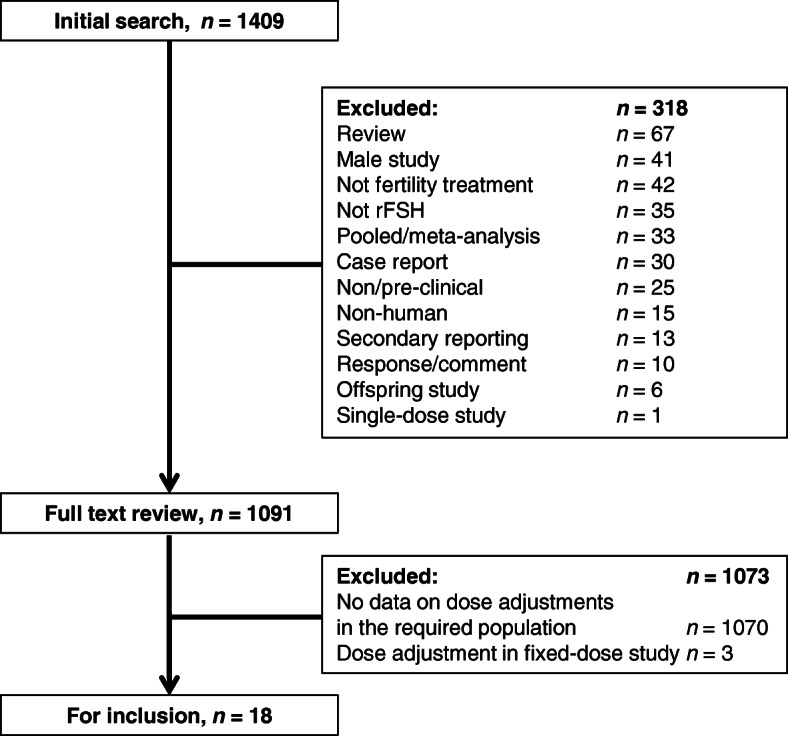
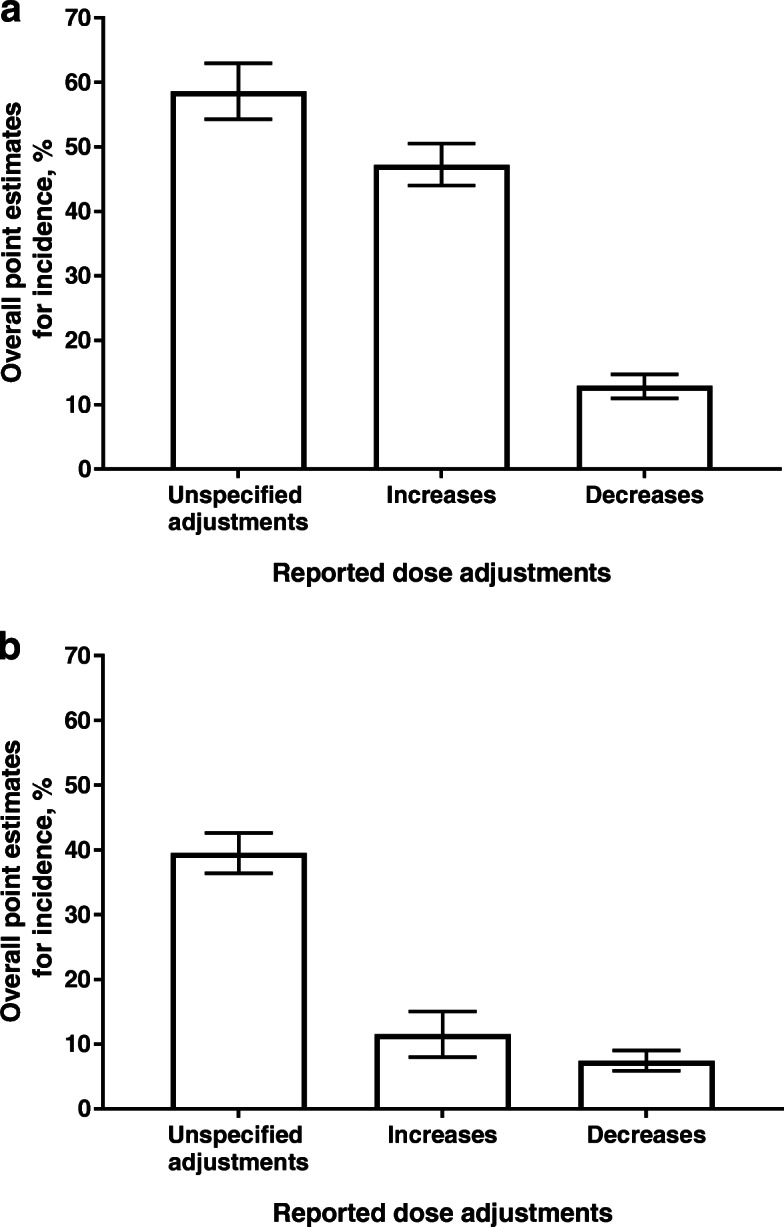
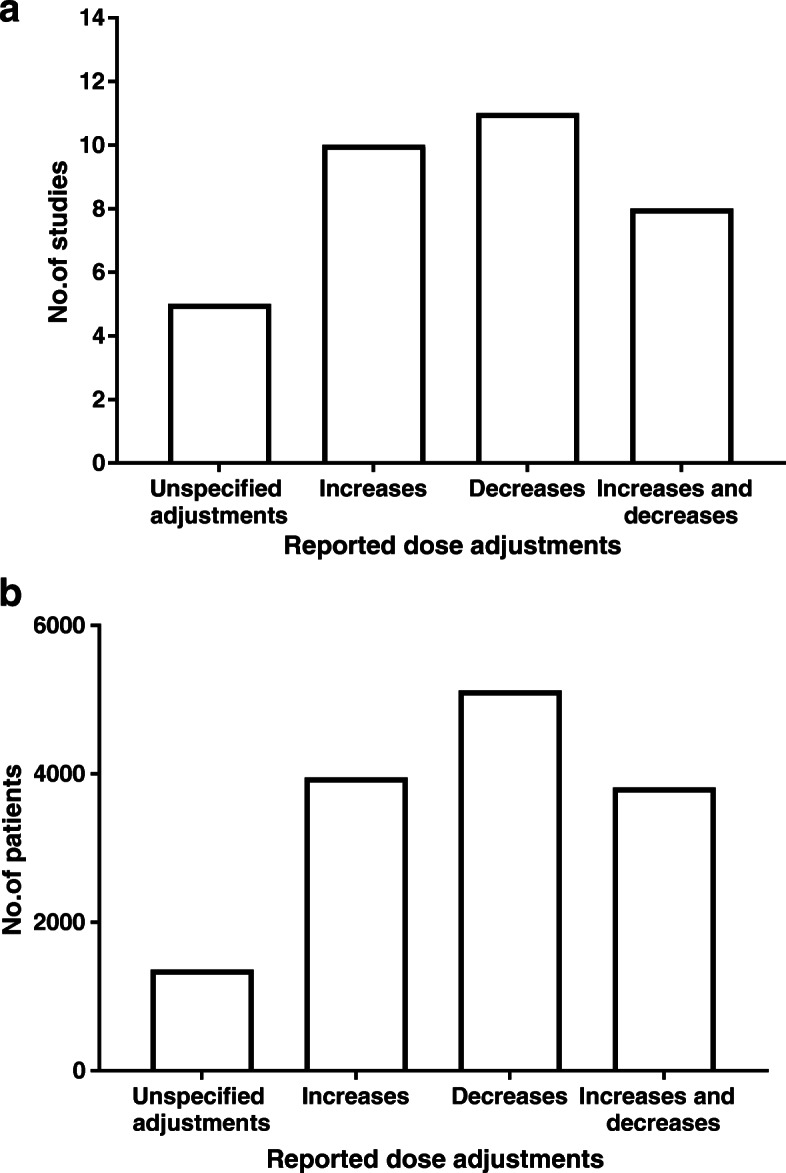
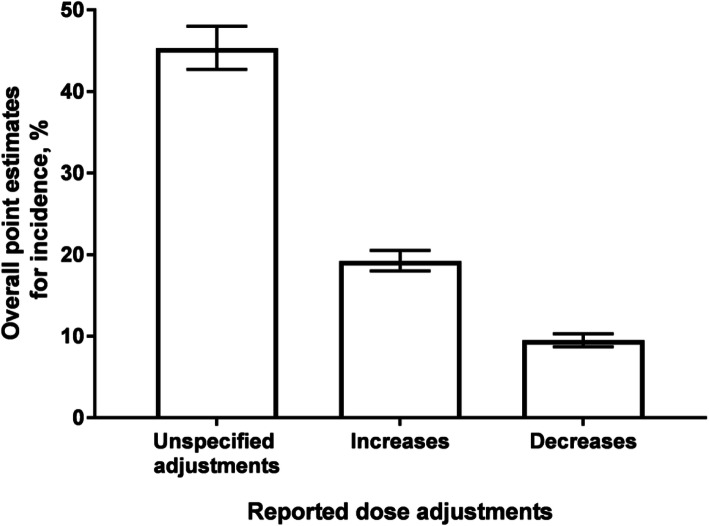
Initially, 1409 publications were identified, of which 318 were excluded during initial screening and 1073 were excluded after full text review for not meeting the inclusion criteria. Eighteen studies (6630 cycles) reported dose adjustment: 5/18 studies (1359 cycles) reported data for an unspecified dose adjustment (direction not defined), in 10/18 studies (3952 cycles) dose increases were reported, and in 11/18 studies (5123 cycles) dose decreases were reported. The studies were performed in women with poor, normal and high response, with one study reporting in oocyte donors and one in obese women. The median day that dose adjustment was permitted was Day 6 after the start of treatment. The point estimates for incidence (95% CI) for unspecified dose adjustment, dose increases, and dose decreases were 45.3% (42.7, 48.0), 19.2% (18.0, 20.5), and 9.5% (8.7, 10.3), respectively.
This systematic review highlights that, in studies in which dose adjustment was allowed and reported, the estimated incidence of r-hFSH dose adjustments during ovarian stimulation was up to 45%.
在接受辅助生殖技术(ART)治疗的患者中,进行控制性卵巢刺激(COS)时,将卵泡刺激素(FSH)起始剂量个体化被认为是标准的临床实践。此外,在 COS 期间,促性腺激素剂量通常会进行调整,以避免卵巢过度刺激或反应不足,但目前可用的数据有限,无法对这些调整进行特征描述。本综述描述了临床试验中报告的重组人 FSH(r-hFSH)剂量调整的频率和方向(增加/减少)。
我们评估了接受 ART 治疗的患者中接受≥1 次 r-hFSH 剂量调整的比例。纳入标准包括:在研究方案中允许剂量调整并报告≥1 次 r-hFSH 剂量调整的接受 ART 治疗的女性的研究(发表于 2007 年 9 月至 2017 年 9 月);不允许/未报告剂量调整的研究被排除在外。提取了关于研究设计、剂量调整和患者特征的数据。基于研究间剂量调整周期的汇总数量,计算了每一项研究和总体的点发生率估计值。采用 Clopper-Pearson 方法计算调整发生率<10%的 95%置信区间(CI);否则,采用正态逼近法。
最初,确定了 1409 篇出版物,其中 318 篇在初步筛选时被排除,1073 篇在全文审查后因不符合纳入标准而被排除。18 项研究(6630 个周期)报告了剂量调整:5/18 项研究(1359 个周期)报告了未指定剂量调整(未定义方向)的数据,10/18 项研究(3952 个周期)报告了剂量增加,11/18 项研究(5123 个周期)报告了剂量减少。这些研究在卵巢反应不良、正常和良好的女性中进行,其中一项研究在卵母细胞供者中进行,另一项在肥胖女性中进行。允许剂量调整的中位时间是治疗开始后第 6 天。未指定剂量调整、剂量增加和剂量减少的发生率点估计值(95%CI)分别为 45.3%(42.7,48.0)、19.2%(18.0,20.5)和 9.5%(8.7,10.3)。
本系统综述强调,在允许和报告剂量调整的研究中,卵巢刺激期间 r-hFSH 剂量调整的估计发生率高达 45%。