The Bio-Protection Research Centre, School of Biological Sciences, University of Canterbury, Christchurch, New Zealand.
The Bio-Protection Research Centre, Lincoln University, Lincoln, New Zealand.
Nat Commun. 2021 May 11;12(1):2696. doi: 10.1038/s41467-021-23030-1.
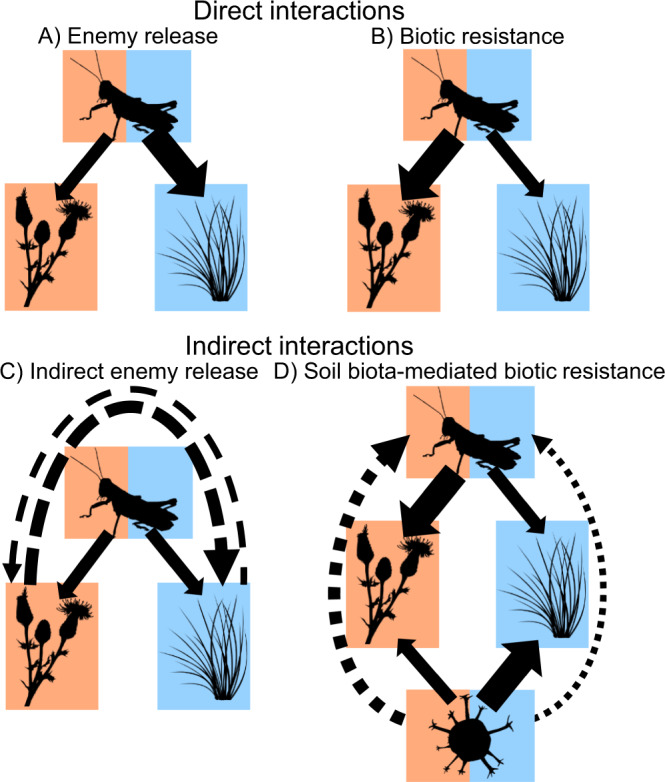
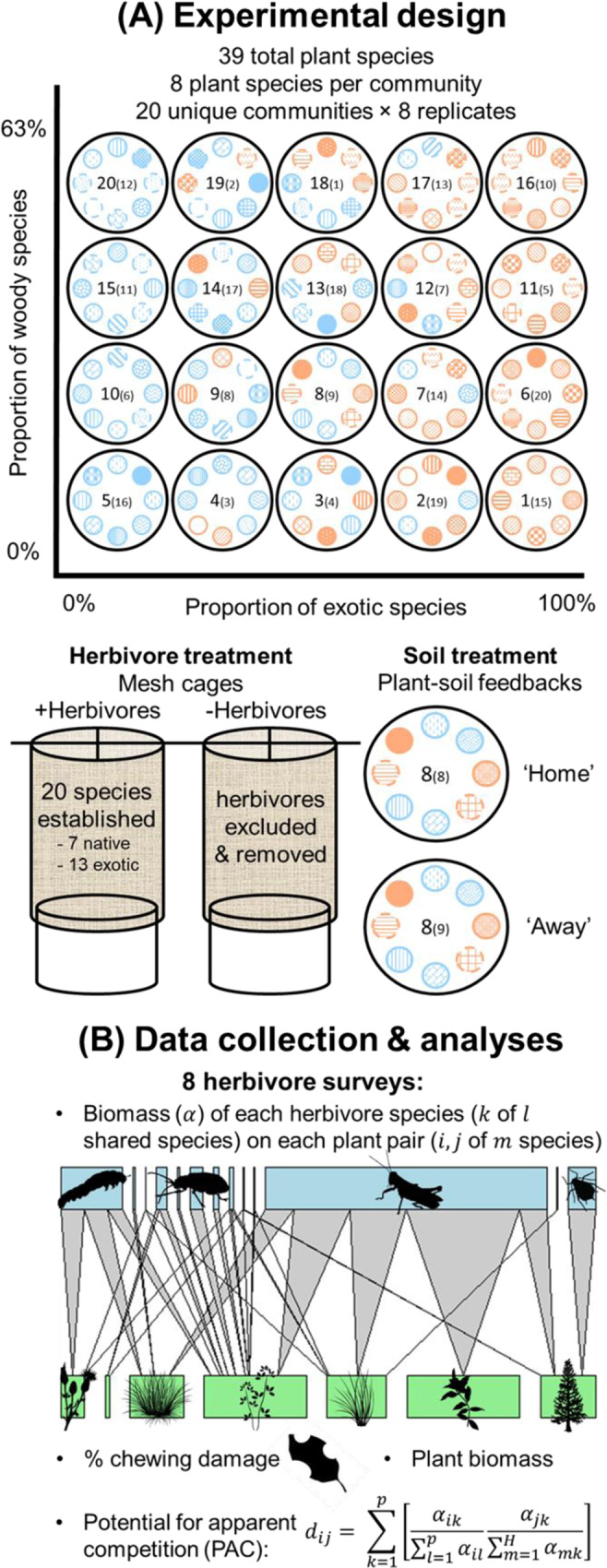
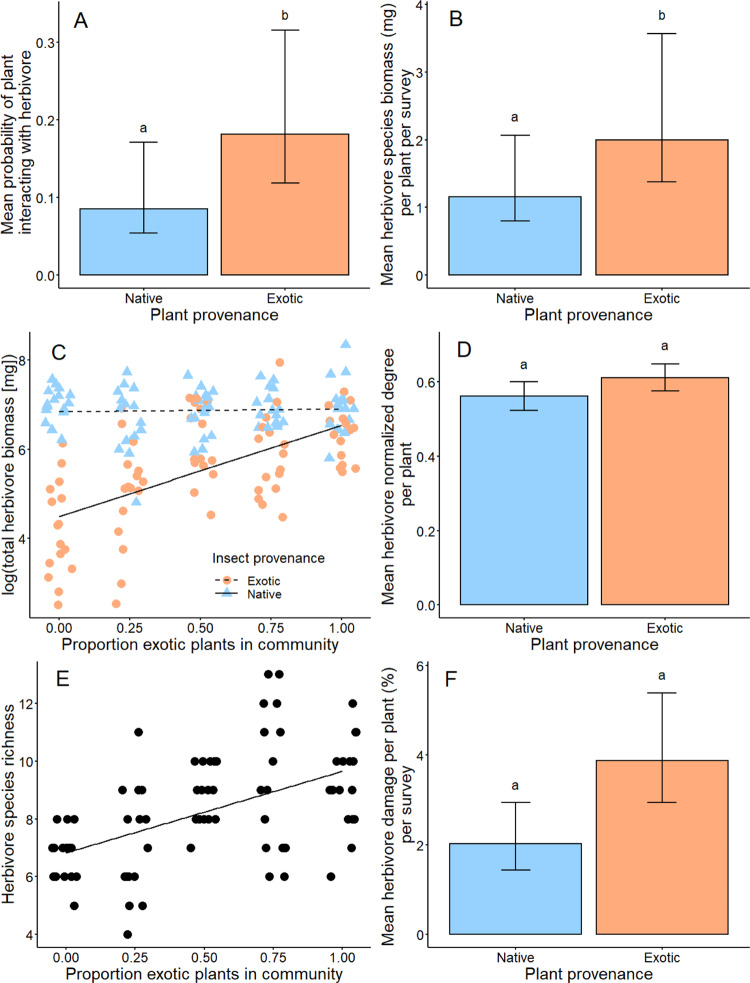
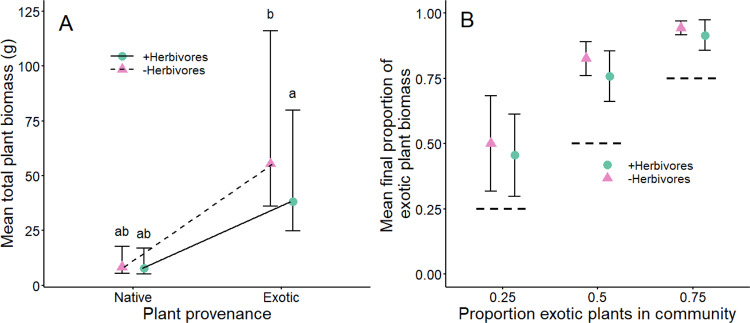
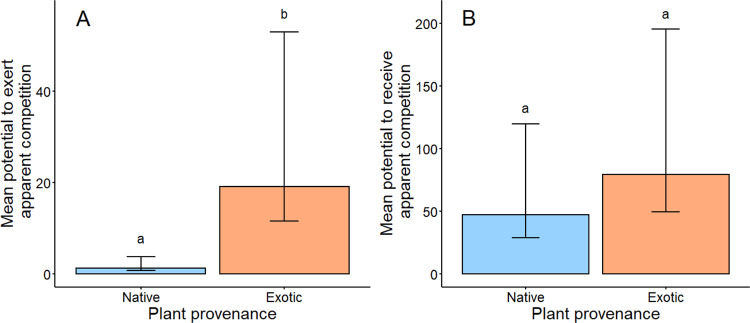
Herbivores may facilitate or impede exotic plant invasion, depending on their direct and indirect interactions with exotic plants relative to co-occurring natives. However, previous studies investigating direct effects have mostly used pairwise native-exotic comparisons with few enemies, reached conflicting conclusions, and largely overlooked indirect interactions such as apparent competition. Here, we ask whether native and exotic plants differ in their interactions with invertebrate herbivores. We manipulate and measure plant-herbivore and plant-soil biota interactions in 160 experimental mesocosm communities to test several invasion hypotheses. We find that compared with natives, exotic plants support higher herbivore diversity and biomass, and experience larger proportional biomass reductions from herbivory, regardless of whether specialist soil biota are present. Yet, exotics consistently dominate community biomass, likely due to their fast growth rates rather than strong potential to exert apparent competition on neighbors. We conclude that polyphagous invertebrate herbivores are unlikely to play significant direct or indirect roles in mediating plant invasions, especially for fast-growing exotic plants.
食草动物可能会促进或阻碍外来植物的入侵,这取决于它们与外来植物的直接和间接相互作用相对于共同出现的本地植物。然而,之前调查直接影响的研究大多使用具有少数天敌的本地-外来成对比较,得出了相互矛盾的结论,并且在很大程度上忽略了明显竞争等间接相互作用。在这里,我们询问本地和外来植物在与无脊椎草食动物的相互作用上是否存在差异。我们操纵和测量了 160 个实验中观社区中的植物-草食动物和植物-土壤生物群相互作用,以检验几种入侵假说。我们发现,与本地植物相比,无论是否存在专门的土壤生物群,外来植物都支持更高的草食动物多样性和生物量,并且更容易受到草食动物的比例生物量减少,而外来植物则始终占据社区生物量的主导地位,这可能是由于它们的快速生长速度,而不是对邻居施加明显竞争的潜力。我们的结论是,多足无脊椎草食动物不太可能在介导植物入侵方面发挥重要的直接或间接作用,尤其是对于快速生长的外来植物。