Meijer Kim, Schilthuizen Menno, Beukeboom Leo, Smit Christian
Groningen Institute for Evolutionary Life Sciences, University of Groningen, Groningen, the Netherlands; Altenburg & Wymenga Ecological Consultants, Veenwouden, the Netherlands.
Groningen Institute for Evolutionary Life Sciences, University of Groningen, Groningen, the Netherlands; Endless Forms group, Naturalis Biodiversity Center, Leiden, the Netherlands.
PeerJ. 2016 Dec 21;4:e2778. doi: 10.7717/peerj.2778. eCollection 2016.
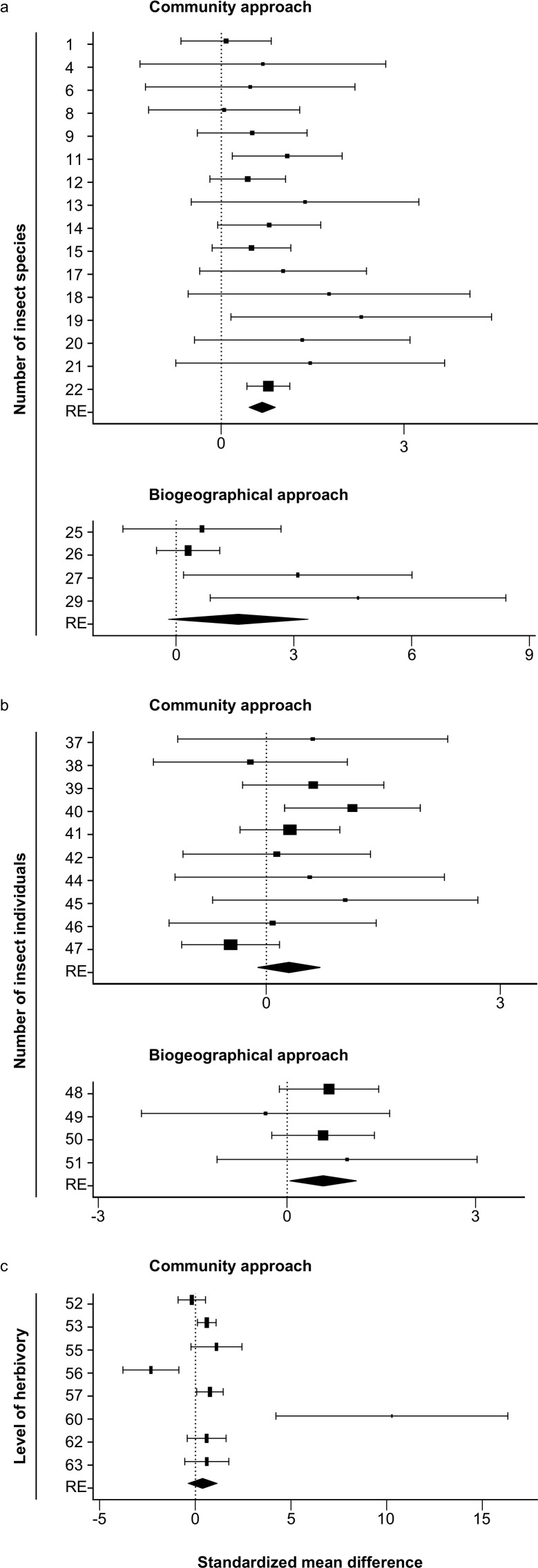
A suggested mechanism for the success of introduced non-native species is the enemy release hypothesis (ERH). Many studies have tested the predictions of the ERH using the community approach (native and non-native species studied in the same habitat) or the biogeographical approach (species studied in their native and non-native range), but results are highly variable, possibly due to large variety of study systems incorporated. We therefore focused on one specific system: plants and their herbivorous insects. We performed a systematic review and compiled a large number (68) of datasets from studies comparing herbivorous insects on native and non-native plants using the community or biogeographical approach. We performed a meta-analysis to test the predictions from the ERH for insect diversity (number of species), insect load (number of individuals) and level of herbivory for both the community and biogeographical approach. For both the community and biogeographical approach insect diversity was significantly higher on native than on non-native plants. Insect load tended to be higher on native than non-native plants at the community approach only. Herbivory was not different between native and non-native plants at the community approach, while there was too little data available for testing the biogeographical approach. Our meta-analysis generally supports the predictions from the ERH for both the community and biogeographical approach, but also shows that the outcome is importantly determined by the response measured and approach applied. So far, very few studies apply both approaches simultaneously in a reciprocal manner while this is arguably the best way for testing the ERH.
外来非本地物种成功的一种推测机制是天敌释放假说(ERH)。许多研究已使用群落方法(在同一栖息地研究本地和非本地物种)或生物地理学方法(在物种的原生地和非原生地范围内进行研究)来检验ERH的预测,但结果差异很大,这可能是由于纳入的研究系统种类繁多所致。因此,我们聚焦于一个特定系统:植物及其食草昆虫。我们进行了一项系统综述,并从使用群落或生物地理学方法比较本地和非本地植物上食草昆虫的研究中汇编了大量(68个)数据集。我们进行了一项荟萃分析,以检验ERH对群落和生物地理学方法中昆虫多样性(物种数量)、昆虫负荷(个体数量)和食草水平的预测。对于群落和生物地理学方法,本地植物上的昆虫多样性均显著高于非本地植物。仅在群落方法中,本地植物上的昆虫负荷往往高于非本地植物。在群落方法中,本地和非本地植物的食草情况没有差异,而用于检验生物地理学方法的数据太少。我们的荟萃分析总体上支持ERH对群落和生物地理学方法的预测,但也表明结果在很大程度上取决于所测量的反应和所应用的方法。到目前为止,很少有研究以相互的方式同时应用这两种方法,而这可以说是检验ERH的最佳方式。