Center for Radiological Research, Columbia University Irving Medical Center, 630 West 168th Street, VC-11-234/5, New York, NY, 10032, USA.
Sci Rep. 2021 May 11;11(1):10049. doi: 10.1038/s41598-021-89449-0.
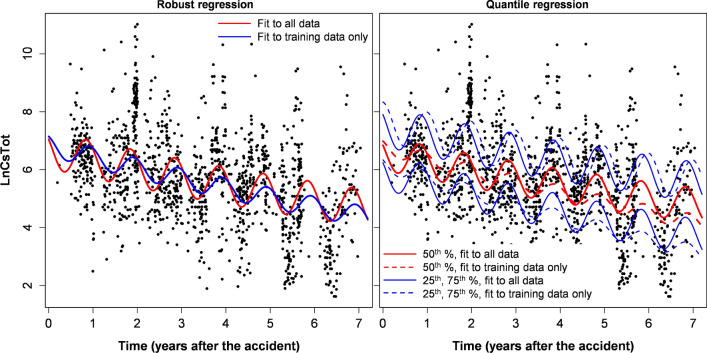
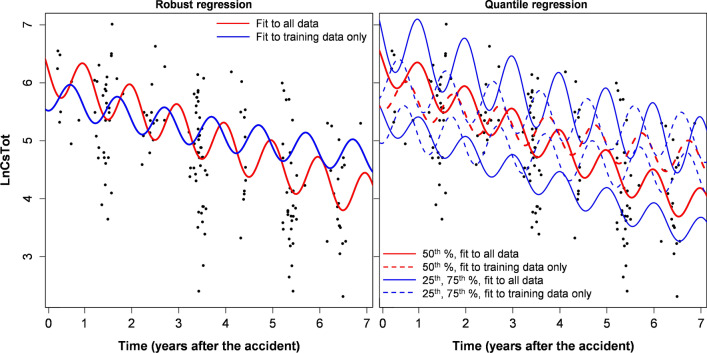
Large quantities of radionuclides released by the Fukushima nuclear power plant accident entered terrestrial and marine ecosystems. The resulting radioactive contamination of large omnivorous wild mammals such as wild boar (Sus scrofa) and Asian black bear (Ursus thibetanus) varied greatly depending on location, season, and time after the accident. Quantitative modeling of how such factors influence radionuclide burdens in these species is important for enhancing current knowledge of chronic radionuclide exposure consequences in mammalian populations, and for assessing potential human risks from consumption of contaminated animal meat. Here we modeled the time course of radioactive cesium (Cs + Cs) concentrations in boar and black bears from Fukushima Prefecture over ~ 7 years after the accident, using nonlinear robust and quantile regressions and mixed-effects modeling. To estimate predictive performance, models fitted to the full data set were compared with those fitted only to the first 3.5 years of data, and tested on the last 3.5 years of data. Ecological half-lives for radioactive cesium, and magnitudes and phase shifts for sinusoidal seasonal oscillations in cesium burdens, were estimated by each analysis method for each species. These results can improve the understanding and prediction of radionuclide concentrations in large mammals that inhabit radioactively contaminated areas.
大量的放射性核素因福岛核电厂事故而释放,进入陆地和海洋生态系统。由此导致的野猪(Sus scrofa)和亚洲黑熊(Ursus thibetanus)等大型杂食性野生动物的放射性污染程度因地而异,因季节和事故发生后的时间而异。定量模拟这些因素如何影响这些物种中的放射性核素负荷对于增强当前对哺乳动物种群中慢性放射性核素暴露后果的认识以及评估食用受污染动物肉的潜在人类风险非常重要。在这里,我们使用非线性稳健和分位数回归以及混合效应模型,对福岛县野猪和黑熊在事故发生后约 7 年的时间内放射性铯(Cs + Cs)浓度的时间进程进行了建模。为了估计预测性能,我们将拟合完整数据集的模型与仅拟合前 3.5 年数据的模型进行了比较,并在最后 3.5 年的数据上进行了测试。每种分析方法都针对每种物种估算了放射性铯的生态半衰期,以及铯负荷中正弦季节性波动的幅度和相位偏移。这些结果可以提高对生活在放射性污染地区的大型哺乳动物中放射性核素浓度的理解和预测。