Regeneration in Hematopoiesis, Institute for Immunology, TU Dresden, Dresden, Germany.
Immunology of Aging, Leibniz Institute on Aging-Fritz Lipmann Institute, Jena, Germany.
Leukemia. 2021 Dec;35(12):3561-3567. doi: 10.1038/s41375-021-01259-5.
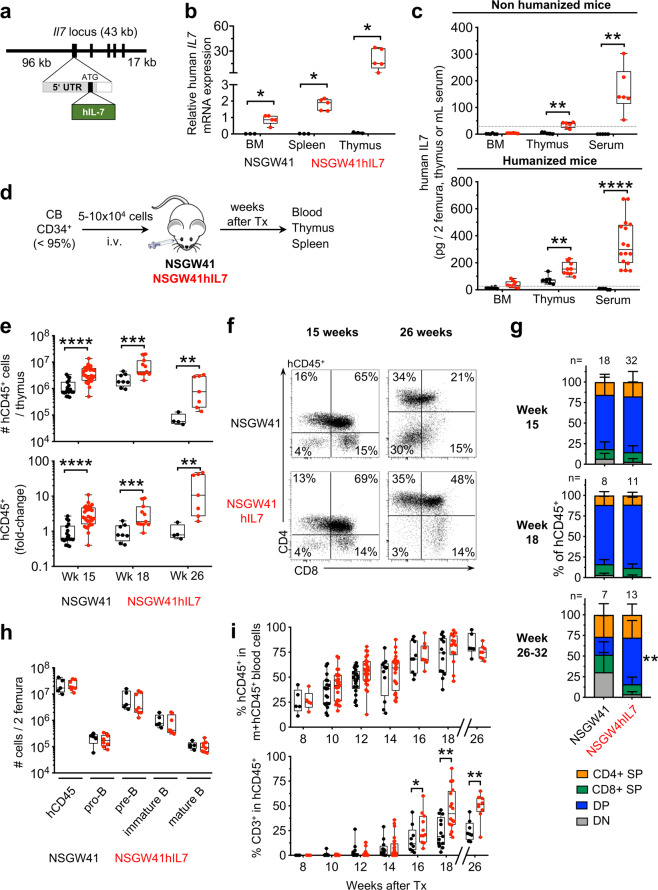
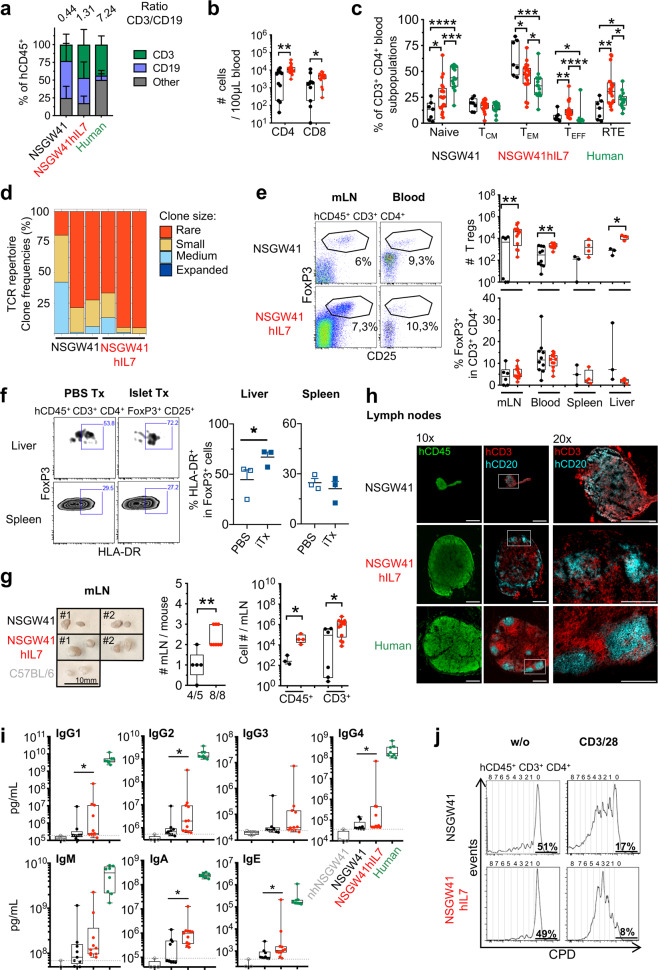
Humanized mouse models have become increasingly valuable tools to study human hematopoiesis and infectious diseases. However, human T-cell differentiation remains inefficient. We generated mice expressing human interleukin-7 (IL-7), a critical growth and survival factor for T cells, under the control of murine IL-7 regulatory elements. After transfer of human cord blood-derived hematopoietic stem and progenitor cells, transgenic mice on the NSGW41 background, termed NSGW41hIL7, showed elevated and prolonged human cellularity in the thymus while maintaining physiological ratios of thymocyte subsets. As a consequence, numbers of functional human T cells in the periphery were increased without evidence for pathological lymphoproliferation or aberrant expansion of effector or memory-like T cells. We conclude that the novel NSGW41hIL7 strain represents an optimized mouse model for humanization to better understand human T-cell differentiation in vivo and to generate a human immune system with a better approximation of human lymphocyte ratios.
人源化小鼠模型已成为研究人类造血和传染病的重要工具。然而,人类 T 细胞的分化仍然效率低下。我们构建了在鼠类白细胞介素 7(IL-7)调控元件控制下表达人 IL-7 的小鼠。在移植人脐血来源的造血干细胞和祖细胞后,命名为 NSGW41hIL7 的 NSGW41 背景下的转基因小鼠,在胸腺中显示出升高和延长的人细胞群体,同时保持胸腺细胞亚群的生理比例。因此,外周血中功能性人类 T 细胞的数量增加,而没有病理性淋巴增生或效应器或记忆样 T 细胞异常扩增的证据。我们得出结论,新型 NSGW41hIL7 品系代表了一种优化的小鼠模型,用于更好地理解体内人类 T 细胞的分化,并生成更接近人类淋巴细胞比例的人类免疫系统。