Blasi Miriam, Kazdal Daniel, Thomas Michael, Christopoulos Petros, Kriegsmann Mark, Brandt Regine, Volckmar Anna-Lena, Kirchner Martina, Heußel Claus Peter, Stenzinger Albrecht, Kuon Jonas
Department of Thoracic Oncology, Thoraxklinik, University of Heidelberg, Heidelberg, Germany.
Institute of Pathology, University Hospital Heidelberg, Heidelberg, Germany.
Case Rep Oncol. 2021 Mar 18;14(1):477-482. doi: 10.1159/000513904. eCollection 2021 Jan-Apr.
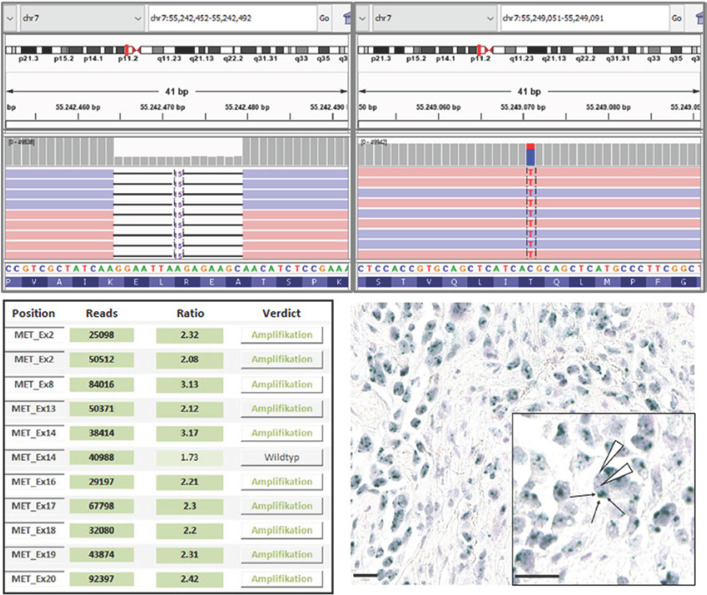
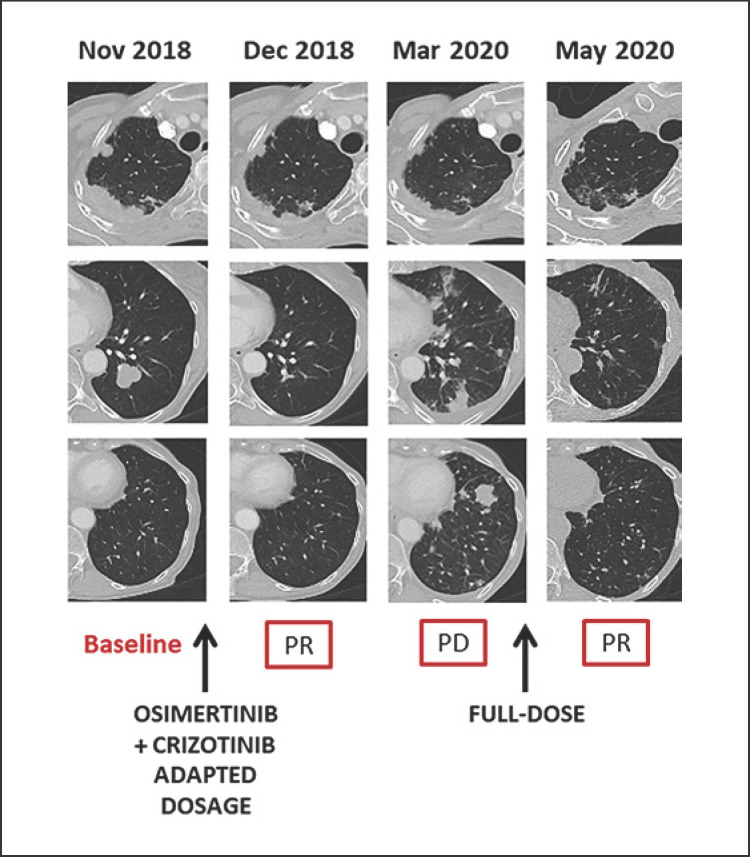
Tyrosine kinase inhibitors (TKIs) represent the standard treatment for patients with non-small cell lung cancer (NSCLC) harboring epidermal growth factor receptor (EGFR) mutations. The duration of the response is, however, limited in time owing to the development of resistance mechanisms to both first- and second-generation agents such as oncogene amplification. This report describes the successful results obtained with the combination of the third-generation TKI osimertinib with the multitargeted TKI and MET inhibitor crizotinib in a patient with EGFR-mutant NSCLC with emerging MET amplification with a tolerable toxicity profile.
酪氨酸激酶抑制剂(TKIs)是表皮生长因子受体(EGFR)突变的非小细胞肺癌(NSCLC)患者的标准治疗方法。然而,由于对第一代和第二代药物(如癌基因扩增)产生耐药机制,反应持续时间在时间上是有限的。本报告描述了第三代TKI奥希替尼与多靶点TKI和MET抑制剂克唑替尼联合应用于一名出现MET扩增且毒性可耐受的EGFR突变NSCLC患者所取得的成功结果。