Ping Jingyao, Feng Peipei, Li Jinye, Zhang Rongjing, Su Yingjuan, Wang Ting
College of Life Sciences South China Agricultural University Guangzhou China.
School of Life Sciences Sun Yat-sen University Guangzhou China.
Ecol Evol. 2021 Mar 20;11(9):4786-4802. doi: 10.1002/ece3.7381. eCollection 2021 May.
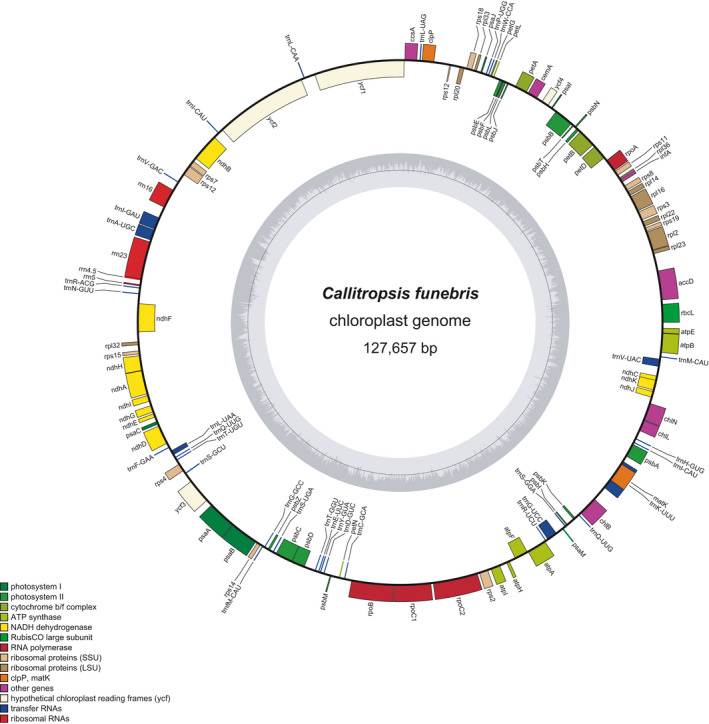
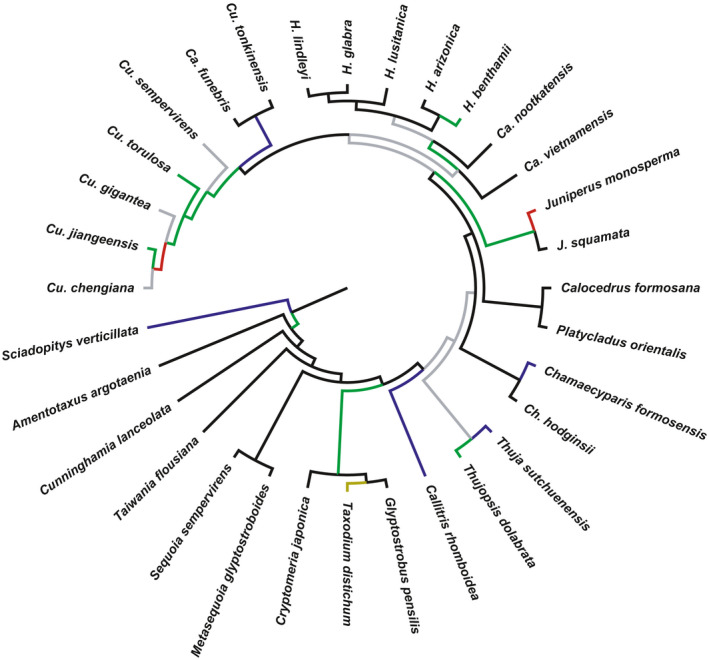
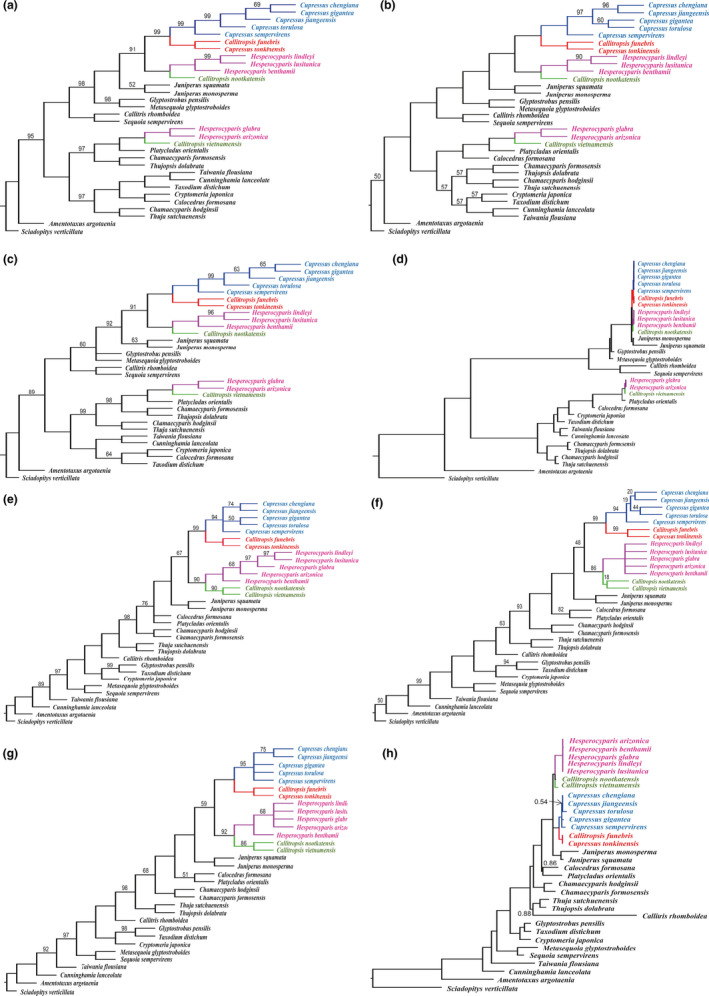
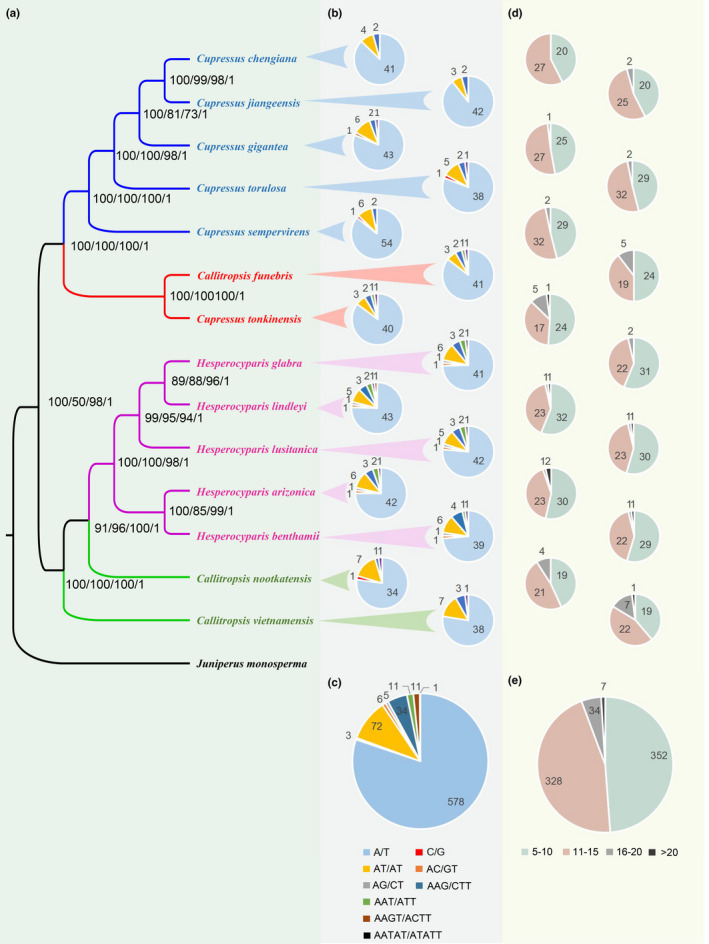
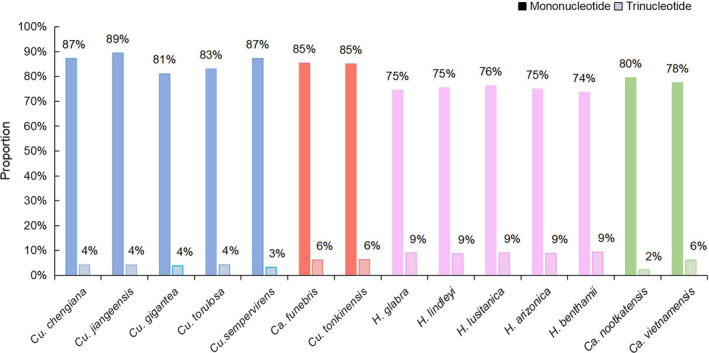
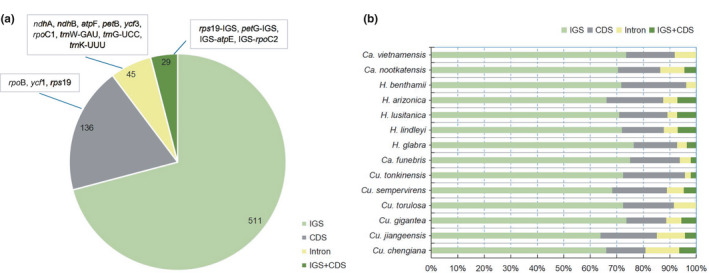
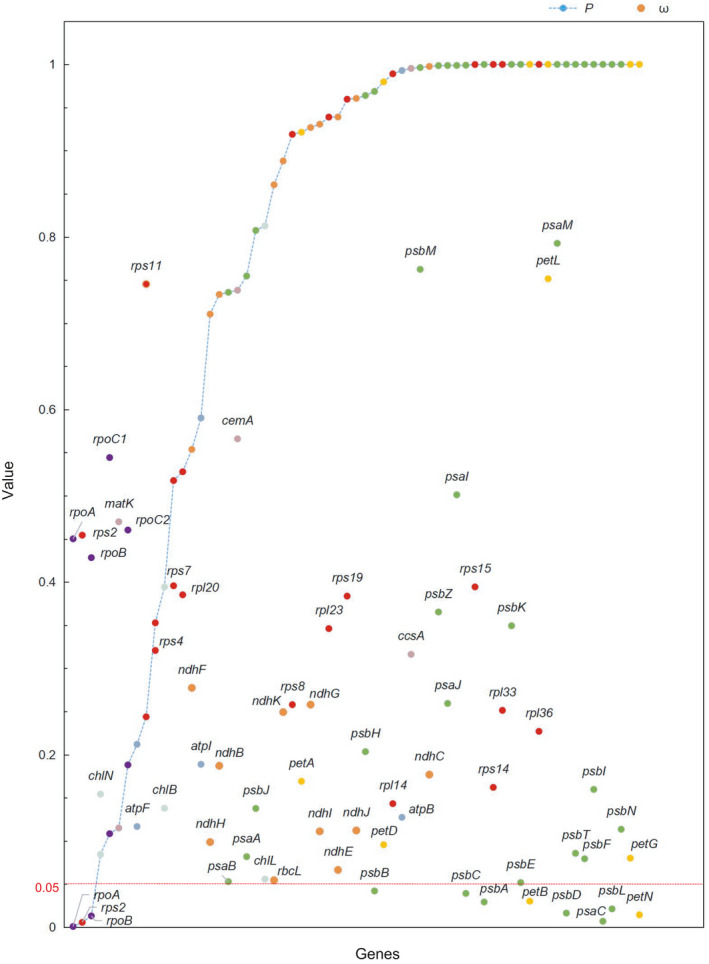
Chloroplast genome sequences have been used to understand evolutionary events and to infer efficiently phylogenetic relationships. (Cupressaceae) is an endemic species in China. Its phylogenetic position is controversial due to morphological characters similar to those of , and . This study used next-generation sequencing technology to sequence the complete chloroplast genome of and then constructed the phylogenetic relationship between and its related species based on a variety of data sets and methods. Simple sequence repeats (SSRs) and adaptive evolution analysis were also conducted. Our results showed that the monophyletic branch consisting of and is a sister to while is not monophyletic; and are nested in turn at the base of the monophyletic group . The statistical results of SSRs supported the closest relationship between and . By performing adaptive evolution analysis under the phylogenetic background of Cupressales, the Branch model detected three genes and the Site model detected 10 genes under positive selection; and the Branch-Site model uncovered that A has experienced positive selection in the branch. Molecular analysis from the chloroplast genome highly supported that is at the base of . Of note, SSR features were found to be able to shed some light on phylogenetic relationships. In short, this chloroplast genomic study has provided new insights into the phylogeny of and revealed multiple chloroplast genes possibly undergoing adaptive evolution.
叶绿体基因组序列已被用于理解进化事件并有效推断系统发育关系。(柏科某属)是中国的特有物种。由于其形态特征与其他某些属相似,其系统发育位置存在争议。本研究利用新一代测序技术对该属的完整叶绿体基因组进行测序,然后基于多种数据集和方法构建了该属与其近缘物种之间的系统发育关系。还进行了简单序列重复(SSRs)和适应性进化分析。我们的结果表明,由该属和另一属组成的单系分支是某属的姐妹分支,而另一属不是单系的;另外两属依次嵌套在单系类群的基部。SSRs的统计结果支持该属与另一属之间的关系最为密切。通过在柏目系统发育背景下进行适应性进化分析,分支模型检测到3个基因,位点模型检测到10个处于正选择下的基因;分支-位点模型揭示了A在某分支中经历了正选择。来自叶绿体基因组的分子分析高度支持该属处于某属的基部。值得注意的是,发现SSRs特征能够为系统发育关系提供一些线索。简而言之,这项叶绿体基因组研究为该属的系统发育提供了新的见解,并揭示了多个可能经历适应性进化的叶绿体基因。