Marques Ana C, Vale Mário, Vicente Daniel, Schreck Murielle, Tervoort Elena, Niederberger Markus
CERENA DEQ Instituto Superior Técnico Universidade de Lisboa Avenida Rovisco Pais Lisboa 1049-001 Portugal.
Laboratory for Multifunctional Materials Department of Materials ETH Zürich, Vladimir-Prelog-Weg 5 Zürich 8093 Switzerland.
Glob Chall. 2021 Jan 27;5(5):2000116. doi: 10.1002/gch2.202000116. eCollection 2021 May.
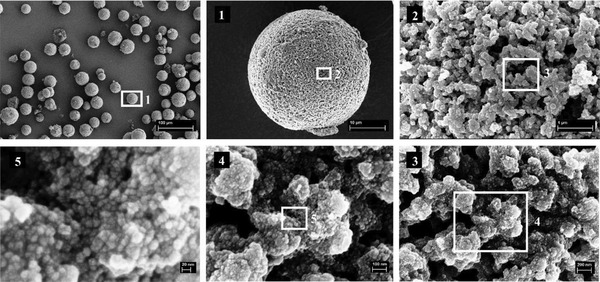
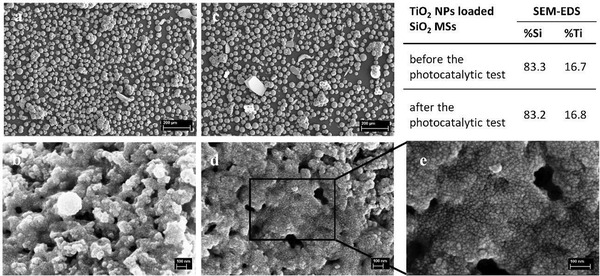
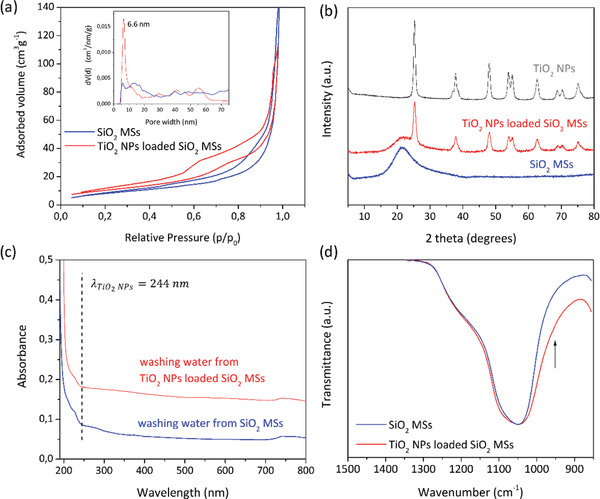
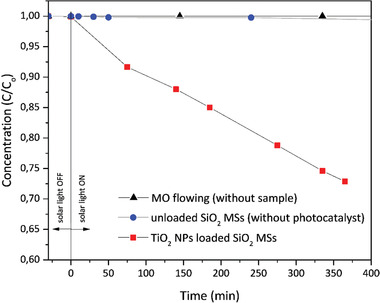
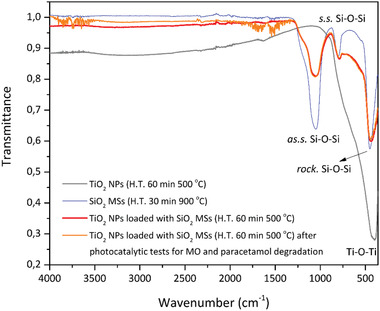
In this paper, inorganic silica microspheres with interconnected macroporosity are tested as a platform for designing robust and efficient photocatalytic systems for a continuous flow reactor, enabling a low cost and straightforward purification of wastewater through solar-driven photocatalysis. The photocatalytically active microspheres are prepared by wet impregnation of porous silica scaffolds with Trizma-functionalized anatase titania (TiO) nanoparticles (NPs). NPs loading of 22 wt% is obtained in the form of a thin and well-attached layer, covering the external surface of the microspheres as well as the internal surface of the pores. The TiO loading leads to an increase of the specific surface area by 26%, without impacting the typically interconnected macroporosity (60%) of the microspheres, which is essential for an efficient flow of the pollutant solution during the photocatalytic tests. These are carried out in a liquid medium for the decomposition of methyl orange and paracetamol. In addition to photocatalytic activity under continuous flow, the microspheres offer the advantage that they can be easily removed from the reaction medium, which is an appealing aspect for industrial applications. In this work, the typical issues of TiO NPs photocatalysts are circumvented, without the need for elaborate chemistries, and for low availability and expensive raw materials.
在本文中,具有相互连通大孔隙率的无机二氧化硅微球被测试用作设计用于连续流动反应器的强大且高效的光催化系统的平台,从而能够通过太阳能驱动的光催化实现低成本且直接的废水净化。光催化活性微球通过用三(羟甲基)氨基甲烷功能化的锐钛矿型二氧化钛(TiO₂)纳米颗粒(NPs)对多孔二氧化硅支架进行湿浸渍来制备。以薄且附着良好的层的形式获得了22 wt%的NPs负载量,该层覆盖微球的外表面以及孔的内表面。TiO₂负载导致比表面积增加26%,而不影响微球通常的相互连通大孔隙率(60%),这对于光催化测试期间污染物溶液的有效流动至关重要。这些测试在液体介质中进行,用于甲基橙和对乙酰氨基酚的分解。除了在连续流动下的光催化活性外,微球还具有可以容易地从反应介质中去除的优点,这对于工业应用来说是一个有吸引力的方面。在这项工作中,规避了TiO₂ NPs光催化剂的典型问题,无需复杂的化学方法,也无需低可用性和昂贵的原材料。