Reguera Javier, Zheng Fangyuan, Shalan Ahmed Esmail, Lizundia Erlantz
BCMaterials, Basque Center for Materials, Applications, and Nanostructures, UPV/EHU Science Park, 48940 Leioa, Spain.
Central Metallurgical Research and Development Institute (CMRDI), P.O. Box 87, Helwan, Cairo, Egypt.
Cellulose (Lond). 2022;29(4):2223-2240. doi: 10.1007/s10570-022-04441-9. Epub 2022 Feb 1.
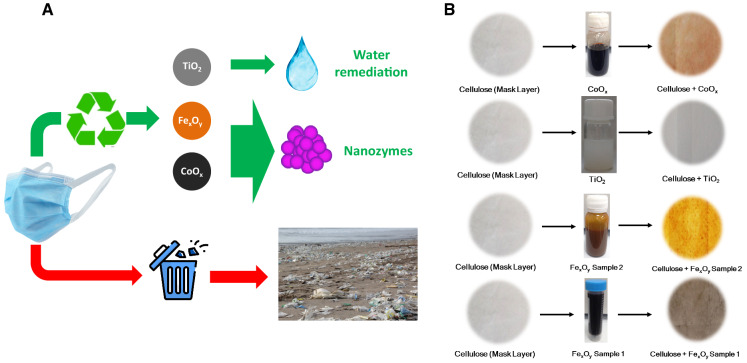
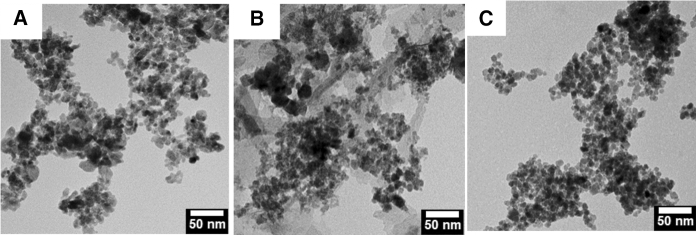
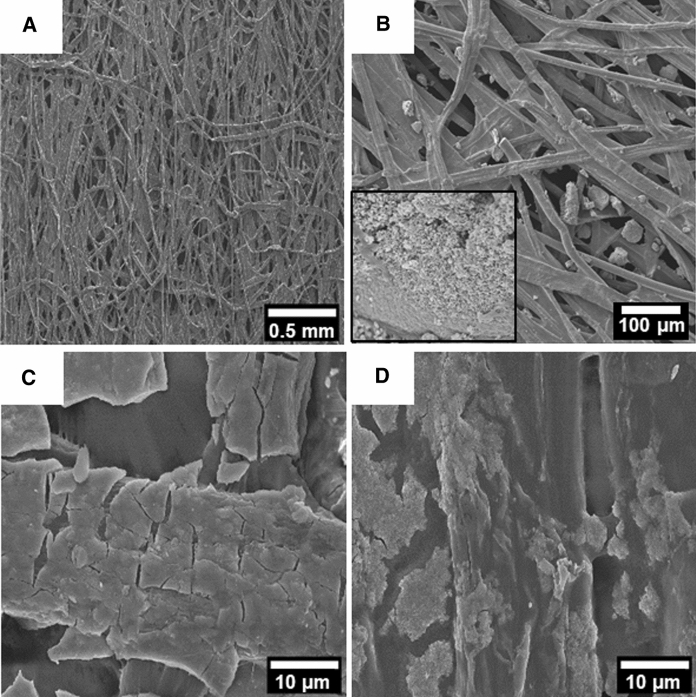
The COVID-19 pandemic outbreak has resulted in the massive fabrication of disposable surgical masks. As the accumulation of discarded face masks represents a booming threat to the environment, here we propose a solution to reuse and upcycle surgical masks according to one of the cornerstones of the circular economy. Specifically, the non-woven cellulosic layer of the masks is used as an environmentally sustainable and highly porous solid support for the controlled deposition of catalytically active metal-oxide nanoparticles. The native cellulosic fibers from the surgical masks are decorated by titanium dioxide (TiO), iron oxide (FeO), and cobalt oxide (CoO) nanoparticles following a simple and scalable approach. The abundant surface -OH groups of cellulose enable the controlled deposition of metal-oxide nanoparticles that are photocatalytically active or shown enzyme-mimetic activities. Importantly, the hydrophilic highly porous character of the cellulosic non-woven offers higher accessibility of the pollutant to the catalytically active surfaces and high retention in its interior. As a result, good catalytic activities with long-term stability and reusability are achieved. Additionally, developed free-standing hybrids avoid undesired media contamination effects originating from the release of nanoscale particles. The upcycling of discarded cellulosic materials, such as the ones of masks, into high-added-value catalytic materials, results an efficient approach to lessen the waste´s hazards of plastics while enhancing their functionality. Interestingly, this procedure can be extended to the upcycling of other systems (cellulosic or not), opening the path to greener manufacturing approaches of catalytic materials.
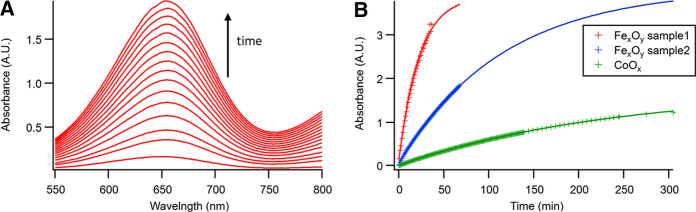
A novel approach to upcycle discarded cellulosic surgical masks is proposed, providing a solution to reduce the undesired accumulation of discarded face masks originating from the COVID-19 pandemic. The non-woven cellulosic layer formed by fibers is used as solid support for the controlled deposition of catalytically active titanium dioxide (TiO), iron oxide (FeO), and cobalt oxide (CoO) nanoparticles. Cellulosic porous materials are proven useful for the photocatalytic decomposition of organic dyes, while their peroxidase-like activity opens the door to advanced applications such as electrochemical sensors. The upcycling of cellulose nonwoven fabrics into value-added catalytic materials lessens the waste´s hazards of discarded materials while enhancing their functionality.
The online version contains supplementary material available at 10.1007/s10570-022-04441-9.
新冠疫情的爆发导致了一次性手术口罩的大量生产。由于废弃口罩的堆积对环境构成了日益严重的威胁,在此我们根据循环经济的一项基本原则,提出了一种对手术口罩进行再利用和升级改造的解决方案。具体而言,口罩的非织造纤维素层被用作一种环境可持续且高度多孔的固体载体,用于催化活性金属氧化物纳米颗粒的可控沉积。通过一种简单且可扩展的方法,利用二氧化钛(TiO₂)、氧化铁(Fe₂O₃)和氧化钴(CoO)纳米颗粒对手术口罩中的天然纤维素纤维进行修饰。纤维素丰富的表面 -OH 基团能够实现对具有光催化活性或呈现类酶活性的金属氧化物纳米颗粒的可控沉积。重要的是,纤维素非织造布的亲水性高孔隙特性使污染物更容易接触到催化活性表面,并在其内部具有高保留率。结果,实现了具有长期稳定性和可重复使用性的良好催化活性。此外,所开发的独立式复合材料避免了源自纳米级颗粒释放的不良介质污染效应。将废弃的纤维素材料(如口罩材料)升级改造为高附加值的催化材料,是一种有效减少塑料废物危害并增强其功能的方法。有趣的是,该方法可扩展到其他系统(无论是否为纤维素系统)的升级改造,为催化材料的更绿色制造方法开辟了道路。
提出了一种升级改造废弃纤维素手术口罩的新方法,为减少新冠疫情期间废弃口罩的不必要堆积提供了一种解决方案。由纤维形成的非织造纤维素层被用作固体载体,用于催化活性二氧化钛(TiO₂)、氧化铁(Fe₂O₃)和氧化钴(CoO)纳米颗粒的可控沉积。纤维素多孔材料被证明可用于有机染料的光催化分解,而其类过氧化物酶活性为电化学传感器等先进应用打开了大门。将纤维素非织造布升级改造为增值催化材料,减少了废弃材料的废物危害,同时增强了其功能。
在线版本包含可在 10.1007/s10570 - 022 - 04441 - 9 获取的补充材料。