Galal Ehab, Abdelhamid Mohamed H, Fath El-Bab Tarek, Abdelhamid Amr
Minia University Hospital, Department of Urology, Minia, Egypt.
Cairo University, Department of Urology, Cairo, Egypt.
Cent European J Urol. 2021;74(1):76-80. doi: 10.5173/ceju.2021.0273.R2. Epub 2021 Feb 12.
The aim of this study was to investigate the effect of 50 mg mirabegron once daily in relieving ureteral double-J (DJ) stent-related discomfort after ureteroscopy (URS) or retrograde intrarenal surgery (RIRS).
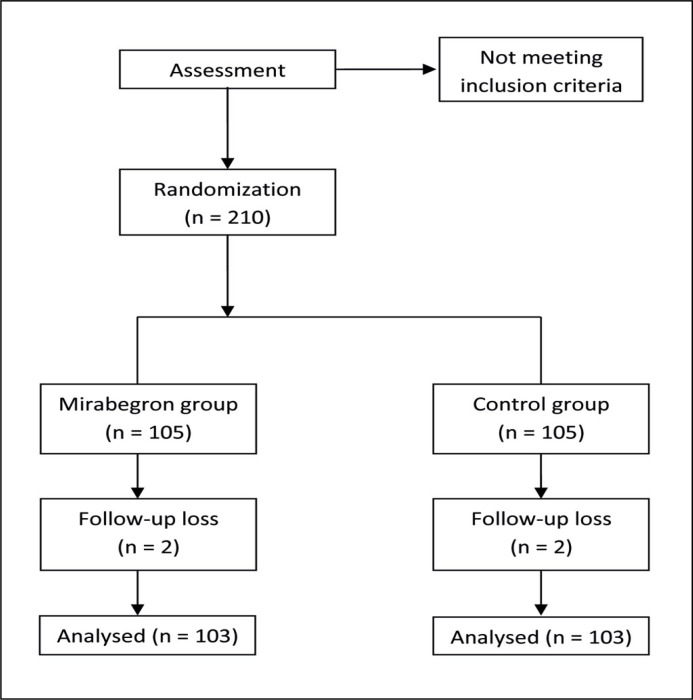
A total of 210 patients who underwent DJ ureteral stent insertion after URS or RIRS were randomized 1:1 to receive either no treatment (Group B) or mirabegron 50 mg once daily (Group A) during the stenting period. At time of stent removal, all patients were evaluated for stent-related symptoms using the Arabic translated and validated ureteral stent symptom questionnaire (USSQ). The severity of stent-related symptoms (SRS) was compared between the two groups.
The mean age was 46.6 ±8.2 years in Group A and 44.7 ±9.4 (26-64) years in the control group (p = 0.13). The stone characteristics, stent size, and position were similar in both groups. Compared to the control group, the mirabegron group had significantly lower daytime frequency, nocturia and urgency (p = 0.028, p = 0.008 and p = 0.012, respectively). As for stent-related pain, Group A had significantly less flank and abdominal pain (p = 0.007 and p = 0.001, respectively). The mirabegron versus control group showed significant difference in mean analgesics use and quality of life (QoL) scores during the stenting period (p = 0.005 and p = 0.003, respectively). Three patients (2.9%) in Group A encountered minor adverse effects (two experienced dry mouth and one presented with constipation).
For patients with indwelling DJ stent, postoperative mirabegron 50 mg use was effective and well-tolerated for the treatment of lower urinary tract symptoms and stent-related pain.
本研究旨在探讨每日一次服用50毫克米拉贝隆对缓解输尿管镜检查(URS)或逆行性肾内手术(RIRS)后输尿管双J(DJ)支架相关不适的效果。
总共210例在URS或RIRS后接受DJ输尿管支架置入的患者被随机分为1:1两组,在支架置入期间,一组不接受治疗(B组),另一组每日一次服用50毫克米拉贝隆(A组)。在取出支架时,使用阿拉伯语翻译并经验证的输尿管支架症状问卷(USSQ)对所有患者的支架相关症状进行评估。比较两组之间支架相关症状(SRS)的严重程度。
A组的平均年龄为46.6±8.2岁,对照组为44.7±9.4(26 - 64)岁(p = 0.13)。两组的结石特征、支架尺寸和位置相似。与对照组相比,米拉贝隆组的白天排尿频率、夜尿症和尿急明显更低(分别为p = 0.028、p = 0.008和p = 0.012)。至于支架相关疼痛,A组的胁腹和腹痛明显更少(分别为p = 0.007和p = 0.001)。在支架置入期间,米拉贝隆组与对照组在平均镇痛药使用和生活质量(QoL)评分方面存在显著差异(分别为p = 0.005和p = 0.003)。A组有3例患者(2.9%)出现轻微不良反应(2例口干,1例便秘)。
对于留置DJ支架的患者,术后服用50毫克米拉贝隆对治疗下尿路症状和支架相关疼痛有效且耐受性良好。