Groh Janos, Berve Kristina, Martini Rudolf
Section of Developmental Neurobiology, Department of Neurology, University Hospital Würzburg, 97080 Würzburg, Germany.
Brain Commun. 2021 Mar 21;3(2):fcab047. doi: 10.1093/braincomms/fcab047. eCollection 2021.
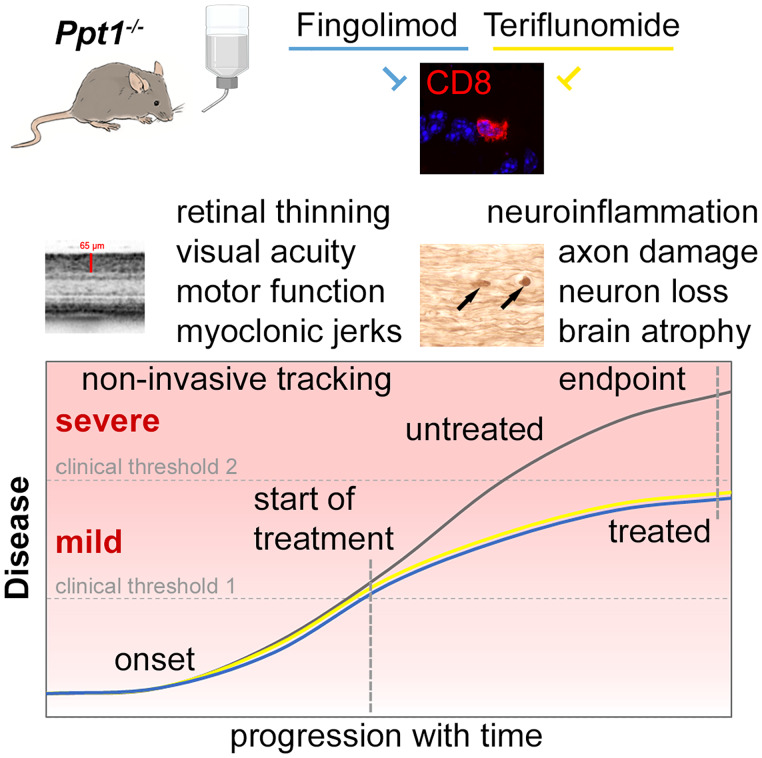
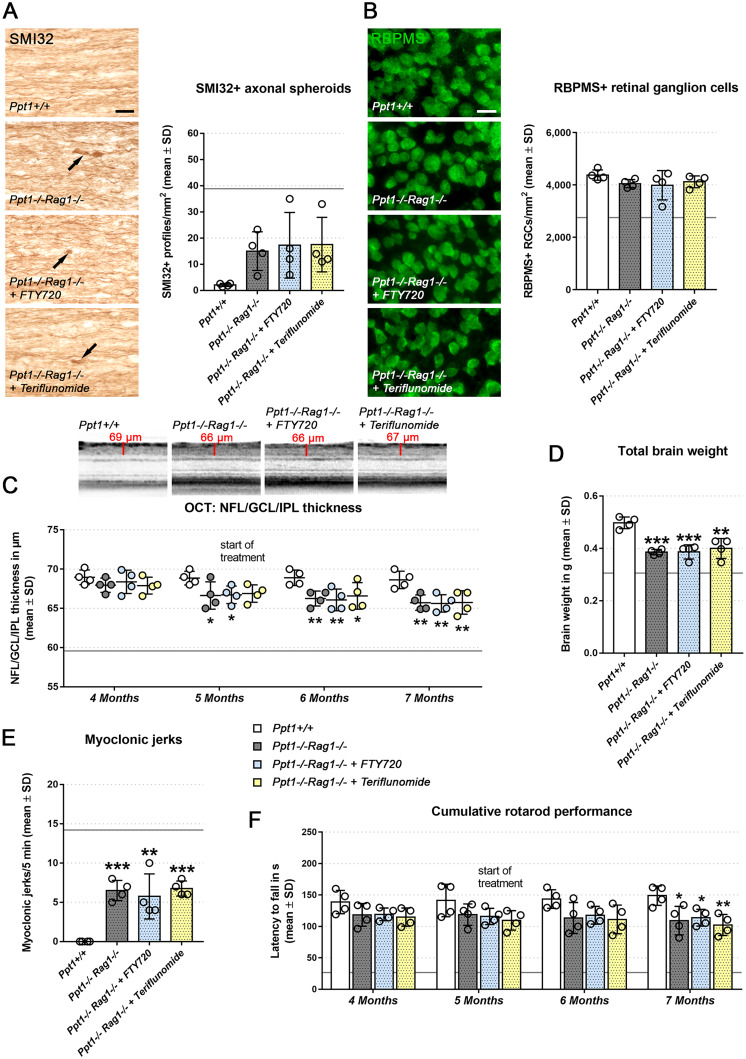
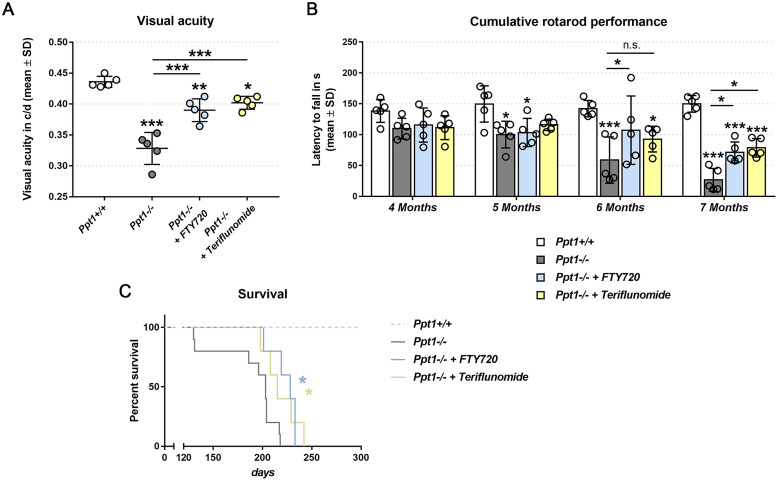
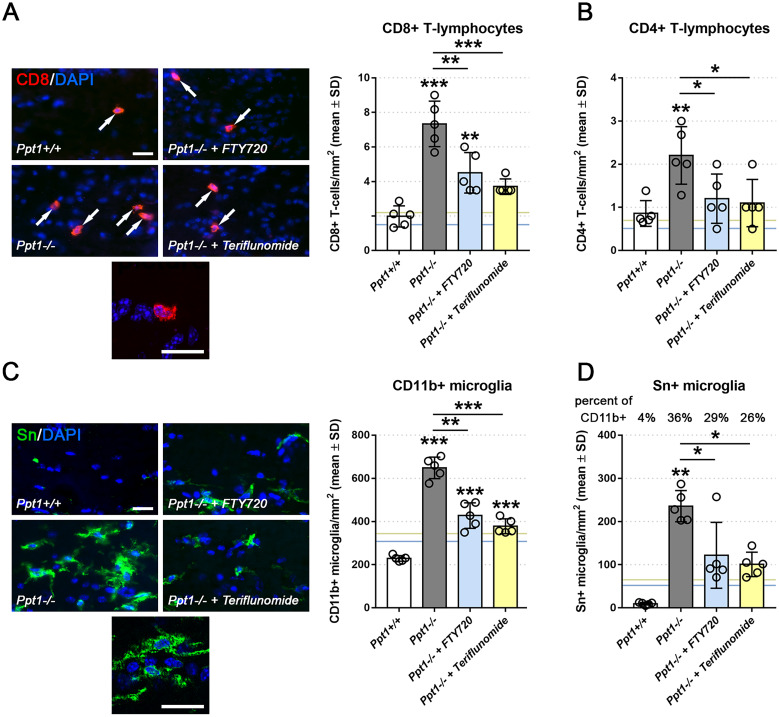
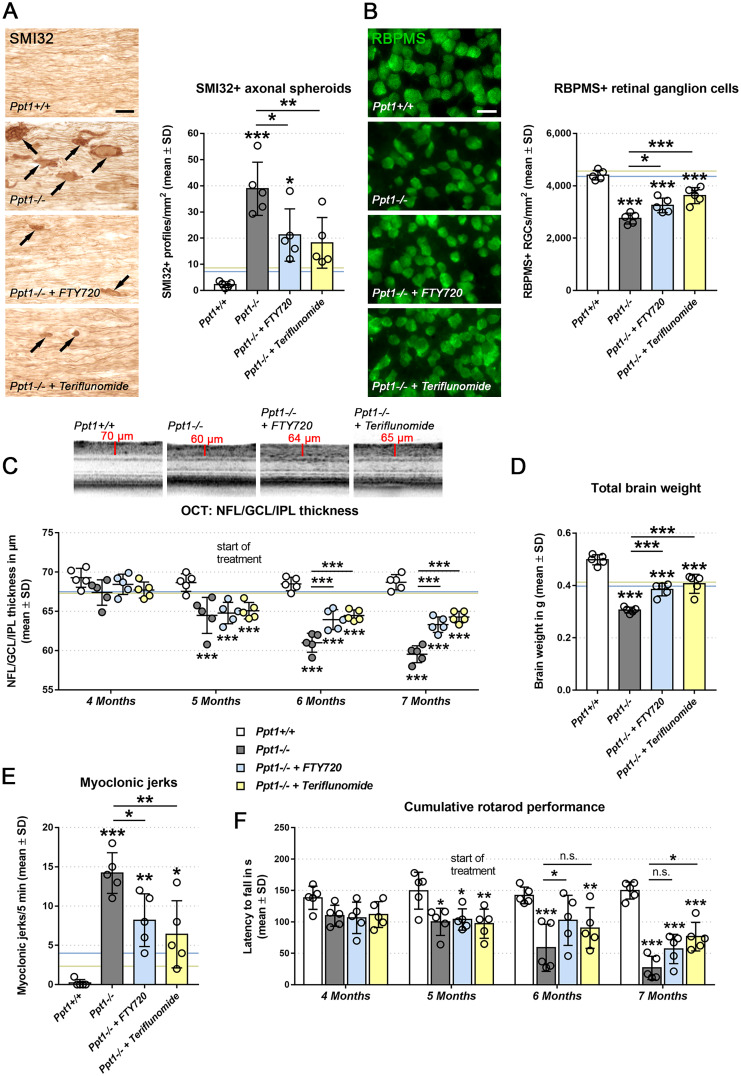
Targeting neuroinflammation in models for infantile and juvenile forms of neuronal ceroid lipofuscinosis (NCL, CLN disease) with the clinically established immunomodulators fingolimod and teriflunomide significantly attenuates the neurodegenerative phenotype when applied preventively, i.e. before the development of substantial neural damage and clinical symptoms. Here, we show that in a mouse model for the early onset and rapidly progressing CLN1 form, more complex clinical phenotypes like disturbed motor coordination and impaired visual acuity are also ameliorated by immunomodulation. Moreover, we show that the disease outcome can be attenuated even when fingolimod and teriflunomide treatment starts after disease onset, i.e. when neurodegeneration is ongoing and clinical symptoms are detectable. In detail, treatment with either drug led to a reduction in T-cell numbers and microgliosis in the CNS, although not to the same extent as upon preventive treatment. Pharmacological immunomodulation was accompanied by a reduction of axonal damage, neuron loss and astrogliosis in the retinotectal system and by reduced brain atrophy. Accordingly, the frequency of myoclonic jerks and disturbed motor coordination were attenuated. Overall, disease alleviation was remarkably substantial upon therapeutic treatment with both drugs, although less robust than upon preventive treatment. To test the relevance of putative immune-independent mechanisms of action in this model, we treated CLN1 mice lacking mature T- and B-lymphocytes. Immunodeficient CLN1 mice showed, as previously reported, an improved neurological phenotype in comparison with genuine CLN1 mice which could not be further alleviated by either of the drugs, reflecting a predominantly immune-related therapeutic mechanism of action. The present study supports and strengthens our previous view that repurposing clinically approved immunomodulators may alleviate the course of CLN1 disease in human patients, even though diagnosis usually occurs when symptoms have already emerged.
在婴儿和青少年形式的神经元蜡样脂褐质沉积症(NCL,CLN病)模型中,使用临床已确立的免疫调节剂芬戈莫德和特立氟胺靶向神经炎症,在预防性应用时,即在实质性神经损伤和临床症状出现之前应用,可显著减轻神经退行性表型。在此,我们表明,在早发性和快速进展的CLN1型小鼠模型中,免疫调节也可改善更复杂的临床表型,如运动协调障碍和视力受损。此外,我们表明,即使在疾病发作后开始使用芬戈莫德和特立氟胺治疗,即当神经退行性变正在进行且临床症状可检测到时,疾病结局也可得到缓解。详细而言,两种药物中的任何一种治疗均导致中枢神经系统中T细胞数量减少和小胶质细胞增生,尽管程度不如预防性治疗。药理免疫调节伴随着视网膜顶盖系统中轴突损伤、神经元丢失和星形胶质细胞增生的减少以及脑萎缩的减轻。相应地,肌阵挛抽搐的频率和运动协调障碍也得到了缓解。总体而言,两种药物进行治疗性治疗时疾病缓解非常显著,尽管不如预防性治疗时强劲。为测试该模型中假定的免疫非依赖性作用机制的相关性,我们对缺乏成熟T和B淋巴细胞的CLN1小鼠进行了治疗。如先前报道,免疫缺陷的CLN1小鼠与真正的CLN1小鼠相比,神经学表型有所改善,而两种药物均无法进一步缓解这种改善,这反映了主要的免疫相关治疗作用机制。本研究支持并强化了我们之前的观点,即重新利用临床批准的免疫调节剂可能会缓解人类患者CLN1疾病的病程,尽管通常在症状已经出现时才进行诊断。