Radiation Medical Science Center for the Fukushima Health Management Survey, Fukushima Medical University, Fukushima-city, Fukushima, Japan.
Department of Epidemiology, School of Medicine, Fukushima Medical University, Fukushima-city, Fukushima, Japan.
J Radiat Res. 2021 May 5;62(Supplement_1):i129-i139. doi: 10.1093/jrr/rraa134.
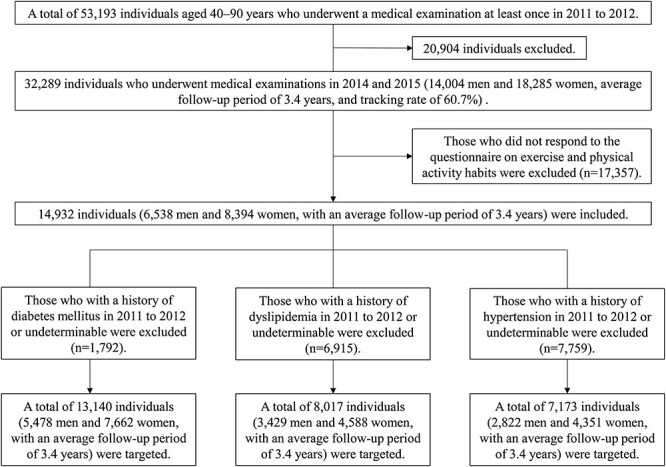
The effect of exercise habits on the increased incidence of lifestyle-related diseases among residents of the evacuation area in Fukushima Prefecture after the Great East Japan Earthquake is not well characterized. This study examined the influence of exercise habits on the frequency of new onset of lifestyle-related diseases in the aftermath of the earthquake using data from the Fukushima Health Management Survey (FHMS). Of the 32 289 individuals (14 004 men and 18 285 women) aged 40-90 years who underwent one or more health examinations in both 2011-12 and 2014-15, those who knew whether they had any lifestyle diseases and who responded to a questionnaire about their exercise and physical activity habits were included (dyslipidemia, 8017; hypertension, 7173; and diabetes mellitus, 13140 individuals). The association between the frequency of new onset of lifestyle-related diseases in 2014-15 and the presence or absence of persistent exercise and physical activity habits (active lifestyle) was examined using the FHMS data. The frequency of new onset of dyslipidemia was significantly lower in the active lifestyle group than in the sedentary lifestyle group (P = 0.008). On univariate and multivariate logistic regression analyses, the presence of active lifestyle, obesity and the experience of evacuation showed a significant association with new onset of dyslipidemia, independent of age, sex or follow-up period. Thus maintaining physical activity and exercise habits may help prevent the new onset of dyslipidemia among residents of the evacuation area in the Fukushima Prefecture after the earthquake.
运动习惯对福岛县地震疏散区居民生活方式相关疾病发病率增加的影响尚不清楚。本研究使用福岛健康管理调查(FHMS)的数据,考察了运动习惯对地震后生活方式相关疾病新发病例频率的影响。在 2011-12 年和 2014-15 年接受过一次或多次健康检查的 32289 名 40-90 岁(男性 14004 名,女性 18285 名)人群中,选取了那些知道自己是否患有生活方式疾病并回答了关于运动和体育活动习惯问卷的人(血脂异常 8017 例,高血压 7173 例,糖尿病 13140 例)。使用 FHMS 数据,考察了 2014-15 年新发生活方式相关疾病的频率与持续运动和体育活动习惯(积极的生活方式)的存在与否之间的关系。与久坐不动的生活方式组相比,积极的生活方式组新发血脂异常的频率显著降低(P=0.008)。单因素和多因素逻辑回归分析显示,积极的生活方式、肥胖和疏散经历与新发血脂异常显著相关,与年龄、性别或随访期无关。因此,保持体育活动和运动习惯可能有助于预防福岛县地震疏散区居民新发血脂异常。