Department of Physical Therapy, Fukushima Medical University School of Medical Sciences, Fukushima 960-8516, Japan.
Radiation Medical Science Center for the Fukushima Health Management Survey, Fukushima Medical University, Fukushima 960-1295, Japan.
Int J Environ Res Public Health. 2022 Mar 14;19(6):3399. doi: 10.3390/ijerph19063399.
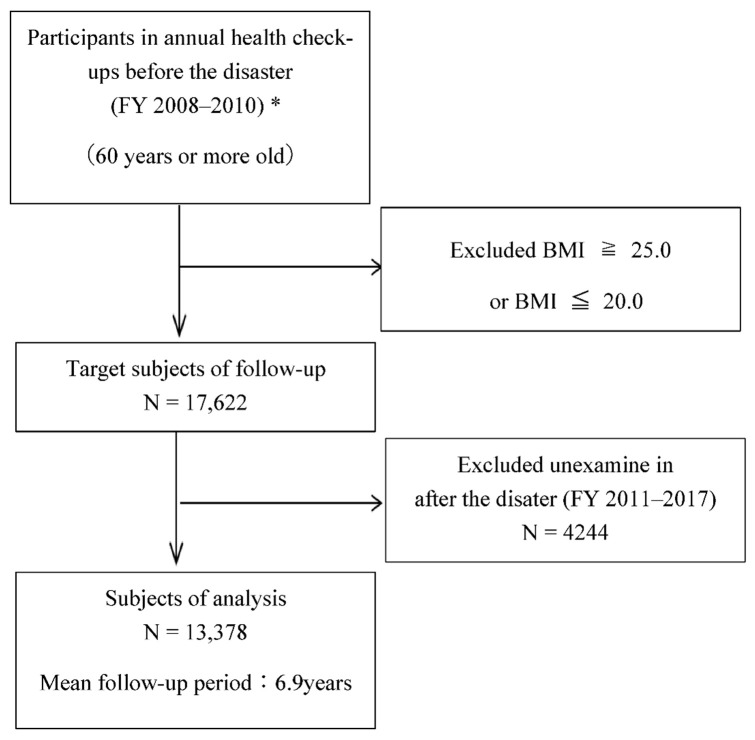
We conducted a longitudinal examination to assess the relationship between lifestyle habits, including exercise habits, and the incidence of undernutrition after the Great East Japan Earthquake in March 2011. Of the 31,411 participants aged ≥60 years who lived in the municipalities' evacuation areas before the disaster and had undergone health examinations, 17,622 persons with a body mass index of 20-25 kg/m were followed up through the FY 2017 (a mean follow-up of 6.9 years). The analysis involved 13,378 individuals who could be followed. The associations between undernutrition after the disaster and lifestyle factors were estimated via multivariable-adjusted analysis using the Cox proportional hazard regression model. The dependent variable was the proportion of undernutrition after the disaster, whereas independent variables included evacuation, exercise habits/physical activity, alcohol consumption, smoking, meals before bedtime, gastrointestinal surgery history, history of lifestyle-related diseases, and two or more subjective symptoms. In total, 1712 of the 13,378 participants were newly undernourished after the disaster. The statistically significant variables influencing the occurrence of undernutrition were non-evacuation (hazard ratio (HR), 1.31; 95% confidence index (CI) 1.17-1.47), poor exercise habits (HR, 1.14; 95% CI 1.03-1.50), and poor physical activity (HR, 1.12; 95% CI 1.01-1.25). Other significant related variables were drinking habits, surgical history, lifestyle-related diseases, and two or more subjective symptoms. These results suggest that regular exercise and/or physical activity might be important in preventing undernutrition following a disaster, regardless of sex, other lifestyle habits, or past medical history.
我们进行了一项纵向研究,以评估生活方式习惯(包括运动习惯)与 2011 年 3 月东日本大地震后营养不良发生率之间的关系。在灾难前居住在避难所的 31411 名年龄≥60 岁的参与者中,有 17622 人身体质量指数为 20-25kg/m,通过 FY 2017 进行了随访(平均随访 6.9 年)。分析包括 13378 名可随访的个体。通过使用 Cox 比例风险回归模型对多变量调整分析,评估了灾难后营养不良与生活方式因素之间的关联。因变量是灾难后营养不良的比例,而自变量包括避难、运动习惯/体力活动、饮酒、吸烟、睡前用餐、胃肠道手术史、生活方式相关疾病史以及两个或更多主观症状。共有 13378 名参与者中的 1712 名在灾难后出现新的营养不良。影响营养不良发生的统计学显著变量是非避难(风险比(HR),1.31;95%置信指数(CI)1.17-1.47)、运动习惯不良(HR,1.14;95%CI 1.03-1.50)和体力活动不良(HR,1.12;95%CI 1.01-1.25)。其他显著相关变量包括饮酒习惯、手术史、生活方式相关疾病以及两个或更多主观症状。这些结果表明,无论性别、其他生活方式习惯或既往病史如何,定期运动和/或体力活动可能对预防灾难后营养不良很重要。