Afyabora consortium, University of Buea, Buea, Cameroon.
Public Health Emergency and Operations Centre (PHEOC), Ministry of Public Health, Yaounde, Cameroon.
PLoS One. 2021 May 12;16(5):e0251504. doi: 10.1371/journal.pone.0251504. eCollection 2021.
A year after the COVID-19 pandemic started, there are still few scientific reports on COVID-19 in Africa. This study explores the clinical profiles and factors associated with COVID-19 in Cameroon.
In this prospective cohort study, we followed patients admitted for suspicion of COVID-19 at Djoungolo Hospital between 01st April and 31st July 2020. Patients were categorised by age groups and disease severity: mild (symptomatic without clinical signs of pneumonia), moderate (with clinical signs of pneumonia without respiratory distress) and severe cases (clinical signs of pneumonia and respiratory distress not requiring invasive ventilation). Demographic information and clinical features were summarised. Multivariable analysis was performed to predict risk.
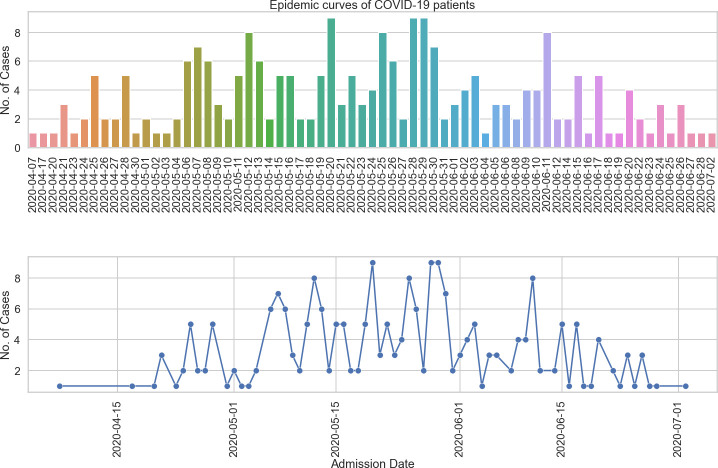
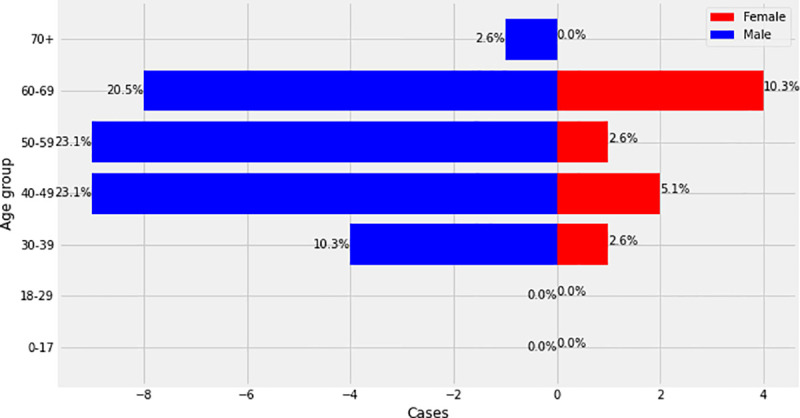
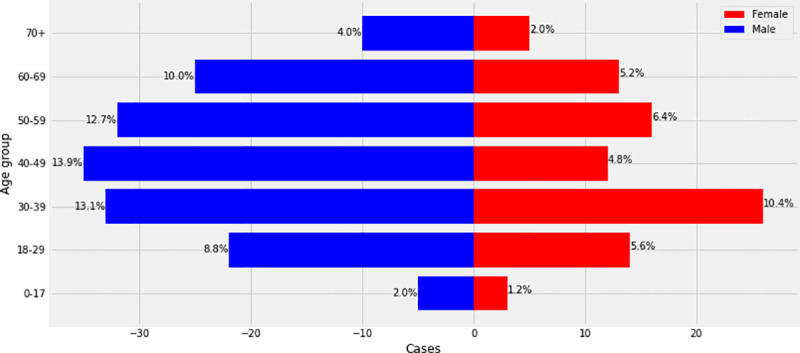
A total of 313 patients were admitted during the study period; 259 were confirmed cases of COVID-19 by Polymerase Chain Reaction (PCR). Among the confirmed cases, the male group aged 40 to 49 years (13.9%) was predominant. Disease severity ranged from mild (26.2%; n = 68) to moderate (59%; n = 153) to severe (14.7%; n = 38); the case fatality rate was 1% (n = 4). Dysgusia (46%; n = 119) and hyposmia/anosmia (37.8%; n = 98) were common features of COVID-19. Nearly one-third of patients had comorbidities (29%; n = 53), of which hypertension was the most common (18.9%; n = 49). Participation in mass gatherings (Odds Ratio (OR) = 2.37; P = 0.03) and dysgusia (OR = 2.09, P = 0.02) were predictive of diagnosis of COVID-19. Age groups 60 to 69 (OR = 7.41; P = 0.0001), 50 to 59 (OR = 4.09; P = 0.03), 40 to 49 (OR = 4.54; P = 0.01), male gender (OR = 2.53; P = 0.04), diabetes (OR = 4.05; P = 0.01), HIV infection (OR = 5.57; P = 0.03), lung disease (OR = 6.29; P = 0.01), dyspnoea (OR = 3.70; P = 0.008) and fatigue (OR = 3.35; P = 0.02) significantly predicted COVID-19 severity.
Most COVID-19 cases in this study were benign with low fatality. Age (40-70), male gender, HIV infection, lung disease, dyspnoea and fatigue are associated with severe COVID-19. Such findings may guide public health decision-making.
在 COVID-19 大流行开始一年后,非洲仍鲜有关于 COVID-19 的科学报告。本研究探讨了喀麦隆 COVID-19 的临床特征和相关因素。
在这项前瞻性队列研究中,我们对 2020 年 4 月 1 日至 7 月 31 日期间在 Djoungolo 医院因疑似 COVID-19 而入院的患者进行了随访。患者按年龄组和疾病严重程度进行分类:轻症(有症状但无肺炎临床体征)、中度(有肺炎临床体征但无呼吸窘迫)和重症(有肺炎临床体征和呼吸窘迫但无需侵入性通气)。总结了人口统计学信息和临床特征。进行了多变量分析以预测风险。
在研究期间共有 313 名患者入院;259 名经聚合酶链反应(PCR)确诊为 COVID-19。在确诊病例中,40 至 49 岁的男性组(13.9%)居多。疾病严重程度从轻症(26.2%;n=68)到中度(59%;n=153)到重症(14.7%;n=38)不等;病死率为 1%(n=4)。味觉障碍(46%;n=119)和嗅觉减退/丧失(37.8%;n=98)是 COVID-19 的常见特征。近三分之一的患者有合并症(29%;n=53),其中高血压最常见(18.9%;n=49)。参加群众集会(优势比(OR)=2.37;P=0.03)和味觉障碍(OR=2.09,P=0.02)与 COVID-19 的诊断有关。60 至 69 岁年龄组(OR=7.41;P=0.0001)、50 至 59 岁年龄组(OR=4.09;P=0.03)、40 至 49 岁年龄组(OR=4.54;P=0.01)、男性(OR=2.53;P=0.04)、糖尿病(OR=4.05;P=0.01)、HIV 感染(OR=5.57;P=0.03)、肺部疾病(OR=6.29;P=0.01)、呼吸困难(OR=3.70;P=0.008)和疲劳(OR=3.35;P=0.02)显著预测 COVID-19 严重程度。
本研究中的大多数 COVID-19 病例均为良性,病死率低。年龄(40-70 岁)、男性、HIV 感染、肺部疾病、呼吸困难和疲劳与严重 COVID-19 相关。这些发现可能为公共卫生决策提供指导。