Xin Hua Hospital Affiliated to Shanghai Jiao Tong University School of Medicine, Shanghai, China.
The Affiliated Yantai Yuhuangding Hospital of Qingdao University, Yantai, China.
BMC Cancer. 2021 May 13;21(1):543. doi: 10.1186/s12885-021-08292-8.
We identified differentiated thyroid cancer (DTC) survivors from SEER registries and performed Poisson regression to calculate the relative risks (RRs) of subsequent malignancies (SMs) by different sites associated with radioactive iodine (RAI) treatment, and the attributable risk proportion of RAI for developing different SMs.
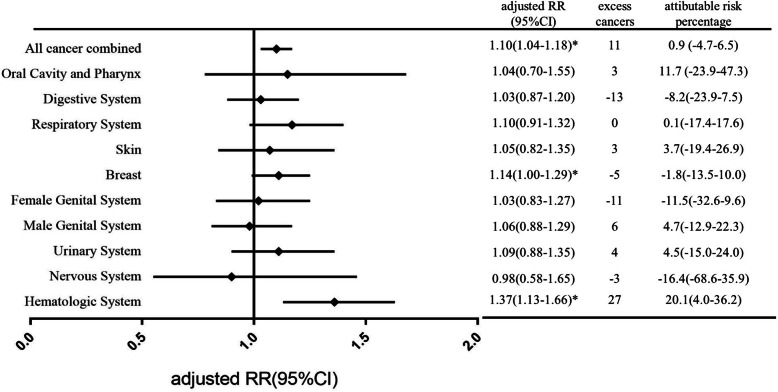
We identified 4628 of 104,026 DTC patients developing a SM after two years of their DTC diagnosis, with a medium follow-up time of 113 months. The adjusted RRs of developing SM associated with RAI varied from 0.98 (0.58-1.65) for neurologic SMs to 1.37 (1.13-1.66) for hematologic SMs. The RRs of developing all cancer combined SMs generally increased with age at DTC diagnosis and decreased with the latency time. We estimated that the attributable risk proportion of RAI treatment is only 0.9% for all cancer combined SMs and 20% for hematologic SMs, which is the highest among all SMs. The tumor features and mortalities in patients treated with and without RAI are generally comparable.
With the large population based analyses, we concluded that a low percentage of DTC survivors would develop SMs during their follow-up. Although the adjusted RR of SMs development increased slightly in patients receiving RAI, the attributable risk proportion associated with RAI was low, suggesting the absolute number of SMs induced by RAI in DTC survivors would be low. The attributable risk proportion of RAI treatment is the highest in hematological SMs, but when in consideration of its low incidence among all DTC survivors, the absolute number of hematological SMs was low.
我们从 SEER 登记处确定了分化型甲状腺癌 (DTC) 幸存者,并进行泊松回归分析,以计算不同部位与放射性碘 (RAI) 治疗相关的继发恶性肿瘤 (SM) 的相对风险 (RR),以及 RAI 导致不同 SM 发生的归因风险比例。
我们在 DTC 诊断后两年内从 104026 例 DTC 患者中确定了 4628 例发生 SM,中位随访时间为 113 个月。与 RAI 相关的 SM 发展的调整后 RR 从神经源性 SM 的 0.98 (0.58-1.65) 到血液学 SM 的 1.37 (1.13-1.66) 不等。所有癌症联合 SMs 的 RR 通常随 DTC 诊断时的年龄增加而增加,随潜伏期时间的延长而降低。我们估计,RAI 治疗的归因风险比例仅为所有癌症联合 SMs 的 0.9%和血液学 SMs 的 20%,在所有 SMs 中最高。接受和未接受 RAI 治疗的患者的肿瘤特征和死亡率通常相当。
通过大型人群分析,我们得出结论,在随访期间,只有一小部分 DTC 幸存者会发生 SMs。尽管接受 RAI 治疗的患者 SMs 发展的调整 RR 略有增加,但与 RAI 相关的归因风险比例较低,表明 RAI 诱导的 DTC 幸存者中的 SMs 绝对数量较低。RAI 治疗的归因风险比例在血液学 SMs 中最高,但考虑到其在所有 DTC 幸存者中的发病率较低,血液学 SMs 的绝对数量较低。