Department of Ophthalmology, Peking University People's Hospital, Eye Diseases and Optometry Institute, 11 Xizhimen South Street, Beijing, 100044, Xicheng District, China.
Beijing Key Laboratory of Diagnosis and Therapy of Retinal and Choroid Diseases, College of Optometry, Peking University Health Science Center, Beijing, China.
BMC Ophthalmol. 2021 May 12;21(1):211. doi: 10.1186/s12886-021-01967-7.
The aim of this study was to evaluate the in vivo confocal microscopic morphology of corneal subbasal nerves and its relationship with clinical parameters in patients with primary Sjögren's syndrome in China.
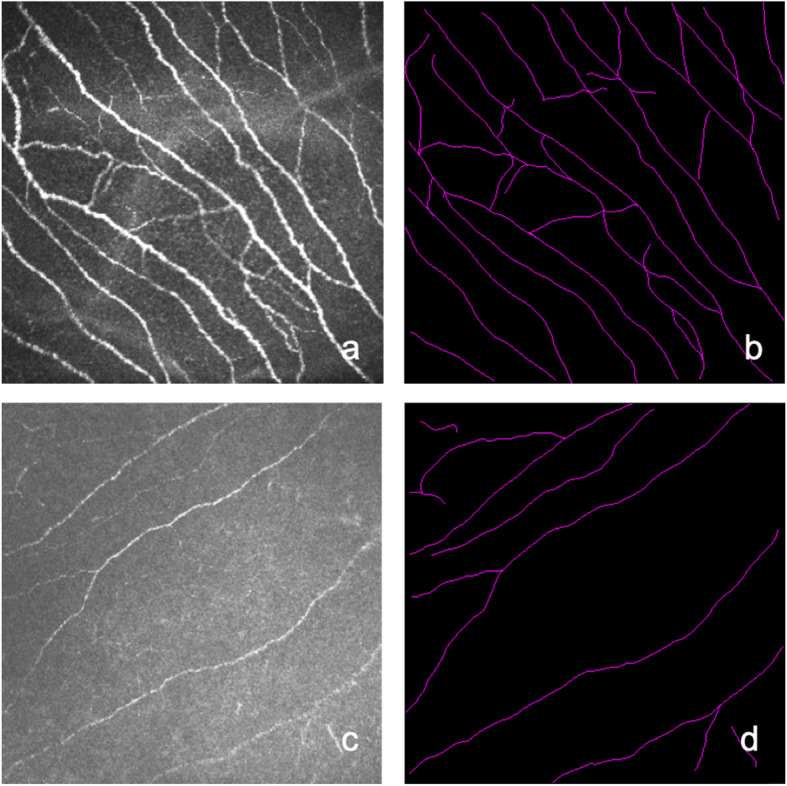
This was a case control study of 22 dry eye disease (DED) patients with primary Sjögren's syndrome (pSS) and 20 control subjects with non-Sjögren dry eye disease (NSDE). Each patient underwent an evaluation of ocular surface disease using the tear film break-up time (TBUT), noninvasive tear film break-up time (NIKBUT), noninvasive tear meniscus height (NIKTMH), corneal staining (National Eye Institute scale, NEI), Schirmer I test, meibography, and corneal subbasal nerve analysis with in vivo confocal microscopy (IVCM). The right eye of each subject was included in this study.
SS patients showed a shorter TBUT (P = 0.009) and Schirmer I test results (P = 0.028) than the NSDE group. However, there was no significant difference in NIKBUT between the two groups (P = 0.393). The nerve density of subbasal nerves, number of nerves and tortuosity of the SS group were significantly lower than those of the NSDE group (P = 0.001, P < 0.001 and P = 0.039, respectively). In the SS group, the mean nerve length was correlated with age and the Schirmer I test (r = - 0.519, P = 0.013 and r = 0.463, P = 0.035, respectively). Corneal staining was correlated with nerve density and the number of nerves (r = - 0.534, P = 0.013 and r = - 0.487, P = 0.025, respectively).
Sjögren syndrome dry eye (SSDE) patients have more severe clinical dry eye parameters than non-Sjögren dry eye disease (NSDE) patients. Compared with NSDE patients, we found that SSDE patients showed decreased corneal subbasal nerve density and numbers.
本研究旨在评估中国原发性干燥综合征(pSS)患者角膜基底部神经的体内共聚焦显微镜形态及其与临床参数的关系。
这是一项对 22 例干燥性眼病(DED)原发性干燥综合征(pSS)患者和 20 例非干燥性干燥综合征(NSDE)患者的病例对照研究。每位患者均接受了泪膜破裂时间(TBUT)、非侵入性泪膜破裂时间(NIKBUT)、非侵入性泪膜新月形高度(NIKTMH)、角膜染色(国家眼科研究所量表,NEI)、泪液分泌试验、泪膜造影和角膜基底部神经的评估分析采用体内共聚焦显微镜(IVCM)。每位患者的右眼均纳入本研究。
SS 患者的 TBUT(P=0.009)和 Schirmer I 试验结果(P=0.028)均短于 NSDE 组。然而,两组之间的 NIKBUT 无显著差异(P=0.393)。SS 组的角膜基底部神经密度、神经数量和神经扭曲度均显著低于 NSDE 组(P=0.001、P<0.001 和 P=0.039)。在 SS 组中,平均神经长度与年龄和 Schirmer I 试验呈负相关(r=-0.519,P=0.013 和 r=-0.463,P=0.035)。角膜染色与神经密度和神经数量呈负相关(r=-0.534,P=0.013 和 r=-0.487,P=0.025)。
干燥综合征(SS)干眼症(SSDE)患者的临床干眼症参数比非干燥综合征(NSDE)患者更严重。与 NSDE 患者相比,我们发现 SSDE 患者的角膜基底部神经密度和数量减少。