Chang Lisha, An Zhaowang, Zhang Jiang, Zhou Fuling, Wang Dali, Liu Jian, Zhang Yunhe
The 2nd Department of Neurology, North China University of Science and Technology Affiliated Hospital, Tangshan 063000, P.R. China.
Department of Neurosurgery, North China University of Science and Technology Affiliated Hospital, Tangshan 063000, P.R. China.
Mol Ther Nucleic Acids. 2021 Jan 26;24:622-633. doi: 10.1016/j.omtn.2021.01.021. eCollection 2021 Jun 4.
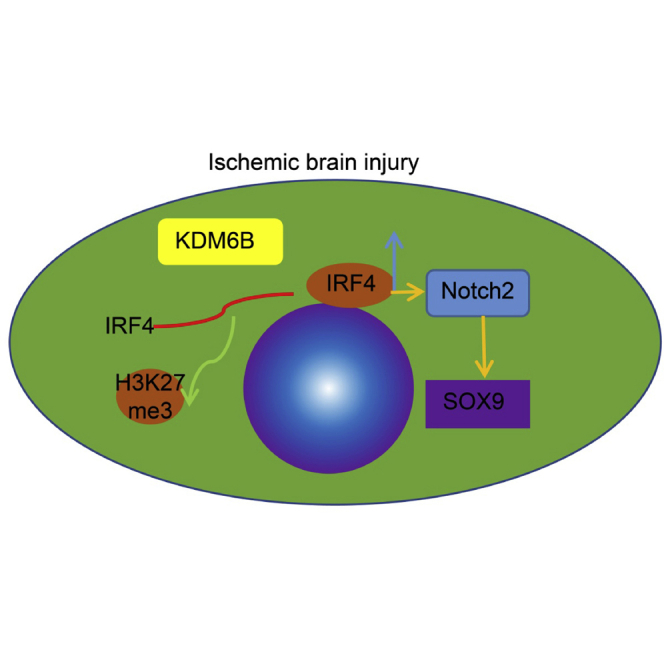
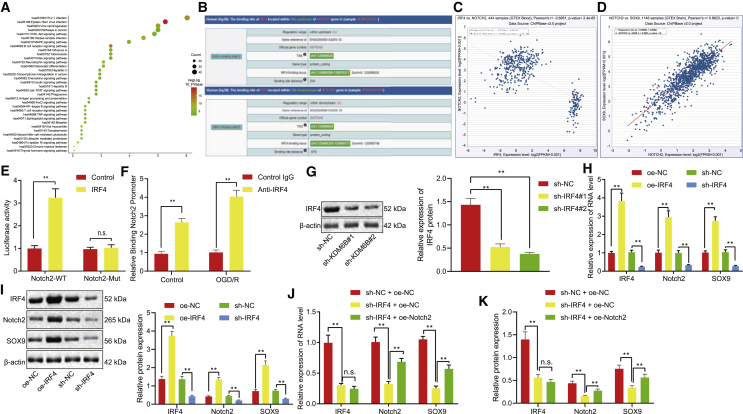
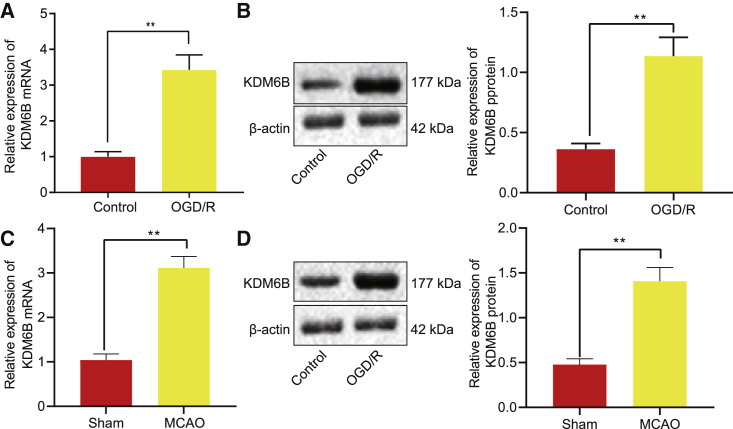
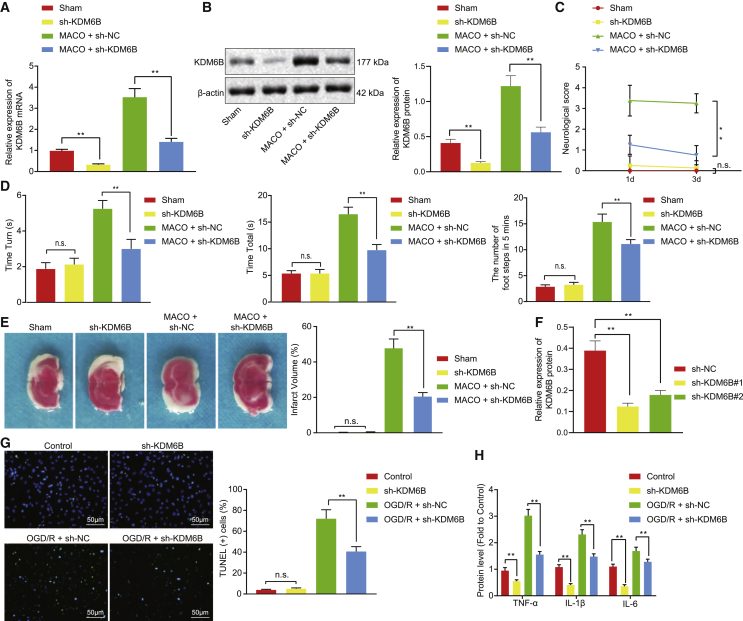
Lysine demethylase 6B (KDM6B) is a histone H3 lysine 27 (H3K27) demethylase that serves as a key mediator of gene transcription. Although KDM6B has been reported to modulate neuroinflammation after ischemic stroke, its role in ischemic brain injury is yet to be well elucidated. Therefore, this study aimed to thoroughly demonstrate the molecular mechanism underlying the effect of KDM6B on neurological function and astrocyte response in post-ischemic brain injury. Middle cerebral artery occlusion/reperfusion (MCAO) mouse models were constructed, while the oxygen-glucose deprivation/reperfusion (OGD/R) model was developed in astrocytes to mimic injury conditions. KDM6B was upregulated post-MCAO in mice and in astrocytes following the induction of OGD/R. Silencing of KDM6B resulted in suppressed neurological deficit, reduced cerebral infarction volume, attenuated neuronal cell apoptosis, and disrupted inflammation. Dual-luciferase reporter gene and chromatin immunoprecipitation-quantitative polymerase chain reaction assays revealed that KDM6B inhibited H3K27 trimethylation in the interferon regulatory factor 4 (IRF4) promoter region, resulting in the upregulation of IRF4 expression, which in turn bound to the Notch2 promoter region to induce its downstream factor SRY-related high-mobility group box 9 (SOX9). SOX9 knockdown reversed the effects of KDM6B overexpression on ischemia-triggered brain damage. Based on these findings, we concluded that KDM6B-mediated demethylation of IRF4 contributes to aggravation of ischemic brain injury through SOX9 activation.
赖氨酸去甲基化酶6B(KDM6B)是一种组蛋白H3赖氨酸27(H3K27)去甲基化酶,是基因转录的关键调节因子。尽管已有报道称KDM6B可调节缺血性中风后的神经炎症,但其在缺血性脑损伤中的作用尚未完全阐明。因此,本研究旨在全面阐明KDM6B对缺血性脑损伤后神经功能和星形胶质细胞反应影响的分子机制。构建了大脑中动脉闭塞/再灌注(MCAO)小鼠模型,同时在星形胶质细胞中建立了氧-葡萄糖剥夺/再灌注(OGD/R)模型以模拟损伤情况。在小鼠MCAO后以及OGD/R诱导后的星形胶质细胞中,KDM6B表达上调。沉默KDM6B可导致神经功能缺损减轻、脑梗死体积减小、神经元细胞凋亡减少以及炎症反应减弱。双荧光素酶报告基因和染色质免疫沉淀-定量聚合酶链反应分析表明,KDM6B抑制干扰素调节因子4(IRF4)启动子区域的H3K27三甲基化,导致IRF4表达上调,进而与Notch2启动子区域结合,诱导其下游因子SRY相关高迁移率族蛋白盒9(SOX9)。敲低SOX9可逆转KDM6B过表达对缺血引发的脑损伤的影响。基于这些发现,我们得出结论,KDM6B介导的IRF4去甲基化通过激活SOX9促进缺血性脑损伤的加重。