Department of Neurology, The First Hospital of Jilin University, Changchun, 130021, Jilin Province, China.
Departments of Pathology and Neurology, Case Western Reserve University School of Medicine, Cleveland, OH, 44106, USA.
Mol Neurobiol. 2021 Sep;58(9):4280-4292. doi: 10.1007/s12035-021-02418-6. Epub 2021 May 13.
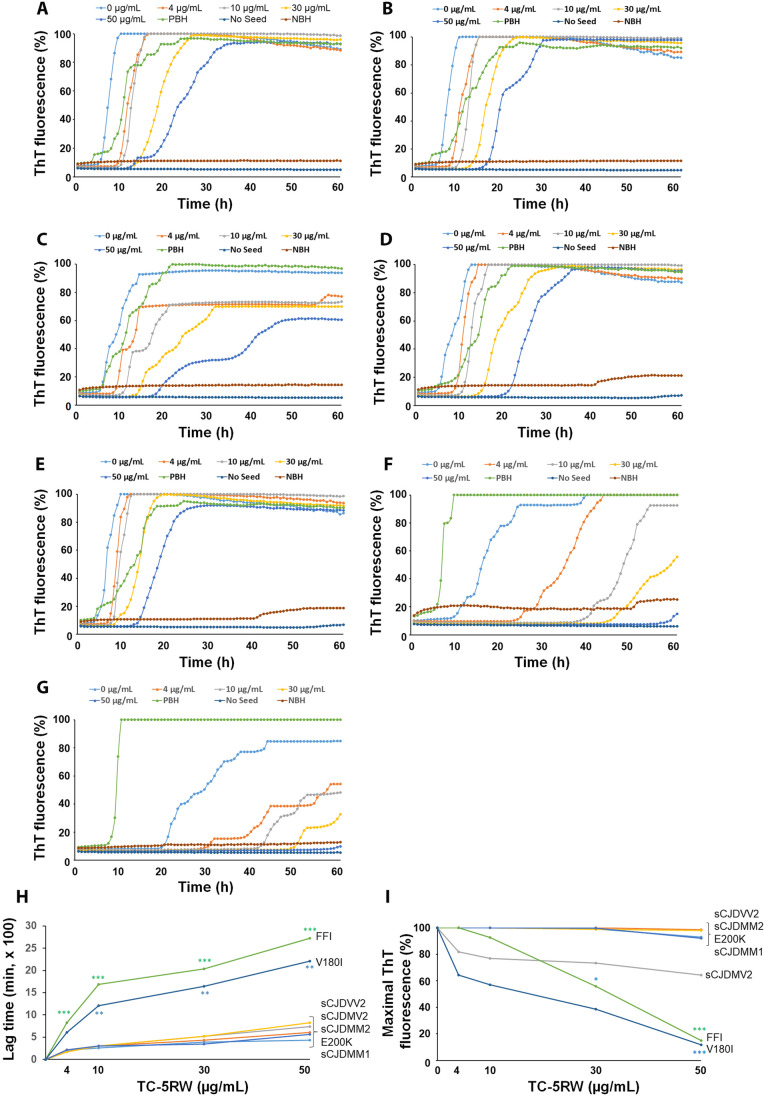
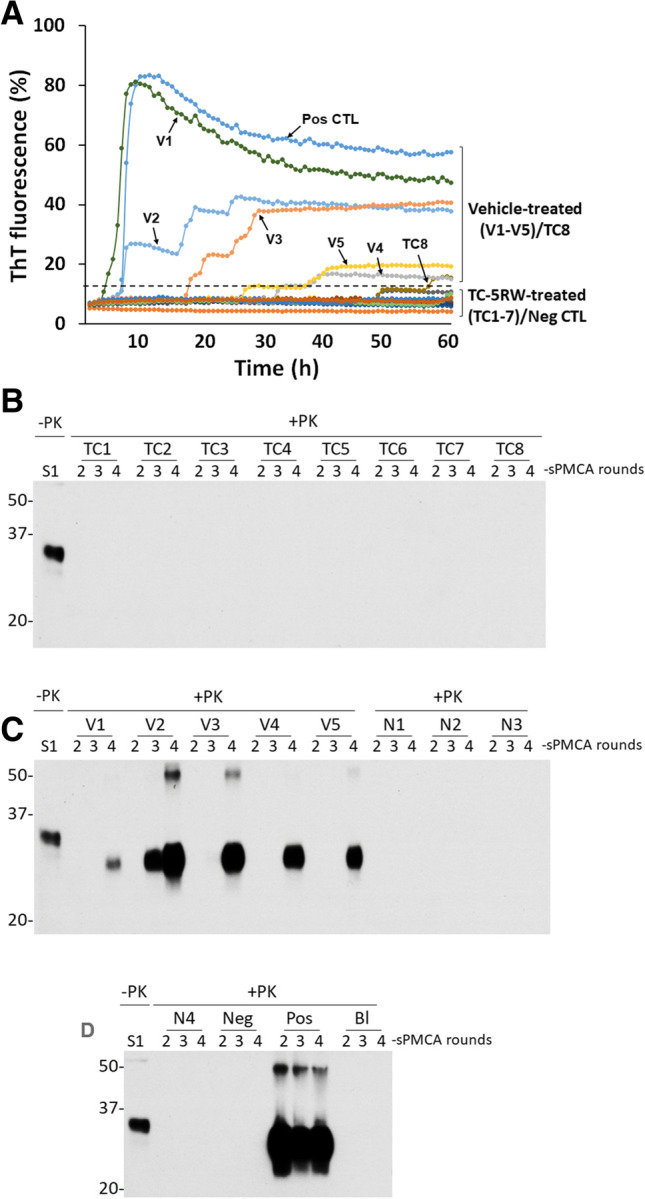
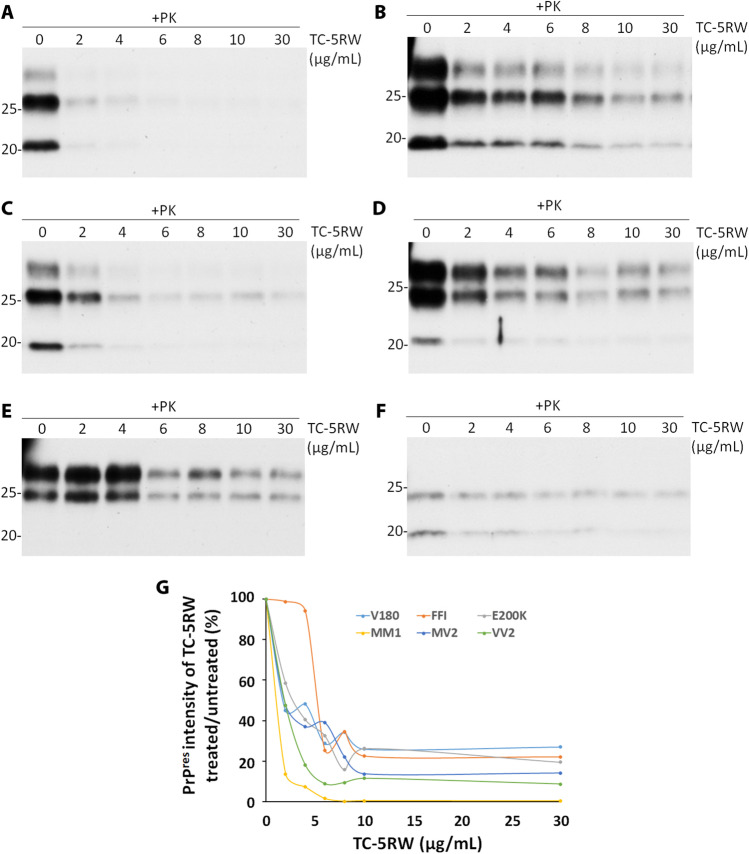
Previous studies have revealed that the infectious scrapie isoform of prion protein (PrP) harbored in the skin tissue of patients or animals with prion diseases can be amplified and detected through the serial protein misfolding cyclic amplification (sPMCA) or real-time quaking-induced conversion (RT-QuIC) assays. These findings suggest that skin PrP-seeding activity may serve as a biomarker for the diagnosis of prion diseases; however, its utility as a biomarker for prion therapeutics remains largely unknown. Cellulose ethers (CEs, such as TC-5RW), widely used as food and pharmaceutical additives, have recently been shown to prolong the lifespan of prion-infected mice and hamsters. Here we report that in transgenic (Tg) mice expressing hamster cellular prion protein (PrP) infected with the 263K prion, the prion-seeding activity becomes undetectable in the skin tissues of TC-5RW-treated Tg mice by both sPMCA and RT-QuIC assays, whereas such prion-seeding activity is readily detectable in the skin of untreated mice. Notably, TC-5RW exhibits an inhibitory effect on the in vitro amplification of PrP in both skin and brain tissues by sPMCA and RT-QuIC. Moreover, we reveal that TC-5RW is able to directly decrease protease-resistant PrP and inhibit the seeding activity of PrP from chronic wasting disease and various human prion diseases. Our results suggest that the level of prion-seeding activity in the skin may serve as a useful biomarker for assessing the therapeutic efficacy of compounds in a clinical trial of prion diseases and that TC-5RW may have the potential for the prevention/treatment of human prion diseases.
先前的研究表明,朊病毒疾病患者或动物皮肤组织中携带的传染性瘙痒症朊病毒蛋白(PrP)异构体可以通过连续蛋白错误折叠循环扩增(sPMCA)或实时震颤诱导转化(RT-QuIC)检测进行放大和检测。这些发现表明皮肤 PrP 引发活性可能作为朊病毒疾病诊断的生物标志物;然而,其作为朊病毒治疗的生物标志物的实用性在很大程度上仍然未知。纤维素醚(CE,如 TC-5RW),广泛用作食品和药物添加剂,最近已被证明可延长感染朊病毒的小鼠和仓鼠的寿命。在这里,我们报告在表达仓鼠细胞朊病毒蛋白(PrP)的转基因(Tg)小鼠中,用 263K 朊病毒感染后,TC-5RW 处理的 Tg 小鼠皮肤组织中的朊病毒引发活性在 sPMCA 和 RT-QuIC 检测中变得无法检测,而未经处理的小鼠的皮肤中则很容易检测到这种朊病毒引发活性。值得注意的是,TC-5RW 通过 sPMCA 和 RT-QuIC 对皮肤和脑组织中 PrP 的体外扩增表现出抑制作用。此外,我们揭示 TC-5RW 能够直接降低蛋白酶抗性 PrP 并抑制慢性消耗性疾病和各种人类朊病毒疾病中 PrP 的引发活性。我们的结果表明,皮肤中的朊病毒引发活性水平可能作为评估临床试验中化合物治疗效果的有用生物标志物,并且 TC-5RW 可能具有预防/治疗人类朊病毒疾病的潜力。