Department of Orthopaedic Surgery, Shanghai Jiao Tong University Affiliated Sixth People's Hospital, Shanghai, 200233, People's Republic of China.
Stem Cell Res Ther. 2021 May 13;12(1):288. doi: 10.1186/s13287-021-02368-9.
Both advanced glycation end products (AGEs) and AGE-mediated M1 macrophage polarization contribute to bone marrow mesenchymal stem cell (BMSC) dysfunction, leading to impaired bone regeneration in type 1 diabetes mellitus (T1DM). Adrenomedullin 2 (ADM2), an endogenous bioactive peptide belonging to the calcitonin gene-related peptide family, exhibits various biological activities associated with the inhibition of inflammation and reduction of insulin resistance. However, the effects and underlying mechanisms of ADM2 in AGE-induced macrophage M1 polarization, BMSC dysfunction, and impaired bone regeneration remain poorly understood.
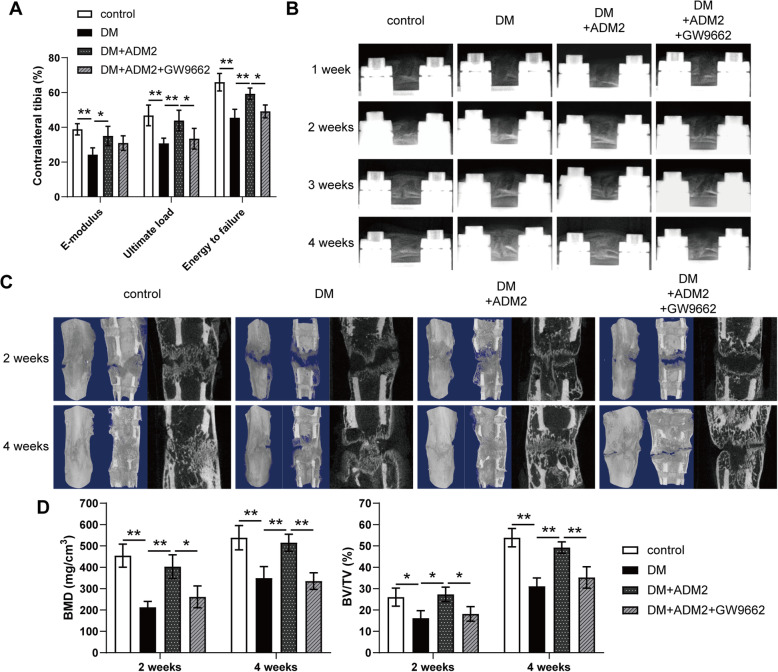
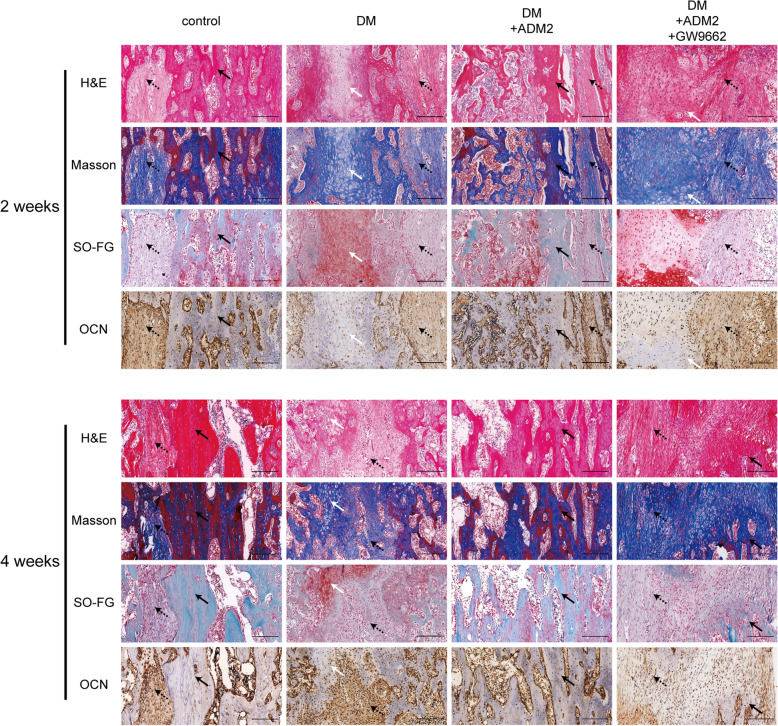
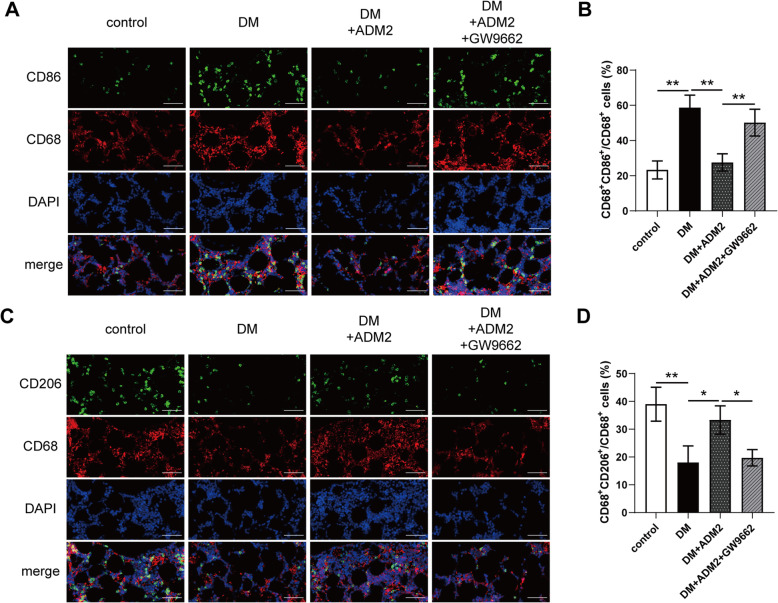
The polarization of bone marrow-derived macrophages was verified using flow cytometry analysis. Alkaline phosphatase (ALP) staining, ALP activity detection, and alizarin red staining were performed to assess the osteogenesis of BMSCs. Quantitative real-time polymerase chain reaction, enzyme-linked immunosorbent assay, western blotting, and immunofluorescence staining were used to assess polarization markers, nuclear factor kappa-light-chain-enhancer of activated B cells (NF-κB) signaling, and osteogenic markers. In vivo, a distraction osteogenesis (DO) rat model with T1DM was established, and tibia samples were collected at different time points for radiological, biomechanical, and histological analyses, to verify the effects of ADM2 on bone regeneration and M2 polarization under diabetic conditions.
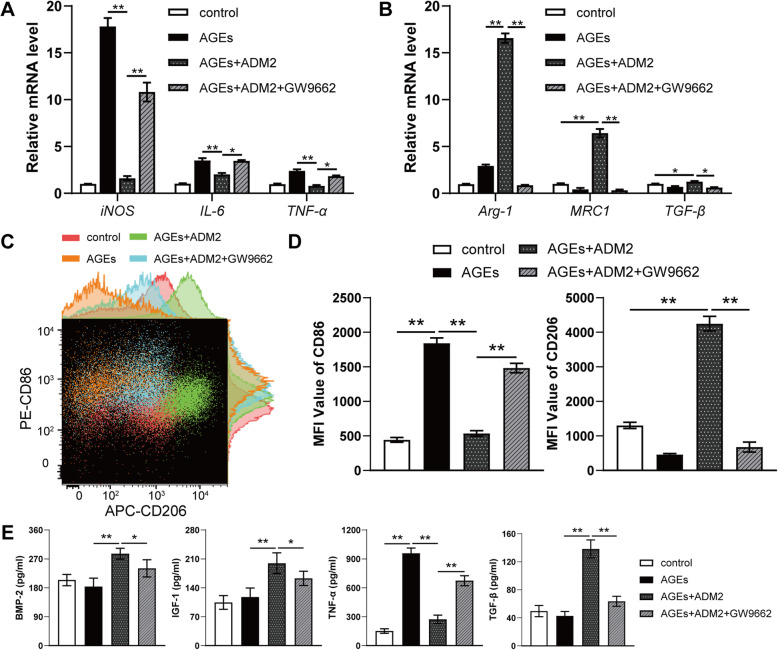
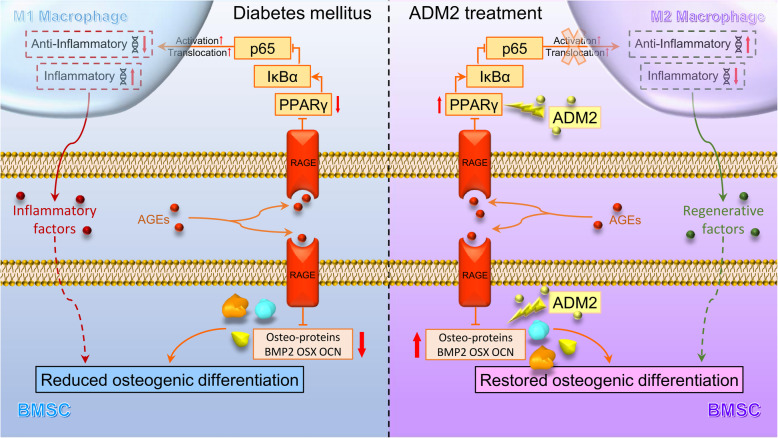
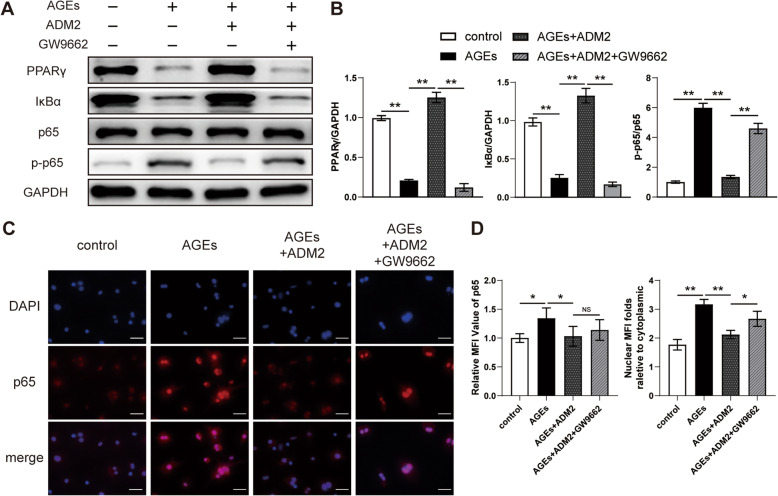
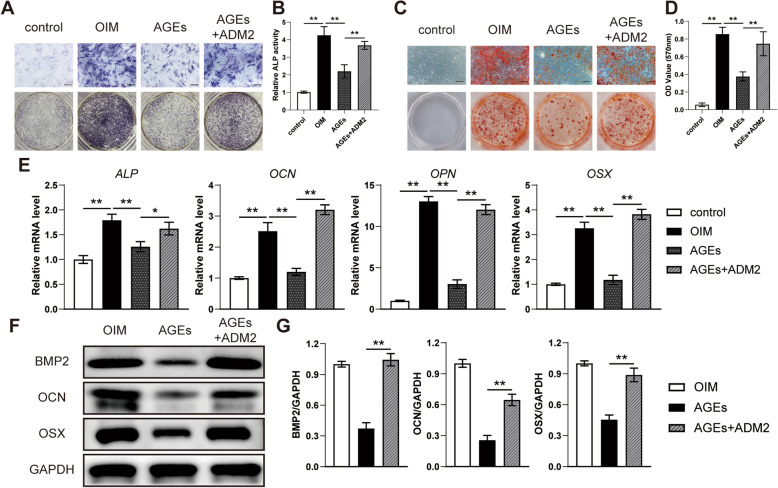
ADM2 treatment reversed AGE-induced M1 macrophage polarization towards the M2 phenotype, which was partially achieved by the peroxisome proliferator-activated receptor γ (PPARγ)-mediated inhibition of NF-κB signaling. The PPARγ inhibitor GW9662 significantly attenuated the effects of ADM2. Besides, ADM2 treatment improved the AGE-impaired osteogenic potential of BMSCs in vitro. Furthermore, ADM2 accelerated bone regeneration, as revealed by improved radiological and histological manifestations and biomechanical parameters, accompanied by improved M2 macrophage polarization in diabetic DO rats, and these effects were partially blocked by GW9662 administration.
These results indicate that ADM2 enhances diabetic bone regeneration during DO, by attenuating AGE-induced imbalances in macrophage polarization, partly through PPARγ/NF-κB signaling, and improving AGE-impaired osteogenic differentiation of BMSCs simultaneously. These findings reveal that ADM2 may serve as a potential bioactive factor for promoting bone regeneration under diabetic conditions, and imply that management of inflammation and osteogenesis, in parallel, may present a promising therapeutic strategy for diabetic patients during DO treatment.
晚期糖基化终产物(AGEs)和 AGE 介导的 M1 巨噬细胞极化都导致骨髓间充质干细胞(BMSC)功能障碍,从而导致 1 型糖尿病(T1DM)中骨再生受损。肾上腺髓质素 2(ADM2)是一种内源性生物活性肽,属于降钙素基因相关肽家族,具有多种与抑制炎症和降低胰岛素抵抗相关的生物学活性。然而,ADM2 在 AGE 诱导的巨噬细胞 M1 极化、BMSC 功能障碍和骨再生受损中的作用及其潜在机制仍知之甚少。
通过流式细胞术分析验证骨髓来源巨噬细胞的极化。碱性磷酸酶(ALP)染色、ALP 活性检测和茜素红染色用于评估 BMSC 的成骨作用。实时定量聚合酶链反应、酶联免疫吸附试验、Western 印迹和免疫荧光染色用于评估极化标志物、核因子 kappa-轻链增强子的激活 B 细胞(NF-κB)信号和成骨标志物。在体内,建立 T1DM 大鼠牵张成骨(DO)模型,在不同时间点采集胫骨样本进行放射学、生物力学和组织学分析,以验证 ADM2 在糖尿病条件下对骨再生和 M2 极化的影响。
ADM2 治疗逆转了 AGE 诱导的 M1 巨噬细胞向 M2 表型的极化,部分通过过氧化物酶体增殖物激活受体 γ(PPARγ)介导的抑制 NF-κB 信号来实现。PPARγ 抑制剂 GW9662 显著减弱了 ADM2 的作用。此外,ADM2 改善了 BMSCs 的 AGE 受损成骨潜能。此外,ADM2 通过改善放射学和组织学表现以及生物力学参数来加速糖尿病 DO 大鼠的骨再生,并且这些作用部分被 GW9662 给药阻断。
这些结果表明,ADM2 通过抑制 AGE 诱导的巨噬细胞极化失衡,同时改善 BMSCs 的 AGE 受损成骨分化,增强糖尿病 DO 期间的骨再生,部分通过 PPARγ/NF-κB 信号。这些发现表明 ADM2 可能作为一种有潜力的生物活性因子,促进糖尿病条件下的骨再生,并暗示炎症和成骨的同时管理,可能为糖尿病患者在 DO 治疗期间提供一种有前景的治疗策略。