Section of Cell Biology and Functional Genomics, Department of Metabolism, Digestion and Reproduction, Imperial College London, London, United Kingdom.
Front Endocrinol (Lausanne). 2021 Apr 27;12:660532. doi: 10.3389/fendo.2021.660532. eCollection 2021.
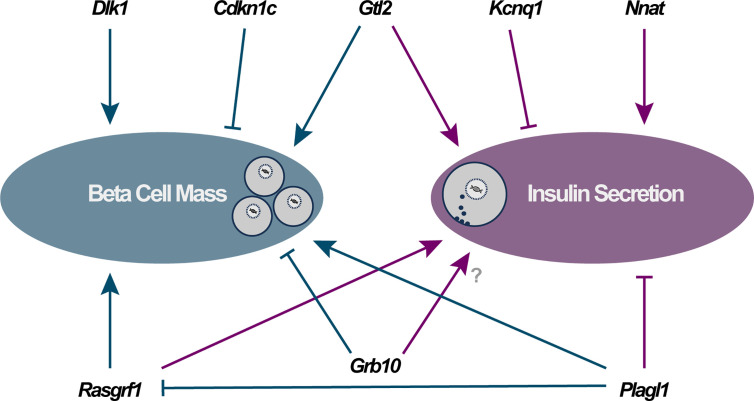
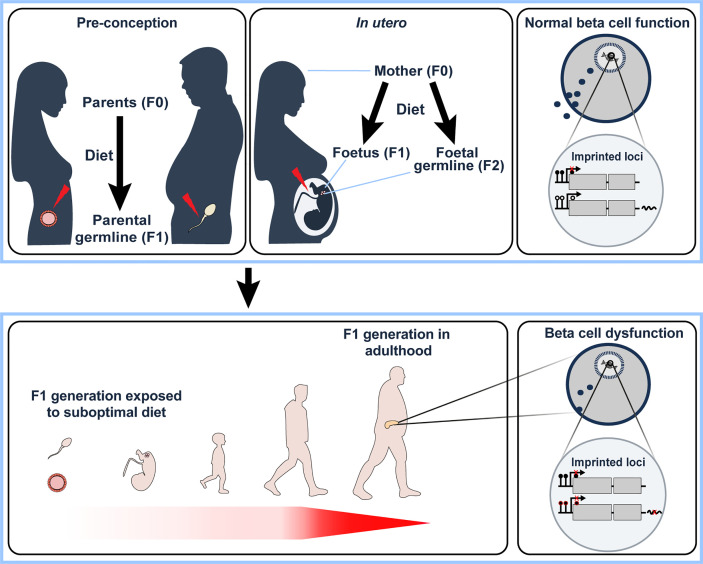
Beta cell failure lies at the centre of the aetiology and pathogenesis of type 2 diabetes and the epigenetic control of the expression of critical beta cell genes appears to play a major role in this decline. One such group of epigenetically-controlled genes, termed 'imprinted' genes, are characterised by transgenerational monoallelic expression due to differential allelic DNA methylation and play key functional roles within beta cells. Here, we review the evidence for this functional importance of imprinted genes in beta cells as well as their nutritional regulation by the diet and their altered methylation and/or expression in rodent models of diabetes and in type 2 diabetic islets. We also discuss imprinted genes in the context of the next generation, where dietary overnutrition in the parents can lead to their deregulation in the offspring, alongside beta cell dysfunction and defective glucose handling. Both the modulation of imprinted gene expression and the likelihood of developing type 2 diabetes in adulthood are susceptible to the impact of nutritional status in early life. Imprinted , therefore, represent an excellent opportunity with which to assess epigenomic changes in beta cells due to the diet in both the current and next generation.
β 细胞衰竭是 2 型糖尿病发病机制和病因学的核心,关键 β 细胞基因的表观遗传控制似乎在这种衰退中起着重要作用。这样一组受表观遗传控制的基因被称为“印迹”基因,其特征是由于等位基因 DNA 甲基化的差异而导致跨代单等位基因表达,并在 β 细胞中发挥关键功能作用。在这里,我们回顾了印迹基因在 β 细胞中的功能重要性的证据,以及它们在饮食中的营养调节,以及它们在糖尿病啮齿动物模型和 2 型糖尿病胰岛中的甲基化和/或表达改变。我们还讨论了印迹基因在下一代中的作用,其中父母的饮食过度营养会导致它们在后代中失调,同时还会导致 β 细胞功能障碍和葡萄糖处理缺陷。印迹基因的表达调节以及成年后患 2 型糖尿病的可能性都容易受到生命早期营养状况的影响。因此,由于饮食,印迹基因代表了评估当前和下一代 β 细胞中表观遗传变化的绝佳机会。