Department of Metabolism, Digestion and Reproduction, Faculty of Medicine, Imperial College London, London, UK.
Lee Kong Chian School of Medicine, Nanyang Technological University, Singapore, Republic of Singapore.
Diabetologia. 2024 Jun;67(6):1079-1094. doi: 10.1007/s00125-024-06123-6. Epub 2024 Mar 21.
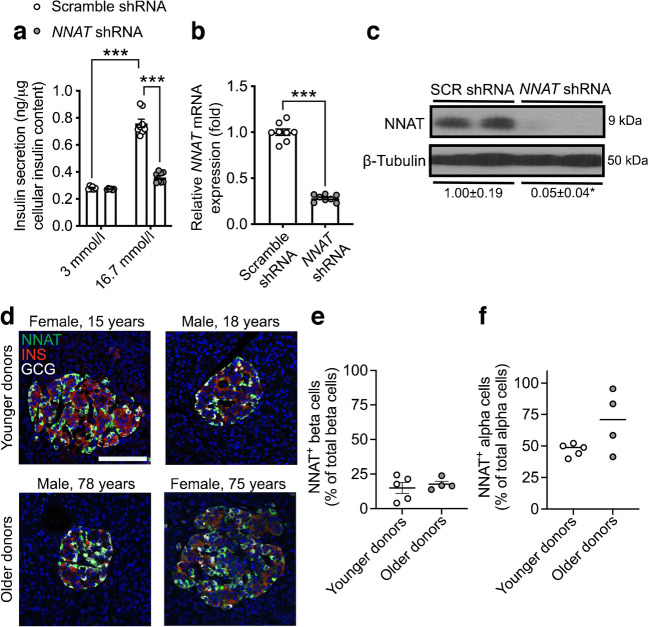
AIMS/HYPOTHESIS: Beta cells within the pancreatic islet represent a heterogenous population wherein individual sub-groups of cells make distinct contributions to the overall control of insulin secretion. These include a subpopulation of highly connected 'hub' cells, important for the propagation of intercellular Ca waves. Functional subpopulations have also been demonstrated in human beta cells, with an altered subtype distribution apparent in type 2 diabetes. At present, the molecular mechanisms through which beta cell hierarchy is established are poorly understood. Changes at the level of the epigenome provide one such possibility, which we explore here by focusing on the imprinted gene Nnat (encoding neuronatin [NNAT]), which is required for normal insulin synthesis and secretion.
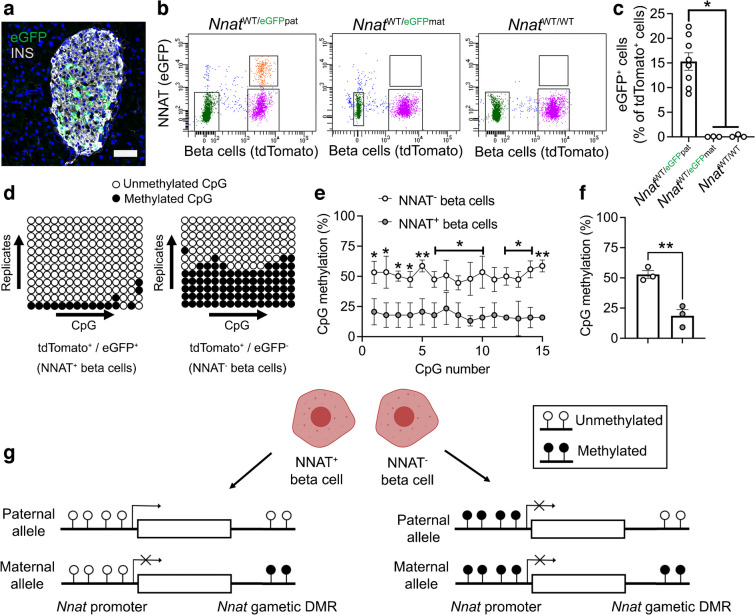
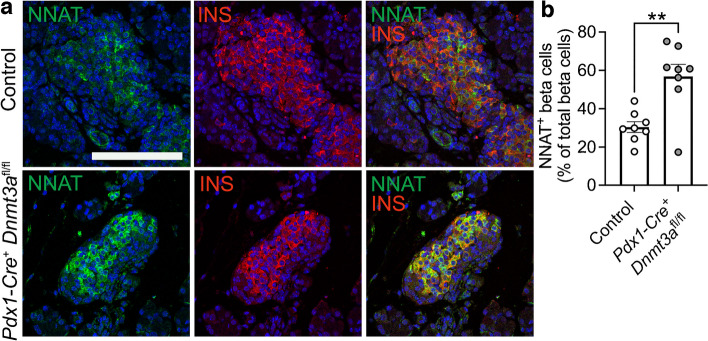
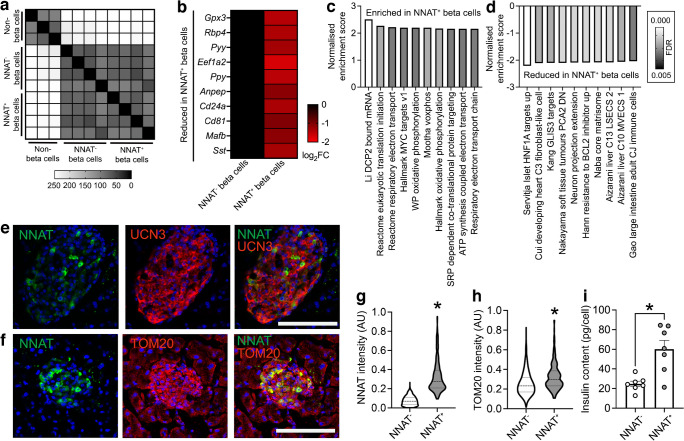
Single-cell RNA-seq datasets were examined using Seurat 4.0 and ClusterProfiler running under R. Transgenic mice expressing enhanced GFP under the control of the Nnat enhancer/promoter regions were generated for FACS of beta cells and downstream analysis of CpG methylation by bisulphite sequencing and RNA-seq, respectively. Animals deleted for the de novo methyltransferase DNA methyltransferase 3 alpha (DNMT3A) from the pancreatic progenitor stage were used to explore control of promoter methylation. Proteomics was performed using affinity purification mass spectrometry and Ca dynamics explored by rapid confocal imaging of Cal-520 AM and Cal-590 AM. Insulin secretion was measured using homogeneous time-resolved fluorescence imaging.
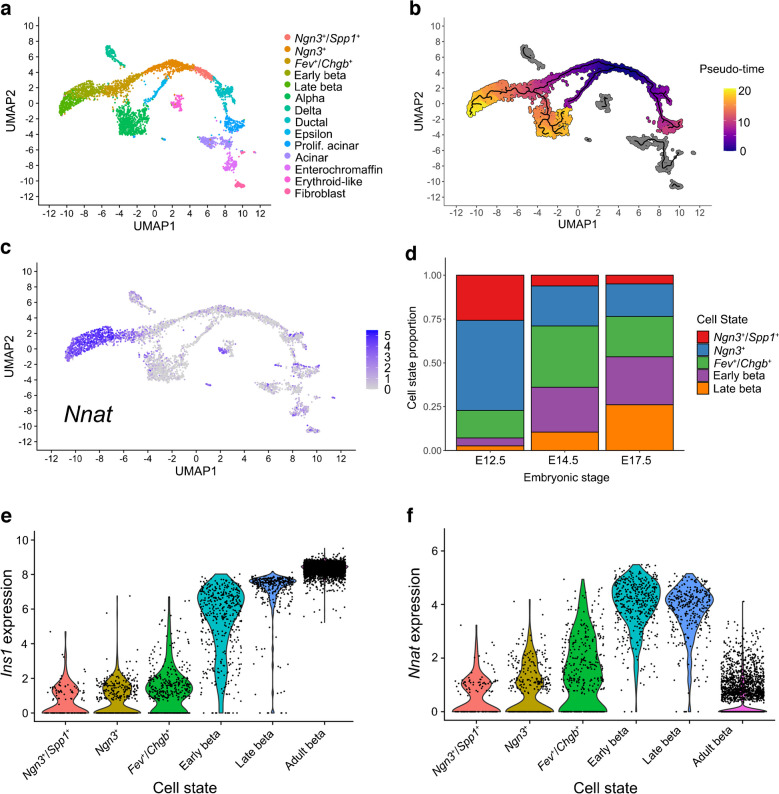
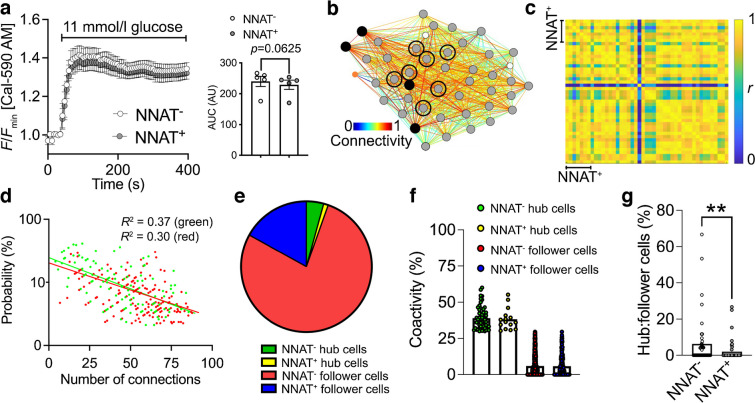
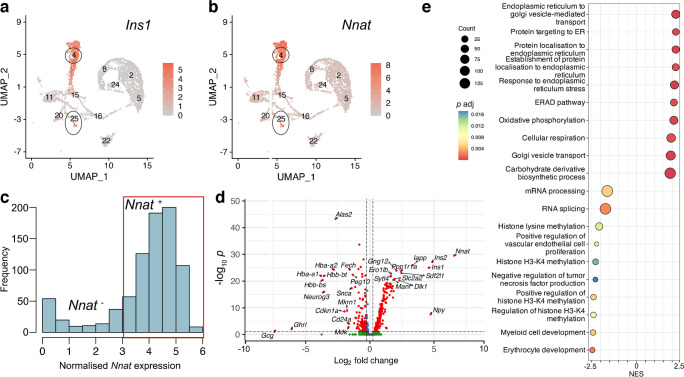
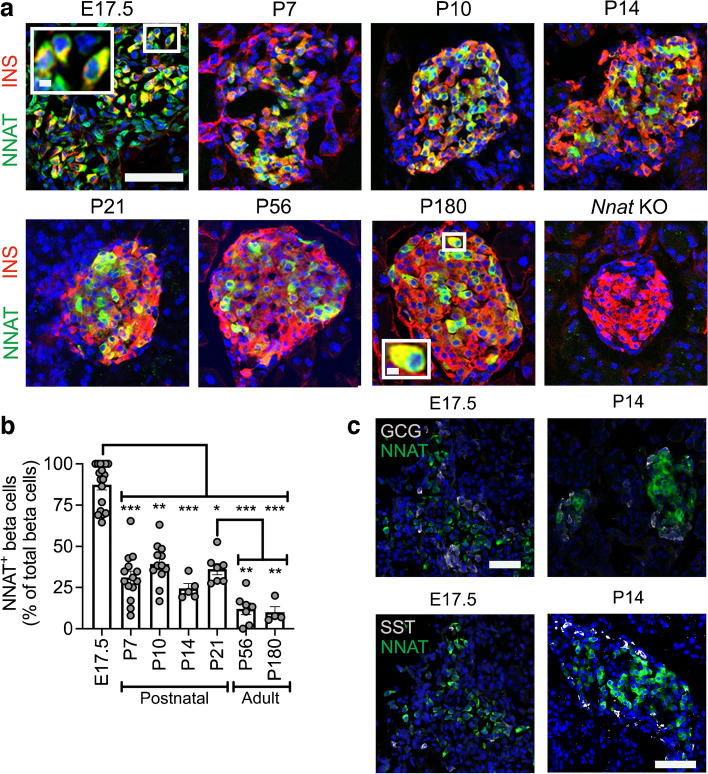
Nnat mRNA was differentially expressed in a discrete beta cell population in a developmental stage- and DNA methylation (DNMT3A)-dependent manner. Thus, pseudo-time analysis of embryonic datasets demonstrated the early establishment of Nnat-positive and -negative subpopulations during embryogenesis. NNAT expression is also restricted to a subset of beta cells across the human islet that is maintained throughout adult life. NNAT beta cells also displayed a discrete transcriptome at adult stages, representing a subpopulation specialised for insulin production, and were diminished in db/db mice. 'Hub' cells were less abundant in the NNAT population, consistent with epigenetic control of this functional specialisation.
CONCLUSIONS/INTERPRETATION: These findings demonstrate that differential DNA methylation at Nnat represents a novel means through which beta cell heterogeneity is established during development. We therefore hypothesise that changes in methylation at this locus may contribute to a loss of beta cell hierarchy and connectivity, potentially contributing to defective insulin secretion in some forms of diabetes.
The mass spectrometry proteomics data have been deposited to the ProteomeXchange Consortium via the PRIDE partner repository with the dataset identifier PXD048465.
目的/假设:胰岛内的β细胞代表一个异质群体,其中单个亚群细胞对胰岛素分泌的整体控制做出独特的贡献。这些亚群包括一群高度连接的“枢纽”细胞,它们对细胞间 Ca 波的传播很重要。在人类β细胞中也已经证明了功能亚群的存在,在 2 型糖尿病中明显存在亚型分布的改变。目前,β细胞层次结构建立的分子机制还知之甚少。表观基因组水平的变化提供了一种可能性,我们在这里通过关注印记基因 Nnat(编码神经元调节蛋白[NNAT])来探索这一可能性,该基因对于正常的胰岛素合成和分泌是必需的。
使用 Seurat 4.0 和在 R 环境下运行的 ClusterProfiler 检查单细胞 RNA-seq 数据集。为了通过流式细胞术分选β细胞,并分别通过亚硫酸氢盐测序和 RNA-seq 分析 CpG 甲基化,生成了在 Nnat 增强子/启动子区域控制下表达增强型 GFP 的转基因小鼠。从胰腺祖细胞阶段删除从头甲基转移酶 DNA 甲基转移酶 3α(DNMT3A)的动物被用于探索启动子甲基化的控制。使用亲和纯化质谱法进行蛋白质组学研究,并通过快速共聚焦成像 Cal-520 AM 和 Cal-590 AM 研究 Ca 动力学。使用均相时间分辨荧光成像测量胰岛素分泌。
Nnat mRNA 在发育阶段和 DNA 甲基化(DNMT3A)依赖性的离散β细胞群体中差异表达。因此,胚胎数据集的伪时间分析表明,在胚胎发生过程中,Nnat 阳性和阴性亚群的早期建立。NNAT 表达也局限于人类胰岛的一部分β细胞,在整个成年期都保持不变。在成年阶段,NNAT 阳性β细胞的转录组也表现出独特性,代表了一个专门用于胰岛素产生的亚群,并且在 db/db 小鼠中减少。在 NNAT 群体中,“枢纽”细胞的丰度较低,这与该功能特化的表观遗传控制一致。
结论/解释:这些发现表明,Nnat 处的差异 DNA 甲基化代表了一种在发育过程中建立β细胞异质性的新方法。因此,我们假设该基因座的甲基化变化可能导致β细胞层次结构和连接性的丧失,从而导致某些形式的糖尿病中胰岛素分泌缺陷。
质谱蛋白质组学数据已通过 PRIDE 合作伙伴数据库通过 ProteomeXchange 联盟提交,数据集标识符为 PXD048465。