Jimoh Olatunji Abubakar, Akinola Micheal Olawale, Oyeyemi Bolaji Fatai, Oyeyemi Wahab Adekunle, Ayodele Simeon Olugbenga, Omoniyi Idowu Samuel, Okin-Aminu Hafsat Ololade
Department of Agricultural Technology, The Federal Polytechnic Ado-Ekiti, Ekiti State 360101, Nigeria.
Molecular Biology Group, Department of Science Technology, The Federal Polytechnic Ado-Ekiti, Ekiti State 360101, Nigeria.
J Anim Sci Technol. 2021 Jan;63(1):46-57. doi: 10.5187/jast.2021.e21. Epub 2021 Jan 31.
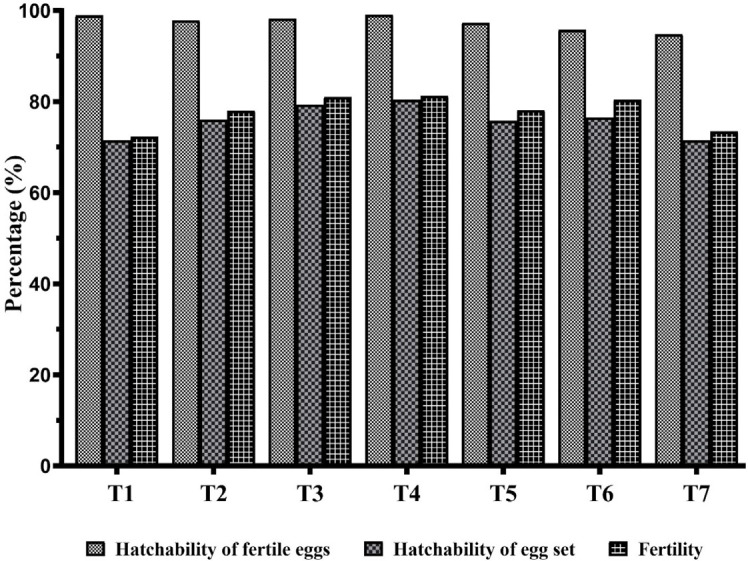
Fruits with antioxidant enrichment can be an economically affordable supplement for mitigating oxidative damage prone spermatozoa membrane pathologies. Computer-assisted sperm analyzer and oxidative status were utilized to evaluate the impact of watermelon () fortification of dextrose saline as diluent for rooster semen and fertility response of hens inseminated. Watermelon juice and dextrose saline were used to formulate diluent of 7 treatments consisting of unextended semen (positive control), 10%, 20%, 30%, 40%, 50% and only dextrose saline (negative control) designated as Treatments 1-7. Pooled semen was obtained from fertile roosters and equilibrated with diluents at ratio 1:2 in the various treatments and were evaluated using computer software coupled microscope and seminal oxidative status assay. 168 laying hens randomly divided into 7 treatment of 8 replicates and 3 hen per replicate. Hen were everted, and semen (2 × 10 Spermatozoa) deposited intra-vagina and eggs collected over 8 weeks to assess fertility and hatchability of eggs laid. The result obtained revealed that watermelon-dextrose saline rooster semen diluent enhanced progressive motility, sperm kinetics and lowered non-progressive motility in T2-T6 compared to T7 over the 3 hours of evaluation. Watermelon addition to rooster semen diluent enhance the antioxidant capacity of rooster semen and lowered lipid peroxide generation. The percentage fertility was highest in T3 (81.01%) and T4 (81.24%) with lowest value obtained in T7 (73.46%). The hatchability of eggs set of hens inseminated with undiluted semen (71.46%) was lower than values for hens inseminated with watermelon inclusive extended semen (75.71%-80.39%). The optimal inclusion of 30%-40% watermelon in dextrose saline diluent enhance rooster semen kinetics, seminal oxidative stability and egg fertility.
富含抗氧化剂的水果可以成为一种经济实惠的补充剂,用于减轻易受氧化损伤的精子细胞膜病变。利用计算机辅助精子分析仪和氧化状态来评估西瓜()强化葡萄糖盐水作为公鸡精液稀释剂的效果以及授精母鸡的生育反应。西瓜汁和葡萄糖盐水用于配制7种处理的稀释剂,包括未稀释精液(阳性对照)、10%、20%、30%、40%、50%以及仅葡萄糖盐水(阴性对照),分别指定为处理1 - 7。从可育公鸡获取混合精液,并在各种处理中以1:2的比例与稀释剂平衡,然后使用计算机软件结合显微镜和精液氧化状态测定法进行评估。168只产蛋母鸡随机分为7组,每组8个重复,每个重复3只母鸡。将母鸡翻肛,向阴道内注入精液(2×10精子),并在8周内收集鸡蛋,以评估所产鸡蛋的受精率和孵化率。所得结果表明,在3小时的评估过程中,与处理7相比,西瓜 - 葡萄糖盐水公鸡精液稀释剂在处理2 - 6中提高了精子的前向运动率、精子动力学,并降低了非前向运动率。向公鸡精液稀释剂中添加西瓜可提高公鸡精液的抗氧化能力并降低脂质过氧化物的产生。受精率最高的是处理3(81.01%)和处理4(81.24%),处理7中获得的值最低(73.46%)。用未稀释精液授精的母鸡所产种蛋的孵化率(71.46%)低于用含西瓜的稀释精液授精的母鸡的值(75.71% - 80.39%)。在葡萄糖盐水稀释剂中最佳添加30% - 40%的西瓜可提高公鸡精液动力学、精液氧化稳定性和蛋的受精率。