Touchard Cyril, Cartailler Jérôme, Vellieux Geoffroy, de Montmollin Etienne, Jaquet Pierre, Wanono Ruben, Reuter Jean, Para Marylou, Bouadma Lila, Timsit Jean-François, d'Ortho Marie-Pia, Kubis Nathalie, Rouvel Tallec Anny, Sonneville Romain
Department of Anesthesiology and Intensive Care, APHP, Lariboisière-Saint Louis Hospitals, 75010, Paris, France.
Inserm, UMRS-942, Paris Diderot University, Paris, France.
Ann Intensive Care. 2021 May 13;11(1):76. doi: 10.1186/s13613-021-00854-0.
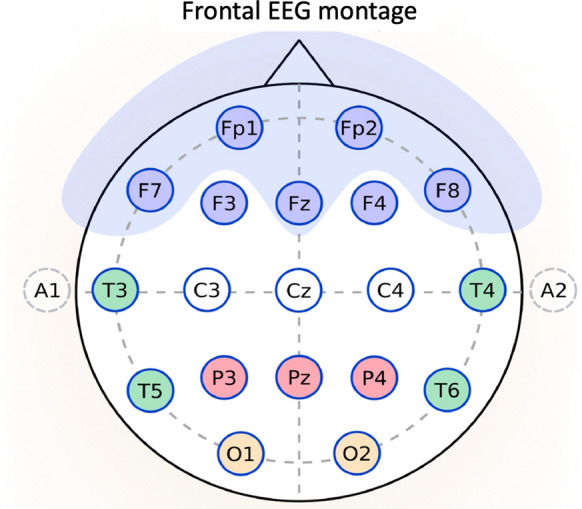
EEG-based prognostication studies in intensive care units often rely on a standard 21-electrode montage (EEG) requiring substantial human, technical, and financial resources. We here evaluate whether a simplified 4-frontal electrode montage (EEG) can detect EEG patterns associated with poor outcomes in adult patients under veno-arterial extracorporeal membrane oxygenation (VA-ECMO).
We conducted a reanalysis of EEG data from a prospective cohort on 118 adult patients under VA-ECMO, in whom EEG was performed on admission to intensive care. EEG patterns of interest included background rhythm, discontinuity, reactivity, and the Synek's score. They were all reassessed by an intensivist on a EEG montage, whose analysis was then compared to an expert's interpretation made on EEG recordings. The main outcome measure was the degree of correlation between EEG and EEG montages to identify EEG patterns of interest. The performance of the Synek scores calculated on EEG and EEG montage to predict outcomes (i.e., 28-day mortality and 90-day Rankin score [Formula: see text]) was investigated in a secondary exploratory analysis.
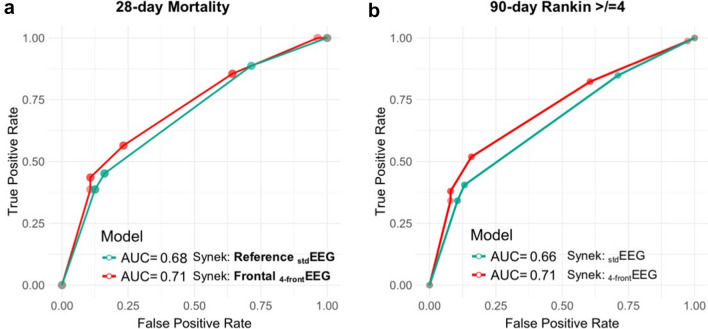
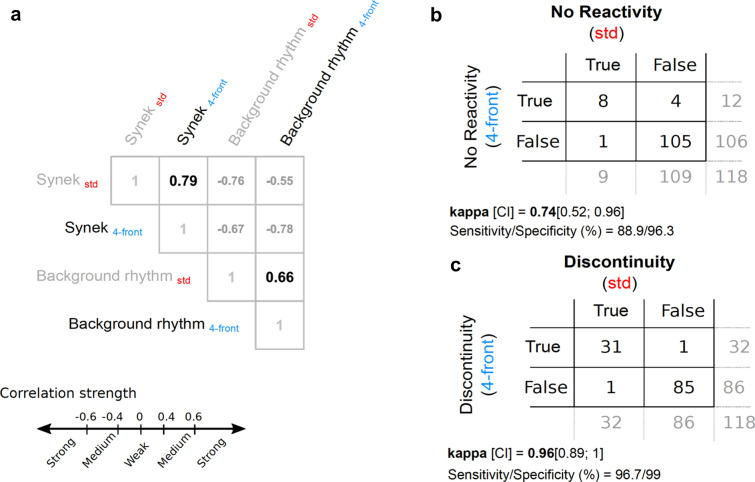
The detection of EEG patterns using EEG was statistically similar to that of EEG for background rhythm (Spearman rank test, ρ = 0.66, p < 0.001), discontinuity (Cohen's kappa, [Formula: see text] = 0.955), reactivity ([Formula: see text] = 0.739) and the Synek's score (ρ = 0.794, p < 0.001). Using the Synek classification, we found similar performances between EEG and EEG montages in predicting 28-day mortality (AUC EEG 0.71, AUC EEG 0.68) and for 90-day poor neurologic outcome (AUC EEG 0.71, AUC EEG 0.66). An exploratory analysis confirmed that the Synek scores determined by 4 or 21 electrodes were independently associated with 28-day mortality and poor 90-day functional outcome.
In adult patients under VA-ECMO, a simplified 4-frontal electrode EEG montage interpreted by an intensivist, detected common EEG patterns associated with poor outcomes, with a performance similar to that of a standard EEG montage interpreted by expert neurophysiologists. This simplified montage could be implemented as part of a multimodal evaluation for bedside prognostication.
重症监护病房中基于脑电图的预后研究通常依赖于标准的21电极导联脑电图,这需要大量的人力、技术和财力资源。我们在此评估一种简化的4额叶电极导联脑电图能否检测到静脉-动脉体外膜肺氧合(VA-ECMO)成年患者预后不良相关的脑电图模式。
我们对118例接受VA-ECMO的成年患者的前瞻性队列脑电图数据进行了重新分析,这些患者在入住重症监护病房时进行了脑电图检查。感兴趣的脑电图模式包括背景节律、间断性、反应性和西内克评分。一名重症监护医生在脑电图导联上对这些模式进行了重新评估,然后将其分析结果与专家对脑电图记录的解读进行比较。主要结局指标是脑电图与脑电图导联之间的相关程度,以识别感兴趣的脑电图模式。在二次探索性分析中,研究了根据脑电图和脑电图导联计算的西内克评分预测结局(即28天死亡率和90天改良Rankin量表评分[公式:见原文])的性能。
使用脑电图检测脑电图模式在背景节律(Spearman秩相关检验,ρ = 0.66,p < 0.001)、间断性(Cohen's κ系数,[公式:见原文] = 0.955)、反应性([公式:见原文] = 0.739)和西内克评分(ρ = 0.794,p < 0.001)方面与使用脑电图导联在统计学上相似。使用西内克分类法,我们发现脑电图和脑电图导联在预测28天死亡率(脑电图曲线下面积0.71,脑电图导联曲线下面积0.68)和90天神经功能不良结局(脑电图曲线下面积0.71,脑电图导联曲线下面积0.66)方面表现相似。一项探索性分析证实,由4个或21个电极确定的西内克评分与28天死亡率和90天功能不良结局独立相关。
在接受VA-ECMO的成年患者中,由重症监护医生解读的简化额叶4电极脑电图导联能够检测到与预后不良相关的常见脑电图模式,其性能与专家神经生理学家解读的标准脑电图导联相似。这种简化导联可作为床旁预后多模式评估的一部分实施。