University of Crete, Medical Faculty, Department of Pathology-Cytopathology .
University of Crete, Medical Faculty, Department of Gastrenterology.
Acta Biomed. 2021 May 12;92(2):e2021106. doi: 10.23750/abm.v92i2.9482.
Osteoclast-like giant cell tumours are rare abdominal malignant neoplasms mainly arising in the pancreas. Because of their rarity, clinical and cytopathology reports are very limited, and sonographic features have not been clearly specified ; these tumors are easily misdiagnosed by ultrasound as mucinous cystic tumors (MCTs) or solid pseudopapillary neoplasms (SPNs).
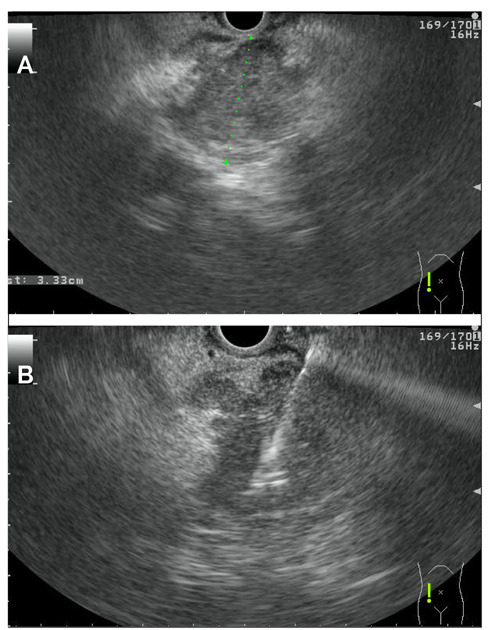
We report a case of osteoclast like giant cell tumor arising in the pancreas of an 80 year old female patient offered by EUS-FNA cytology on direct and cell block slides. A biphasic pattern composed by a malignant mononuclear cell component and a giant cell component were hallmarks to the diagnosis.
Our case highlights the performance of EUS-FNA in the diagnostic approach of abdominal tumours and the significance of cell block method in the interpretation of osteoclast-like giant cell pancreatic tumour.
破骨细胞样巨细胞瘤是一种罕见的腹部恶性肿瘤,主要发生在胰腺。由于其罕见性,临床和细胞病理学报告非常有限,超声特征也没有明确说明;这些肿瘤很容易被超声误诊为黏液性囊腺瘤(MCT)或实性假乳头状瘤(SPN)。
我们报告了一例发生在 80 岁女性胰腺的破骨细胞样巨细胞瘤病例,该患者经超声内镜引导下细针抽吸细胞学检查(EUS-FNA)直接涂片和细胞块切片。一个由恶性单核细胞成分和巨细胞成分组成的双相模式是诊断的特征。
我们的病例强调了 EUS-FNA 在腹部肿瘤诊断方法中的作用,以及细胞块方法在解释胰腺破骨细胞样巨细胞瘤中的重要性。