Department of Pediatrics, Center for Lysosomal and Metabolic Diseases, Erasmus MC, University Medical Center Rotterdam, PO Box 2040, 3000 CA, Rotterdam, The Netherlands.
Department of Pediatric Physiotherapy, Erasmus MC, University Medical Center Rotterdam, Rotterdam, The Netherlands.
Orphanet J Rare Dis. 2021 May 14;16(1):221. doi: 10.1186/s13023-021-01858-6.
Neuronal ceroid lipofuscinosis type 2 (CLN2 disease) is a rare rapidly progressive neurodegenerative disorder, resulting in early death. Intracerebroventricular enzyme replacement therapy (ERT) with cerliponase alfa is now available and has shown to delay disease progression in symptomatic patients. It is yet unknown if cerliponase alfa can prevent disease onset in presymptomatic patients.
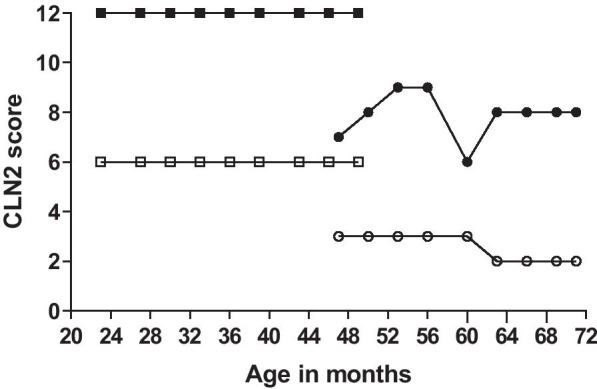
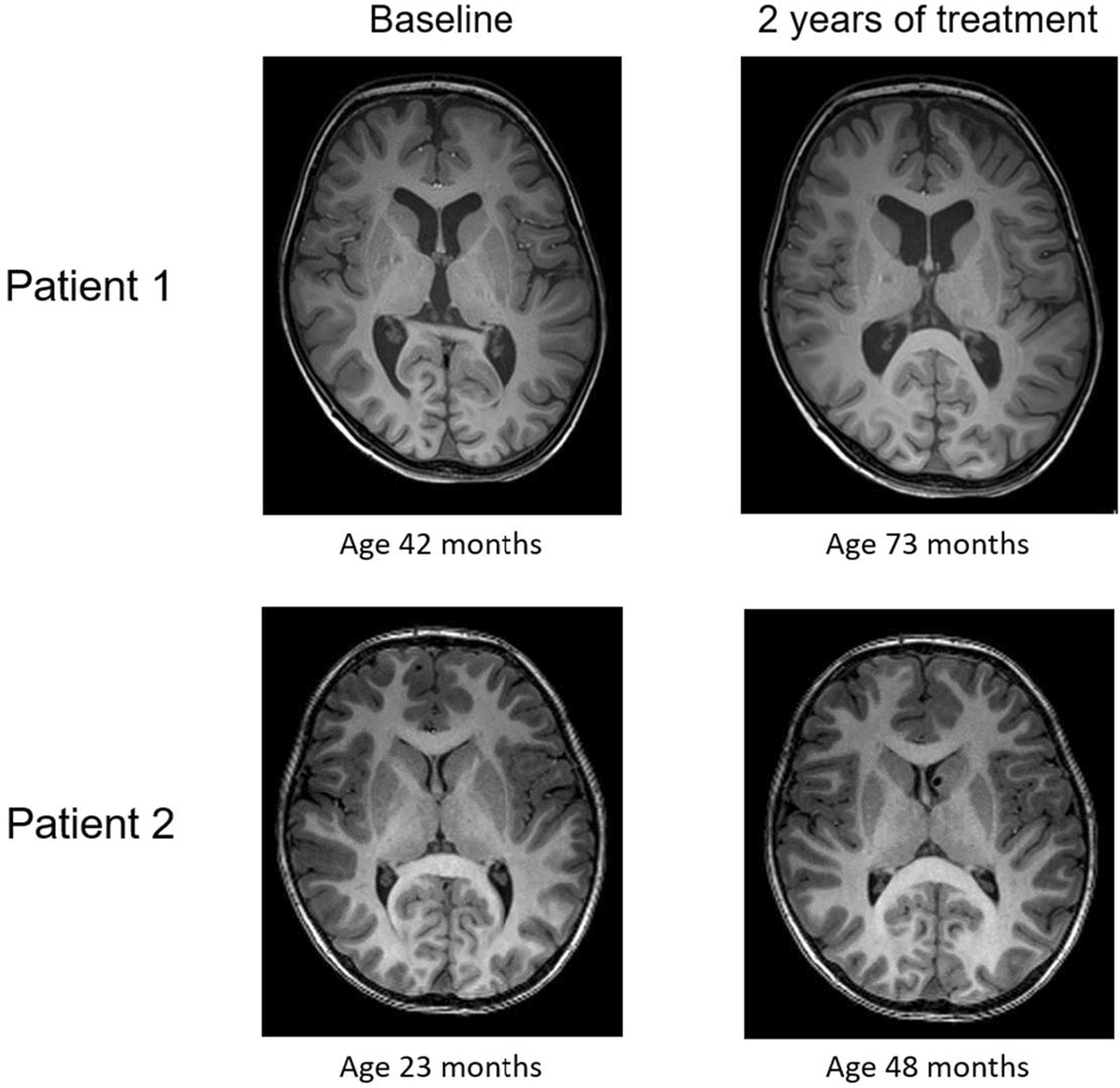
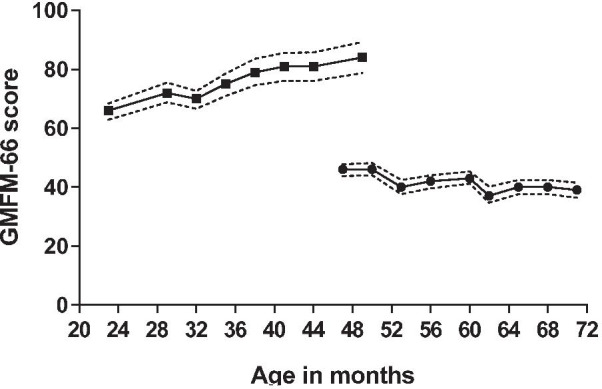
We evaluated the effect of 2 years of intracerebroventricular ERT in two siblings with CLN2 disease, one symptomatic (age 47 months) and one presymptomatic (age 23 months) at treatment start, using the CLN2 Clinical Rating Scale (CLN2 CRS), Gross Motor Function Measure-66 (GMFM-66) for motor function, Bayley Scales of Infant and Toddler Development, 3rd Edition, Dutch (BSID-III-NL) for neurocognitive development, brain MRI, and visual evoked potentials (VEP), electroretinogram (ERG) and retinoscopy for visual function. On the CLN2 CRS patient 1 showed a decline from 3 to 2 in the combined motor and language score due to regression in language use (CLN2 CRS total score after 2 years of treatment: 8), whereas a decline of 2 or more points in the combined motor and language score would be expected without treatment. Patient 2 retained the maximum score of 3 in all 4 subdomains (CLN2 CRS total score after 2 years of treatment: 12). The GMFM-66 total score declined from 46 to 39 in patient 1 and showed an age-appropriate increase from 66 to 84 in patient 2. Cognitive-developmental age decreased from 24 to 11 months in patient 1, whereas an increase in cognitive-developmental age from 21 to 39 months was seen in patient 2. Cerebral and cerebellar atrophy observed on MRI in patient 1 at age 42 months (before treatment) was not observed in patient 2 at age 48 months (after 2 years of treatment).
We show that cerliponase alfa is able to delay the onset of symptoms when treatment is started in a presymptomatic stage of CLN2 disease. Our results advocate the start of treatment at an early age before symptom onset, but should be confirmed in a larger cohort study.
神经元蜡样脂褐质沉积症 2 型(CLN2 病)是一种罕见的快速进展性神经退行性疾病,导致早期死亡。脑室内酶替代疗法(ERT)用 cerliponase alfa 现已上市,并已证明可延迟有症状患者的疾病进展。尚不清楚 cerliponase alfa 是否可以预防无症状患者的疾病发作。
我们使用 CLN2 临床评分量表(CLN2 CRS)、粗大运动功能测量-66(GMFM-66)评估了 2 名 CLN2 疾病患者 2 年脑室内 ERT 的效果,其中 1 名有症状(治疗开始时年龄为 47 个月),1 名无症状(治疗开始时年龄为 23 个月),Bayley 婴儿和幼儿发育量表,第 3 版,荷兰语(BSID-III-NL)用于神经认知发育,脑 MRI 和视觉诱发电位(VEP),视网膜电图(ERG)和视网膜检查用于视觉功能。在 CLN2 CRS 上,患者 1 的语言使用出现倒退,导致运动和语言综合评分从 3 下降到 2(治疗 2 年后的 CLN2 CRS 总评分:8),而没有治疗的话,预计综合运动和语言评分会下降 2 分或更多。患者 2 在所有 4 个亚域中均保持最大得分为 3(治疗 2 年后的 CLN2 CRS 总评分:12)。GMFM-66 总分从患者 1 的 46 下降到 39,而患者 2 的年龄适宜的增加从 66 增加到 84。患者 1 的认知发育年龄从 24 个月下降到 11 个月,而患者 2 的认知发育年龄从 21 个月增加到 39 个月。患者 1 在 42 个月(治疗前)时的 MRI 上观察到的大脑和小脑萎缩在患者 2 时的 48 个月(治疗 2 年后)时未观察到。
我们表明,当在 CLN2 疾病的无症状阶段开始治疗时,cerliponase alfa 能够延迟症状的发作。我们的结果主张在症状出现之前的早期开始治疗,但应在更大的队列研究中得到证实。