From the Elizabeth Glaser Pediatric AIDS Foundation, Maseru, Lesotho.
Department of Biostatistics and Bioinformatics, George Washington University Milken Institute School of Public Health, Washington, District of Columbia.
Pediatr Infect Dis J. 2021 Sep 1;40(9):821-826. doi: 10.1097/INF.0000000000003174.
Without treatment, HIV infection in pregnant women is associated with adverse pregnancy outcomes. We compared adverse pregnancy outcomes among HIV-positive women on antiretroviral therapy (ART) and HIV-negative women who enrolled for antenatal care in selected health facilities in Maseru district, Lesotho.
We enrolled a cohort of HIV-positive and HIV-negative women at their first antenatal visit and followed them through delivery. Study data on miscarriage, stillbirth, preterm birth, low birth weight and birth defects were collected through participant interviews and medical record abstraction. We used the Rao-Scott χ2 test and the t test to assess differences in characteristics and outcomes between HIV-positive and HIV-negative women and generalized estimating equations for multivariable analysis.
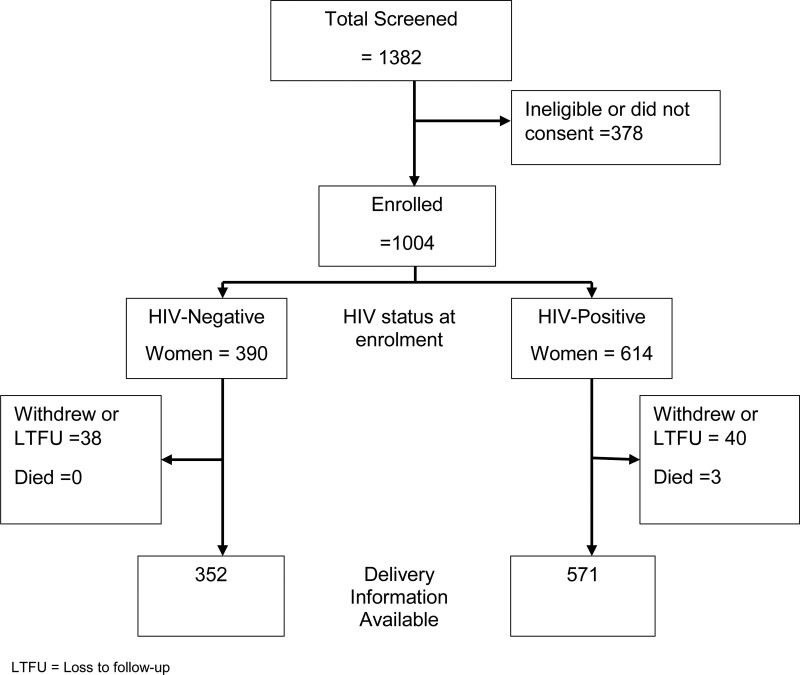
A total of 614 HIV-positive and 390 HIV-negative pregnant women were enrolled in the study with delivery information on 571 (93.1%) and 352 (90.3%) respectively. In the delivery cohort, the median age at enrolment was 28 years for HIV-positive women and 23 years for HIV-negative women with median gestational ages of 20 and 21 weeks, respectively. A total of 149 singleton pregnancies had documented adverse pregnancy outcomes; 33 (9.6%) HIV-negative pregnancies and 116 (20.6%) HIV-positive pregnancies. Compared with their HIV-negative counterparts, HIV-positive women were more likely to experience an adverse pregnancy outcome, adjusted odds ratio (AOR) 2.6 [95% confidence interval (CI): 1.71-3.97]; an intrauterine death (miscarriage or stillbirth), AOR 2.64 [95% CI: 1.25-5.49]; or a low birth weight delivery, AOR 1.89 [95% CI: 1.16-3.09].
Adverse pregnancy outcomes remained 2-3 times higher among HIV-positive women compared with HIV-negative women despite universal ART.
未经治疗的孕妇 HIV 感染与不良妊娠结局相关。我们比较了在莱索托马塞卢区选定保健机构接受产前护理的抗逆转录病毒治疗 (ART) 艾滋病病毒阳性妇女与艾滋病病毒阴性妇女的不良妊娠结局。
我们在首次产前就诊时招募了一组 HIV 阳性和 HIV 阴性妇女,并对她们进行了分娩随访。通过参与者访谈和病历摘录收集了流产、死胎、早产、低出生体重和出生缺陷的研究数据。我们使用 Rao-Scott χ2 检验和 t 检验评估 HIV 阳性和 HIV 阴性妇女的特征和结局差异,并使用广义估计方程进行多变量分析。
共有 614 名 HIV 阳性和 390 名 HIV 阴性孕妇入组研究,分别有 571 名(93.1%)和 352 名(90.3%)孕妇分娩。在分娩队列中,HIV 阳性妇女的中位年龄为 28 岁,HIV 阴性妇女为 23 岁,中位孕龄分别为 20 周和 21 周。共有 149 例单胎妊娠有不良妊娠结局记录;33 例(9.6%)HIV 阴性妊娠和 116 例(20.6%)HIV 阳性妊娠。与 HIV 阴性孕妇相比,HIV 阳性孕妇发生不良妊娠结局的调整比值比(AOR)为 2.6(95%置信区间:1.71-3.97);宫内死亡(流产或死胎)的 AOR 为 2.64(95%置信区间:1.25-5.49);或低出生体重分娩的 AOR 为 1.89(95%置信区间:1.16-3.09)。
尽管普遍使用 ART,HIV 阳性妇女的不良妊娠结局仍比 HIV 阴性妇女高 2-3 倍。