Department of Neurology, David Geffen School of Medicine, University of California, Los Angeles, CA, 90095, USA.
Division of Peptide Biochemistry, Technical University of Munich, 85354, Freising, Germany.
Acta Neuropathol. 2021 Sep;142(3):495-511. doi: 10.1007/s00401-021-02324-0. Epub 2021 May 15.
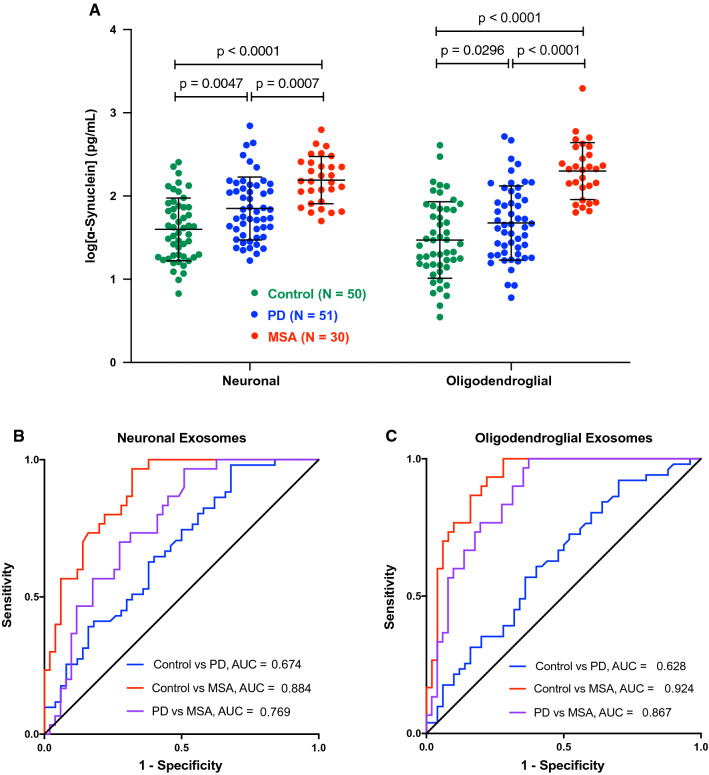
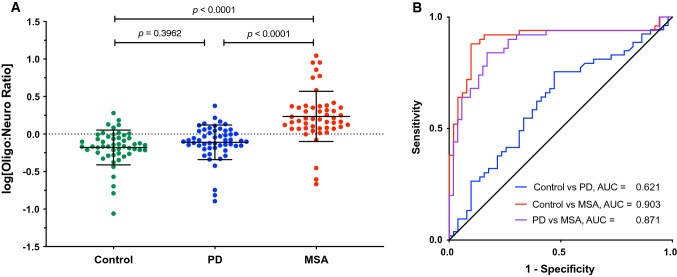
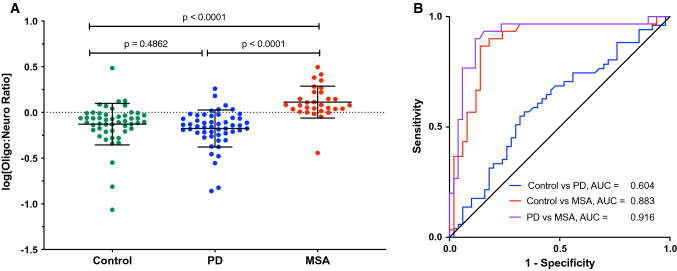
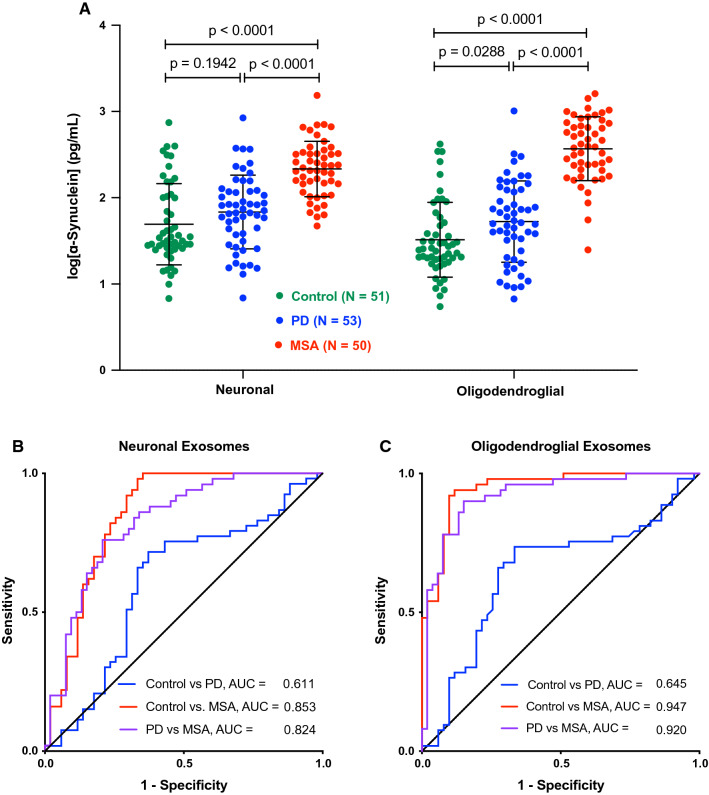
The diagnosis of Parkinson's disease (PD) and atypical parkinsonian syndromes is difficult due to the lack of reliable, easily accessible biomarkers. Multiple system atrophy (MSA) is a synucleinopathy whose symptoms often overlap with PD. Exosomes isolated from blood by immunoprecipitation using CNS markers provide a window into the brain's biochemistry and may assist in distinguishing between PD and MSA. Thus, we asked whether α-synuclein (α-syn) in such exosomes could distinguish among healthy individuals, patients with PD, and patients with MSA. We isolated exosomes from the serum or plasma of these three groups by immunoprecipitation using neuronal and oligodendroglial markers in two independent cohorts and measured α-syn in these exosomes using an electrochemiluminescence ELISA. In both cohorts, α-syn concentrations were significantly lower in the control group and significantly higher in the MSA group compared to the PD group. The ratio between α-syn concentrations in putative oligodendroglial exosomes compared to putative neuronal exosomes was a particularly sensitive biomarker for distinguishing between PD and MSA. Combining this ratio with the α-syn concentration itself and the total exosome concentration, a multinomial logistic model trained on the discovery cohort separated PD from MSA with an AUC = 0.902, corresponding to 89.8% sensitivity and 86.0% specificity when applied to the independent validation cohort. The data demonstrate that a minimally invasive blood test measuring α-syn in blood exosomes immunoprecipitated using CNS markers can distinguish between patients with PD and patients with MSA with high sensitivity and specificity. Future optimization and validation of the data by other groups would allow this strategy to become a viable diagnostic test for synucleinopathies.
帕金森病(PD)和非典型帕金森综合征的诊断由于缺乏可靠、易于获取的生物标志物而变得困难。多系统萎缩(MSA)是一种突触核蛋白病,其症状经常与 PD 重叠。使用中枢神经系统标志物通过免疫沉淀从血液中分离的外泌体提供了一个了解大脑生物化学的窗口,并可能有助于区分 PD 和 MSA。因此,我们询问了使用 CNS 标志物通过免疫沉淀从这三组患者的血清或血浆中分离出的外泌体中的α-突触核蛋白(α-syn)是否可以区分健康个体、PD 患者和 MSA 患者。我们在两个独立的队列中使用神经元和少突胶质细胞标志物通过免疫沉淀从这三组患者的血清或血浆中分离出外泌体,并使用电化学发光 ELISA 测量这些外泌体中的α-syn。在两个队列中,与 PD 组相比,对照组的α-syn 浓度显著降低,MSA 组的α-syn 浓度显著升高。与假定神经元外泌体相比,假定少突胶质细胞外泌体中的α-syn 浓度的比值是区分 PD 和 MSA 的一种特别敏感的生物标志物。将该比值与 α-syn 浓度本身和总外泌体浓度相结合,使用发现队列中训练的多项式逻辑模型将 PD 与 MSA 区分开来,AUC 值为 0.902,当应用于独立验证队列时,其敏感性为 89.8%,特异性为 86.0%。该数据表明,使用 CNS 标志物通过免疫沉淀测量血液外泌体中的α-syn 的微创血液检测可以以高灵敏度和特异性区分 PD 患者和 MSA 患者。其他小组对数据的进一步优化和验证将使该策略成为一种可行的突触核蛋白病诊断测试。