Lv Bin, Jing Feng, Tian Cheng-Lin, Liu Jian-Chao, Wang Jun, Cao Xiang-Yu, Liu Xin-Feng, Yu Sheng-Yuan
Department of Neurology, Chinese PLA General Hospital, Beijing, China.
Department of Medical Statistics, Chinese PLA General Hospital, Beijing, China.
J Korean Neurosurg Soc. 2021 May;64(3):418-426. doi: 10.3340/jkns.2020.0247. Epub 2021 Apr 30.
A role of diffusion-weighted imaging (DWI) in the diagnosis of cerebral venous thrombosis (CVT) is not wellunderstood. This study evaluates the effectiveness of DWI in the diagnosis of CVT.
Literature search was conducted in electronic databases for the identification of studies which reported the outcomes of patients subjected to DWI for CVT diagnosis. Random-effects meta-analyses were performed to achieve overall estimates of important diagnostic efficiency indices including hyperintense signal rate, the sensitivity and specificity of DWI in diagnosing CVT, and the apparent diffusion coefficient (ADC) of DWI signal areas and surrounding tissue.
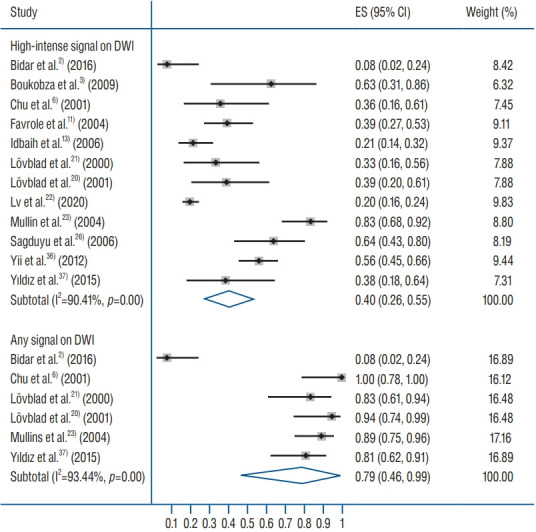
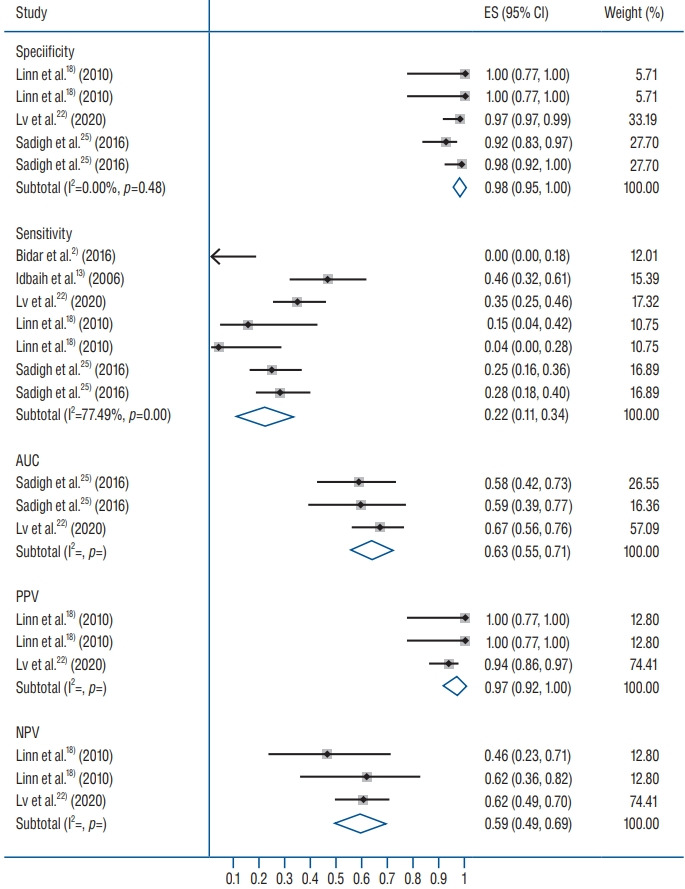
Nineteen studies (443 patients with 856 CVTs; age 40 years [95% confidence interval (CI), 33 to 43]; 28% males [95% CI, 18 to 38]; symptom onset to DWI time 4.6 days [95% CI, 2.3 to 6.9]) were included. Hyperintense signals on DWI were detected in 40% (95% CI, 26 to 55) of the cases. The sensitivity of DWI for detecting CVT was 22% (95% CI, 11 to 34) but specificity was 98% (95% CI, 95 to 100). ADC values were quite heterogenous in DWI signal areas. However, generally the ADC values were lower in DWI signal areas than in surrounding normal areas (mean difference-0.33×10⁻³ mm2/s [95% CI, -0.44 to -0.23]; p<0.00001).
DWI has a low sensitivity in detecting CVT and thus has a high risk of missing many CVT cases. However, because of its high specificity, it may have supporting and exploratory roles in CVT diagnosis.
弥散加权成像(DWI)在脑静脉血栓形成(CVT)诊断中的作用尚未完全明确。本研究评估DWI在CVT诊断中的有效性。
在电子数据库中进行文献检索,以识别报告了接受DWI进行CVT诊断的患者结果的研究。进行随机效应荟萃分析,以获得重要诊断效率指标的总体估计值,包括高信号率、DWI诊断CVT的敏感性和特异性,以及DWI信号区域和周围组织的表观扩散系数(ADC)。
纳入19项研究(443例患者,共856处CVT;年龄40岁[95%置信区间(CI),33至43];28%为男性[95%CI,18至38];症状出现至进行DWI的时间为4.6天[95%CI,2.3至6.9])。40%(95%CI,26至55)的病例在DWI上检测到高信号。DWI检测CVT的敏感性为22%(95%CI,11至34),但特异性为98%(95%CI,95至100)。DWI信号区域的ADC值差异很大。然而,一般来说,DWI信号区域的ADC值低于周围正常区域(平均差异为-0.33×10⁻³mm2/s[95%CI,-0.44至-0.23];p<0.00001)。
DWI在检测CVT方面敏感性较低,因此漏诊许多CVT病例的风险较高。然而,由于其高特异性,它可能在CVT诊断中具有辅助和探索作用。