Christe Guillaume, Darlow Ben, Pichonnaz Claude
Department of Physiotherapy, HESAV School of Health Sciences, HES-SO University of Applied Sciences and Arts Western Switzerland, Lausanne, Switzerland.
Swiss BioMotion Lab, Department of Musculoskeletal Medicine, University Hospital and University of Lausanne (CHUV-UNIL), Lausanne, Switzerland.
Arch Physiother. 2021 May 17;11(1):13. doi: 10.1186/s40945-021-00106-1.
Implementation of best-practice care for patients with low back pain (LBP) is an important issue. Physiotherapists' who hold unhelpful beliefs are less likely to adhere to guidelines and may negatively influence their patients' beliefs. Pre-registration education is critical in moving towards a biopsychosocial model of care. This study aimed to investigate the changes in 2nd year physiotherapy students' beliefs about LBP after a module on spinal pain management and determine whether these changes were maintained at the end of academic training.
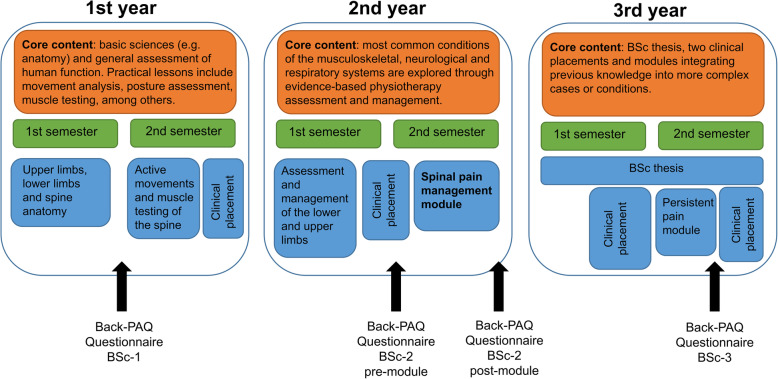
During three consecutive calendar years, this longitudinal cohort study assessed physiotherapy students' beliefs with the Back Pain Attitudes Questionnaires (Back-PAQ) in their 1st year, before and after their 2nd year spinal management learning module, and at the end of academic training (3rd year). Unpaired t-tests were conducted to explore changes in Back-PAQ score.
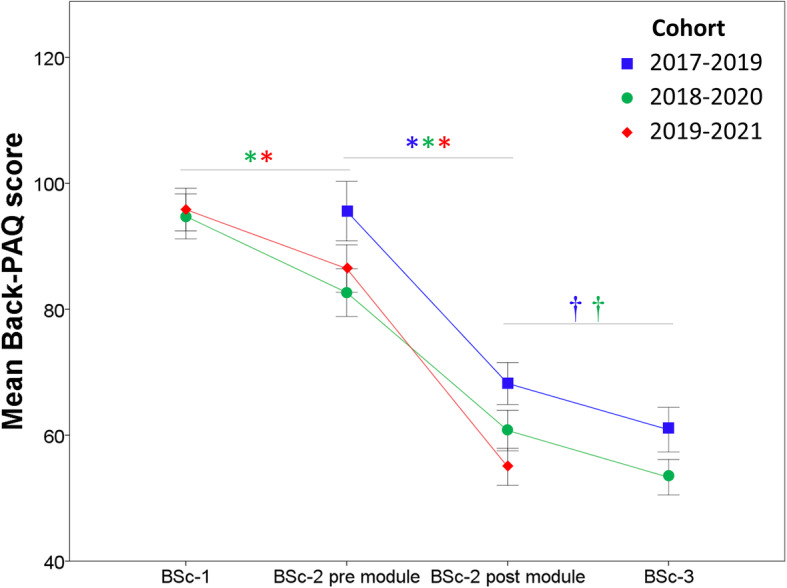
The mean response rate after the spinal management module was 90% (128/143 students). The mean (± SD) Back-PAQ score was 87.73 (± 14.21) before and 60.79 (± 11.44) after the module, representing a mean difference of - 26.95 (95%CI - 30.09 to - 23.80, p < 0.001). Beliefs were further improved at the end of 3rd year (- 7.16, 95%CI - 10.50 to - 3.81, p < 0.001).
A spinal management learning module considerably improved physiotherapy students' beliefs about back pain. Specifically, unhelpful beliefs about the back being vulnerable and in need of protection were substantially decreased after the module. Improvements were maintained at the end of academic training one-year later. Future research should investigate whether modifying students' beliefs leads to improved clinical practice in their first years of practice.
为腰痛(LBP)患者实施最佳实践护理是一个重要问题。持有无益信念的物理治疗师不太可能遵守指南,并且可能对其患者的信念产生负面影响。预注册教育对于迈向生物心理社会护理模式至关重要。本研究旨在调查物理治疗专业二年级学生在接受脊柱疼痛管理模块培训后对腰痛信念的变化,并确定这些变化在学术培训结束时是否得以维持。
在连续三个日历年中,这项纵向队列研究使用背痛态度问卷(Back-PAQ)在物理治疗专业学生第一年、第二年脊柱管理学习模块前后以及学术培训结束时(第三年)评估他们的信念。进行非配对t检验以探讨Back-PAQ评分的变化。
脊柱管理模块后的平均回复率为90%(128/143名学生)。模块前Back-PAQ评分的平均值(±标准差)为87.73(±14.21),模块后为60.79(±11.44),平均差异为-26.95(95%CI -30.09至-23.80,p<0.001)。在第三年结束时信念进一步改善(-7.16,95%CI -10.50至-3.81,p<0.001)。
脊柱管理学习模块显著改善了物理治疗专业学生对背痛的信念。具体而言,关于背部易受伤且需要保护的无益信念在该模块后大幅减少。一年后的学术培训结束时,改善得以维持。未来的研究应调查改变学生的信念是否会在他们执业的第一年改善临床实践。