School of Kinesiology and Health Studies, Queen's University, Kingston, ON K7L 3N6, Canada.
School of Kinesiology and Health Studies, Queen's University, Kingston, ON K7L 3N6, Canada; Department of Public Health Sciences, Queen's University, Kingston, ON K7L 3N6, Canada.
J Sport Health Sci. 2021 May;10(3):368-378. doi: 10.1016/j.jshs.2019.06.006. Epub 2019 Jun 18.
The purpose of this study was to determine which intensities, patterns, and types of 24-h movement behaviors are most strongly associated with cardiometabolic risk factors among children.
A total of 369 children aged 10-13 years were studied. Participants wore an Actical accelerometer and a Garmin Forerunner 220 Global Positioning System logger and completed an activity and sleep log for 7 days. Data from these instruments were combined to estimate average minute per day spent in 14 intensities, 11 types, and 14 patterns of movement. Body mass index, resting heart rate, and systolic blood pressure values were combined to create a cardiometabolic risk factor score. Partial least squares regression analysis was used to examine associations between the 39 movement behavior characteristics and the cardiometabolic risk factor score. The variable importance in projection (VIP) values were used to determine and rank important movement behavior characteristics. There was evidence of interaction by biological maturity, and the analyses were conducted separately in the 50% least mature and 50% most mature participants.
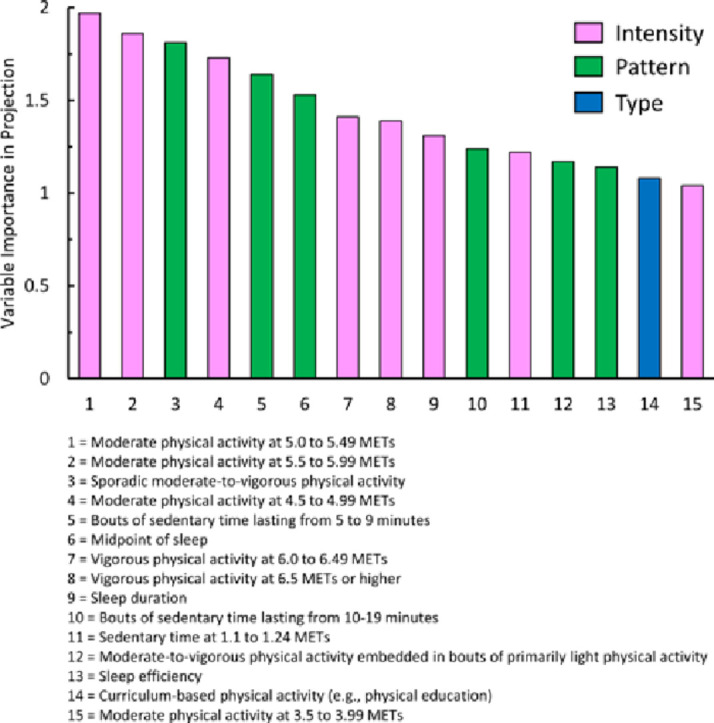
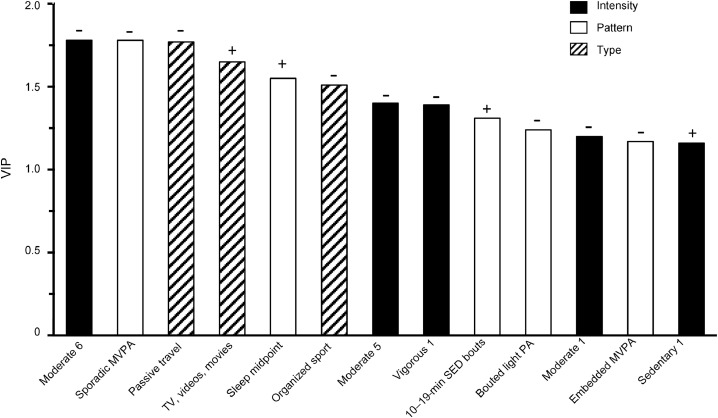
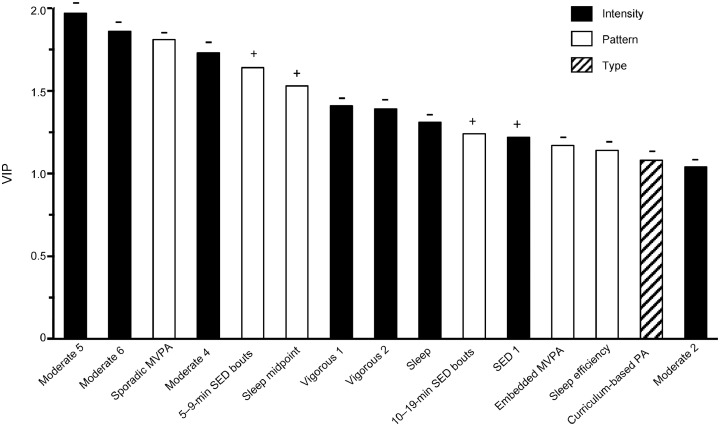
For the least biologically mature participants, fifteen of the 39 movement behavior characteristics had important VIP value scores; eight of these reflected movement intensities (particularly moderate and vigorous intensities), six reflected movement patterns, and one reflected a movement type. For the most mature participants, thirteen of the 39 movement behavior characteristics had important VIP value scores, with five reflecting intensities (particularly moderate and vigorous intensities), five reflecting patterns, and three reflecting types of movement.
More than 12 movement behavior characteristics were associated with cardiometabolic risk factors within both the most and least mature participants. Movement intensities within the moderate and vigorous intensity ranges were the most consistent correlates of these risk factors.
本研究旨在确定儿童 24 小时运动行为的哪些强度、模式和类型与心血管代谢危险因素的关联最强。
共有 369 名 10-13 岁的儿童参与了研究。参与者佩戴 Actical 加速度计和 Garmin Forerunner 220 全球定位系统记录仪,并完成了 7 天的活动和睡眠日志。这些仪器的数据被合并在一起,以估计每天平均每分钟的 14 个强度、11 种类型和 14 种运动模式。体重指数、静息心率和收缩压值被组合在一起,形成心血管代谢风险因素评分。偏最小二乘法回归分析用于研究 39 种运动行为特征与心血管代谢风险因素评分之间的关联。投影变量重要性(VIP)值用于确定和排名重要的运动行为特征。生物成熟度存在交互作用的证据,分析分别在最不成熟和最成熟的 50%参与者中进行。
对于最不成熟的参与者,39 种运动行为特征中有 15 种具有重要的 VIP 值分数;其中 8 种反映了运动强度(特别是中等和剧烈强度),6 种反映了运动模式,1 种反映了运动类型。对于最成熟的参与者,39 种运动行为特征中有 13 种具有重要的 VIP 值分数,其中 5 种反映了强度(特别是中等和剧烈强度),5 种反映了模式,3 种反映了运动类型。
在最不成熟和最成熟的参与者中,超过 12 种运动行为特征与心血管代谢危险因素有关。中等和剧烈强度范围内的运动强度是这些风险因素的最一致的相关因素。