Hosseini Shirin, Michaelsen-Preusse Kristin, Schughart Klaus, Korte Martin
Department of Cellular Neurobiology, Zoological Institute, TU-Braunschweig, Braunschweig, Germany.
Neuroinflammation and Neurodegeneration Group, Helmholtz Centre for Infection Research, Braunschweig, Germany.
Front Cell Neurosci. 2021 Apr 28;15:643650. doi: 10.3389/fncel.2021.643650. eCollection 2021.
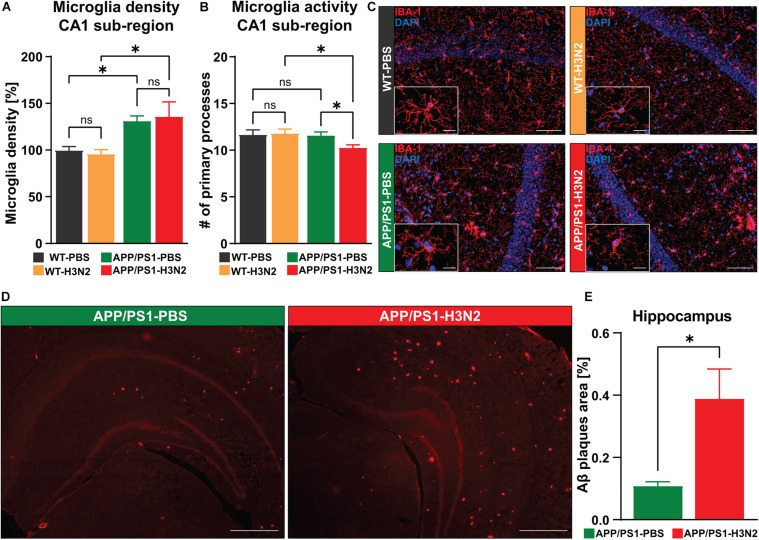
Influenza viruses until today are a leading cause of worldwide severe pandemics and represent a major threat to human and animal health. Although the primary target of influenza viruses is the lung, infection may manifest with acute and even chronic neurological complications (e.g., status epilepticus, encephalopathies, and encephalitis) potentially increasing the long-term risk for neurodegenerative diseases. We previously described that a peripheral influenza A virus (IAV) infection caused by non-neurotropic H3N2 (maHK68) variant leads to long-term neuroinflammation and synapse loss together with impaired memory formation in young adult mice. Processes of neuroinflammation have been associated with neurodegenerative diseases such as Alzheimer's disease (AD) and prolonged or excessive innate immune responses are considered a risk factor for AD. Here, the role of purely peripheral IAV infection for the development and progression of AD in a transgenic mouse model (APP/PS1) was investigated. At 2 months of age, mice were infected with H3N2 IAV and the detailed analysis of microglia morphology revealed neuroinflammation in the hippocampus already of 6 months old non-infected APP/PS1 mice together with impaired spatial learning, however, microglia activation, amyloid-β plaques load and cognitive impairments were even more pronounced in APP/PS1 mice upon H3N2 infection. Moreover, CA1 hippocampal dendritic spine density was reduced even at 120 dpi compared to wild-type and also to non-infected APP/PS1 mice, whereas neuronal cells number was not altered. These findings demonstrate that non-neurotropic H3N2 IAV infection as a peripheral immune stimulation may exacerbate AD symptoms possibly by triggering microglial hyperactivation.
直至今日,流感病毒仍是全球严重大流行的主要病因,对人类和动物健康构成重大威胁。尽管流感病毒的主要靶器官是肺,但感染可能表现为急性甚至慢性神经并发症(如癫痫持续状态、脑病和脑炎),这可能会增加神经退行性疾病的长期风险。我们之前描述过,由非嗜神经性H3N2(maHK68)变体引起的外周甲型流感病毒(IAV)感染会导致成年小鼠长期神经炎症和突触丧失,同时记忆形成受损。神经炎症过程与神经退行性疾病如阿尔茨海默病(AD)有关,而先天性免疫反应的延长或过度被认为是AD的一个风险因素。在此,我们研究了单纯外周IAV感染在转基因小鼠模型(APP/PS1)中对AD发生和发展的作用。在2月龄时,小鼠感染H3N2 IAV,对小胶质细胞形态的详细分析显示,6月龄未感染的APP/PS1小鼠海马中已经存在神经炎症,同时空间学习能力受损,然而,H3N2感染后,APP/PS1小鼠的小胶质细胞激活、淀粉样β斑块负荷和认知障碍更为明显。此外,与野生型以及未感染的APP/PS1小鼠相比,即使在感染后120天,CA1海马区树突棘密度也降低了,而神经元细胞数量没有改变。这些发现表明,作为外周免疫刺激的非嗜神经性H3N2 IAV感染可能通过触发小胶质细胞过度激活而加剧AD症状。