Holubová-Kroupová Anna, Šlamberová Romana
Department of Physiology, Third Faculty of Medicine, Charles University, Prague, Czechia.
Front Behav Neurosci. 2021 Apr 29;15:648780. doi: 10.3389/fnbeh.2021.648780. eCollection 2021.
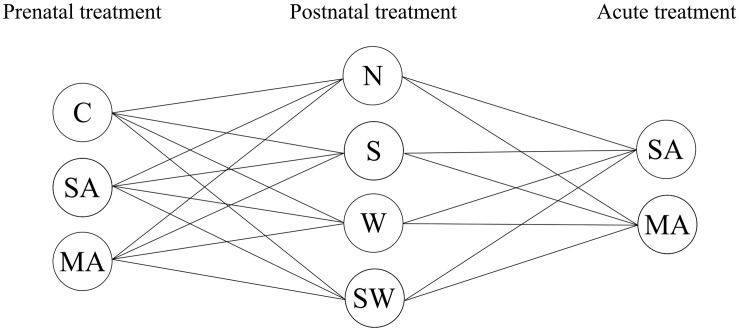
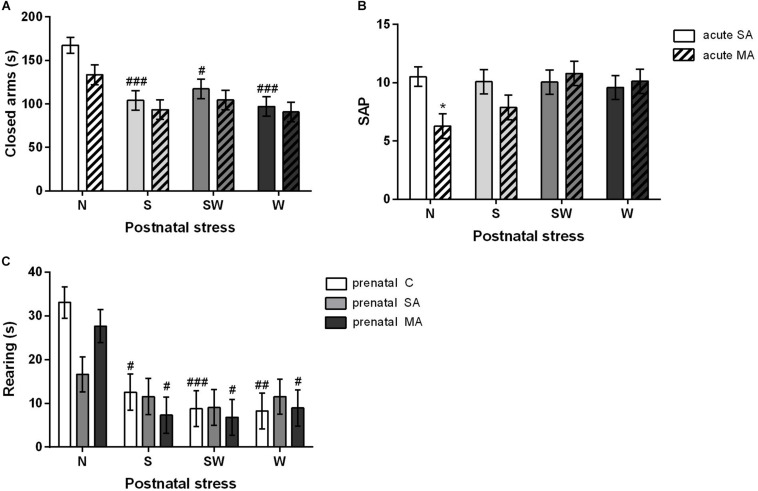
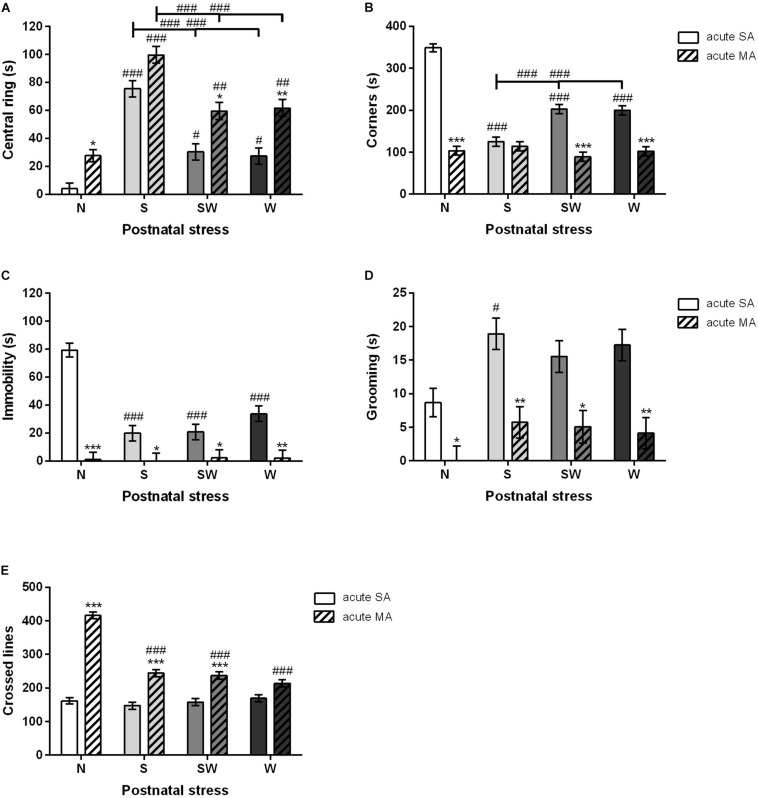
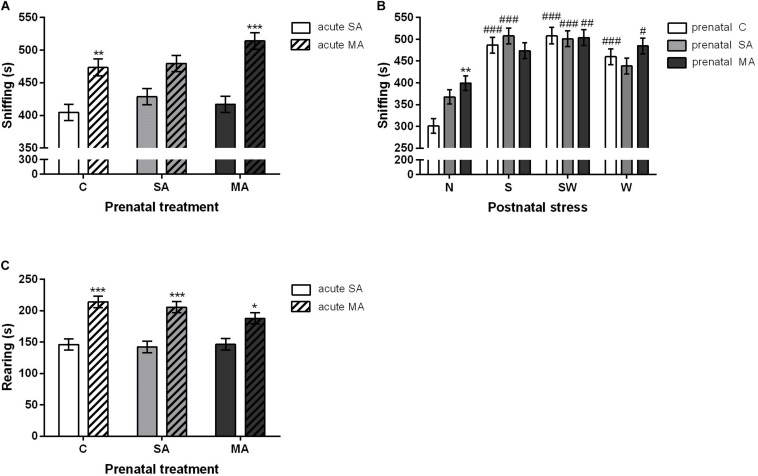
Methamphetamine (MA) is an illicit synthetic psychostimulant drug, and its abuse is growing worldwide. MA has been reported as the primary drug of choice, by drug-abusing women, during pregnancy. Since MA easily crosses the placental barrier, the fetus is exposed to MA in a similar fashion to the mother. This study aimed to evaluate the effect of long-term perinatal stressors and drug exposure on anxiety-like behavior in adult male rats using the open field test (OF) and elevated plus maze (EPM). Dams were divided into three groups according to drug treatment during pregnancy: controls (C), saline-SA [subcutaneous (s.c.), 1 ml/kg], and MA (s.c., 5 mg/kg). Litters were divided into four groups according to postnatal stressors: non-stressed controls (N), maternal separation (S), maternal cold water stress (W), and maternal separation plus maternal cold water stress (SW). Forty-five minutes before testing (in both OF and EPM), one-half of adult male rats received an (s.c.) injection of MA and the other half received an SA injection. Prenatal MA/stress exposure did not affect anxiety-like behavior in adult male rats in both tests. In the OF, an acute MA dose in adulthood increased the time spent in the central disk area, decreased time spent in the corners, and decreased time spent immobile and grooming. Also, postnatal stress increased time spent in the central disk area, decreased time spent in corners, and increased mobility compared to controls. All groups of rats exposed to postnatal stressors spent significantly less time in the closed arms of the EPM compared to controls. Overall, our results indicate that early postnatal stress and a single acute MA administration in adulthood decreases the parameters of anxiety-like behavior in adult male rats regardless of prenatal MA exposure. Moreover, postnatal stress maternal separation impacts the effect of acute MA administration in adulthood. Long-term postnatal stress may thus result in improved adaptation to subsequent stressful experiences later in life.
甲基苯丙胺(MA)是一种非法合成的精神刺激药物,其滥用现象在全球范围内日益增多。据报道,MA是孕期滥用药物的女性首选的主要药物。由于MA极易穿过胎盘屏障,胎儿接触MA的方式与母亲相似。本研究旨在通过旷场试验(OF)和高架十字迷宫(EPM)评估长期围产期应激源和药物暴露对成年雄性大鼠焦虑样行为的影响。根据孕期药物治疗情况,将母鼠分为三组:对照组(C)、生理盐水组(SA,皮下注射,1 ml/kg)和MA组(皮下注射,5 mg/kg)。根据产后应激源,将幼崽分为四组:无应激对照组(N)、母婴分离组(S)、母体冷水应激组(W)和母婴分离加母体冷水应激组(SW)。在测试前45分钟(OF和EPM测试均如此),一半成年雄性大鼠接受皮下注射MA,另一半接受SA注射。产前MA/应激暴露在两项测试中均未影响成年雄性大鼠的焦虑样行为。在OF测试中,成年期急性给予MA剂量增加了在中央盘区域停留的时间,减少了在角落停留的时间,以及减少了静止和梳理毛发的时间。此外,与对照组相比,产后应激增加了在中央盘区域停留的时间,减少了在角落停留的时间,并增加了活动能力。与对照组相比,所有暴露于产后应激源的大鼠组在EPM的封闭臂中停留的时间明显减少。总体而言,我们的结果表明,无论产前是否暴露于MA,产后早期应激和成年期单次急性给予MA均可降低成年雄性大鼠焦虑样行为的参数。此外,产后应激——母婴分离会影响成年期急性给予MA的效果。因此,长期产后应激可能会导致成年后对后续应激经历的适应能力增强。