Sturma Agnes, Hruby Laura A, Boesendorfer Anna, Pittermann Anna, Salminger Stefan, Gstoettner Clemens, Politikou Olga, Vujaklija Ivan, Farina Dario, Aszmann Oskar C
Clinical Laboratory for Bionic Extremity Reconstruction, Department of Surgery, Medical University of Vienna, Vienna, Austria.
Neurorehabilitation Engineering Group, Department of Bioengineering, Imperial College London, London, United Kingdom.
Front Neurorobot. 2021 Apr 30;15:645261. doi: 10.3389/fnbot.2021.645261. eCollection 2021.
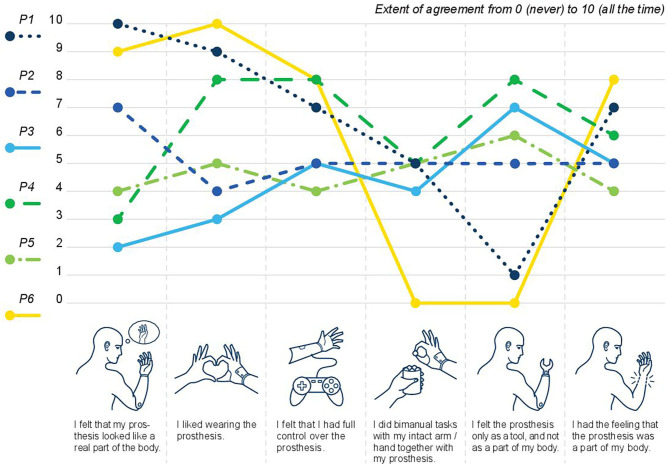
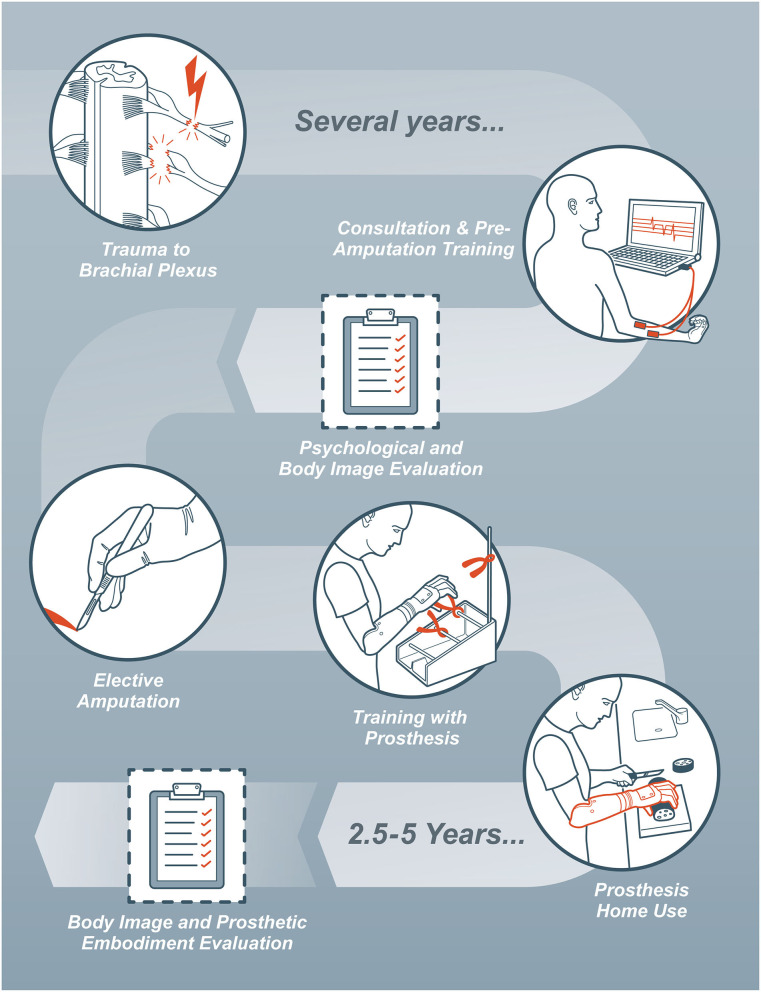
Brachial plexus injuries with multiple-root involvement lead to severe and long-lasting impairments in the functionality and appearance of the affected upper extremity. In cases, where biologic reconstruction of hand and arm function is not possible, bionic reconstruction may be considered as a viable clinical option. Bionic reconstruction, through a careful combination of surgical augmentation, amputation, and prosthetic substitution of the functionless hand, has been shown to achieve substantial improvements in function and quality of life. However, it is known that long-term distortions in the body image are present in patients with severe nerve injury as well as in prosthetic users regardless of the level of function. To date, the body image of patients who voluntarily opted for elective amputation and prosthetic reconstruction has not been investigated. Moreover, the degree of embodiment of the prosthesis in these patients is unknown. We have conducted a longitudinal study evaluating changes of body image using the patient-reported Body Image Questionnaire 20 (BIQ-20) and a structured questionnaire about prosthetic embodiment. Six patients have been included. At follow up 2.5-5 years after intervention, a majority of patients reported better BIQ-20 scores including a less negative body evaluation (5 out of 6 patients) and higher vital body dynamics (4 out of 6 patients). Moreover, patients described a strong to moderate prosthesis embodiment. Interestingly, whether patients reported performing bimanual tasks together with the prosthetic hand or not, did not influence their perception of the prosthesis as a body part. In general, this group of patients undergoing prosthetic substitution after brachial plexus injury shows noticeable inter-individual differences. This indicates that the replacement of human anatomy with technology is not a straight-forward process perceived in the same way by everyone opting for it.
多根受累的臂丛神经损伤会导致受影响上肢的功能和外观出现严重且持久的损害。在无法进行手和手臂功能生物重建的情况下,可考虑将仿生重建作为一种可行的临床选择。通过精心结合手术增强、截肢以及对无功能手进行假体替代的仿生重建,已被证明能在功能和生活质量方面取得显著改善。然而,已知严重神经损伤患者以及假肢使用者无论功能水平如何,都会出现长期的身体形象扭曲。迄今为止,尚未对自愿选择择期截肢和假肢重建患者的身体形象进行研究。此外,这些患者对假体的融入程度尚不清楚。我们进行了一项纵向研究,使用患者报告的身体形象问卷20(BIQ - 20)和一份关于假体融入的结构化问卷来评估身体形象的变化。共纳入了6名患者。在干预后2.5至5年的随访中,大多数患者报告BIQ - 20得分有所改善,包括身体评价负面程度降低(6名患者中有5名)以及生命体征动态得分提高(6名患者中有4名)。此外,患者描述了对假体的融入程度为强至中度。有趣的是,患者是否报告使用假手执行双手任务并不影响他们将假体视为身体一部分的认知。总体而言,这组臂丛神经损伤后接受假体替代的患者表现出明显的个体差异。这表明用技术替代人体解剖结构并非一个对每个选择它的人来说都以相同方式感知的简单过程。