Saverino Alessia, Baiardi Paola, Galata Giuseppe, Pedemonte Gloria, Vassallo Claudio, Pistarini Caterina
Rehabilitation Unit, Istituti Clinici Scientifici Maugeri, Genoa, Italy.
Scientific Direction, Istituti Clinici Scientifici Maugeri, Istituti di Ricovero e Cura a Carattere Scientifico (IRCCS), Pavia, Italy.
Front Neurol. 2021 Apr 29;12:643251. doi: 10.3389/fneur.2021.643251. eCollection 2021.
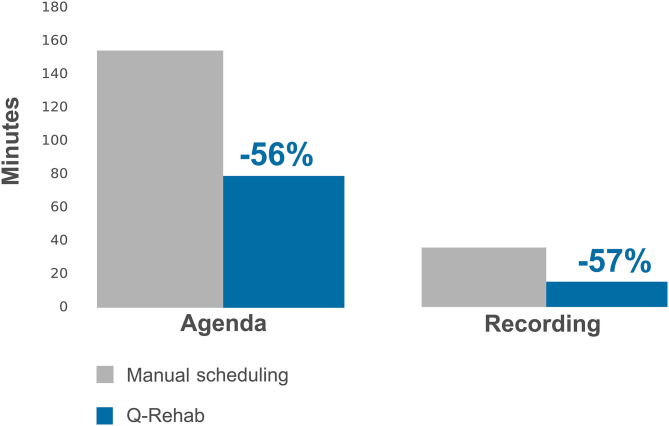
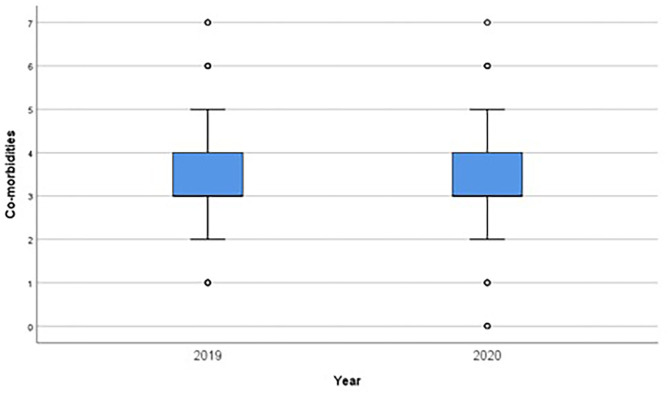
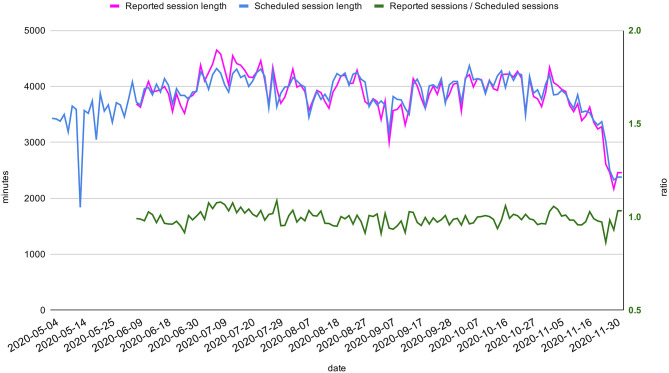
The COVID-19 pandemic has posed great challenges in inpatient rehabilitation services, not only to implement the preventative measures to avoid the spreading of the virus in a highly interactive, multidisciplinary setting but also to create a rehabilitation pathway for post-COVID-19 patients. The aim of this retrospective study was to describe the role of a digital and artificial intelligence platform (DAIP) in facilitating the implementation of changes in a rehabilitation service during the COVID-19 pandemic. We gathered qualitative and quantitative descriptors of the DAIP, including measures to assess its efficiency in scheduling therapy sessions, and staff satisfaction using two simple numeric rating scales and the System Usability Scale. We describe how the volume of activity and the quality of care of our rehabilitation service have changed when the DAIP was implemented by comparing the pre-COVID-19 and the pandemic periods for patients' [sex, age, co-morbidities, diagnosis, and Functional Independence Measure (FIM) gain] and service's (bed occupancy, patients' length of stay, and staff capacity) characteristics. Bed occupancy and the impact of rehabilitation on patients' outcome remained stable between the two periods. The DAIP provided a qualitative support for goal setting from remote; 95% of the planned sessions were delivered; the time for scheduling and registering sessions dropped by 50%. Staff satisfaction was about 70% for the easiness and 60% for the usefulness, and the mean "usability" score was close to the cut off for sufficient usability (mean score 65 where 68 is the cut off). By applying the DAIP to rehabilitation treatment, it was shown that the management of rehabilitation can be efficiently performed even in the COVID-19 pandemic. Staff satisfaction reflected a good acceptance of the changes considering the turbulent changes and the stress burden occurring at the time of the pandemic.
新冠疫情给住院康复服务带来了巨大挑战,既要在高度互动的多学科环境中实施预防措施以避免病毒传播,又要为新冠康复患者建立康复路径。这项回顾性研究的目的是描述数字与人工智能平台(DAIP)在新冠疫情期间促进康复服务变革实施过程中的作用。我们收集了DAIP的定性和定量描述信息,包括评估其安排治疗课程效率的指标,以及使用两个简单数字评分量表和系统可用性量表来衡量员工满意度。通过比较新冠疫情前和疫情期间患者的[性别、年龄、合并症、诊断及功能独立性测量(FIM)增益]和服务的(床位占用率、患者住院时长及员工能力)特征,我们描述了实施DAIP后康复服务的活动量和护理质量是如何变化的。两个时期的床位占用率以及康复对患者预后的影响保持稳定。DAIP为远程设定目标提供了定性支持;95%的计划课程得以实施;安排和登记课程的时间减少了50%。员工对其易用性的满意度约为70%,对其有用性的满意度为60%,平均“可用性”得分接近足够可用性的临界值(平均分为65,临界值为68)。通过将DAIP应用于康复治疗表明,即使在新冠疫情期间,康复管理也能高效进行。考虑到疫情期间发生的剧烈变化和压力负担,员工满意度反映出对这些变化的良好接受度。