Lin Tong, Li Li, Liang Caijun, Peng Lisheng
The Fourth Clinical Medical School, Guangzhou University of Chinese Medicine, Shenzhen 518033, China.
Shenzhen Hospital of Traditional Chinese Medicine, Shenzhen 518033, China.
Evid Based Complement Alternat Med. 2021 Apr 27;2021:3495360. doi: 10.1155/2021/3495360. eCollection 2021.
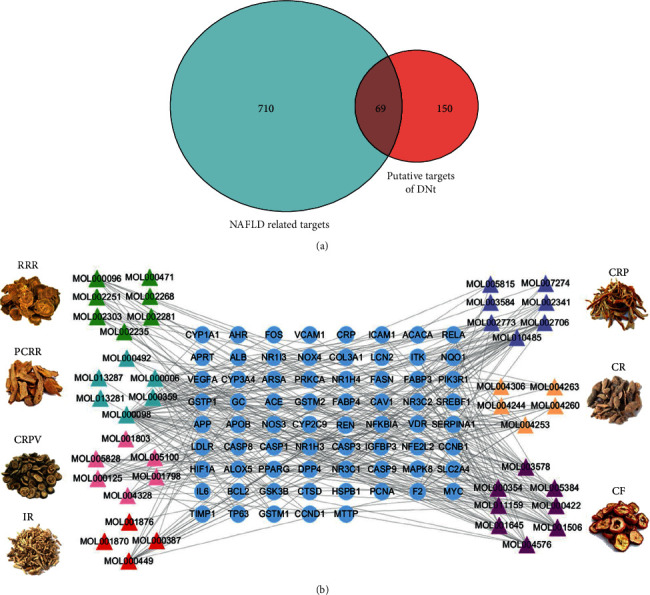
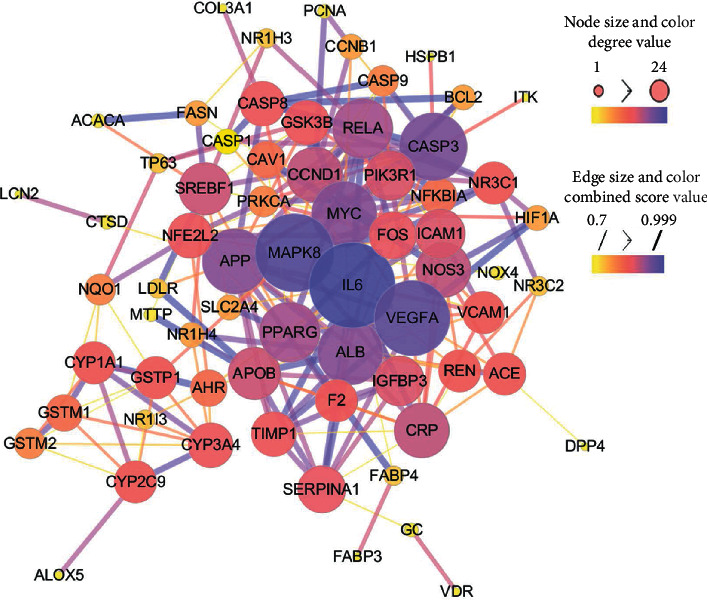
Nonalcoholic fatty liver disease (NAFLD) is a rising global public health concern due to its prevalence. Danning Tablets (DNt), a composite prescription of Chinese herbal medicine, shows significant curative effects on NAFLD in clinical application. This study aimed to decipher the bioactive substances and potential mechanisms of action of DNt in the treatment of NAFLD, applying an integrated network pharmacology approach. First, the bioactive compounds of DNt were screened based on their pharmacokinetic properties, and the corresponding drug targets were predicted. Then, the NAFLD-related targets were collected. The overlapping targets between the putative targets of DNt and NAFLD-related targets were identified as the potential therapeutic targets of DNt against NAFLD. Subsequently, the networks were constructed and analyzed, and the key bioactive compounds and targets were screened out depending on their importance in the networks. Functional enrichment analysis was carried out to elucidate the potential mechanisms of DNt acting on NAFLD. Finally, a molecular docking simulation was implemented to assess the potential binding affinity between the key targets and the bioactive compounds. As a result, 43 bioactive compounds of DNt and 69 putative targets were identified. Based on the network analysis, we found seven key bioactive compounds (quercetin, -sitosterol, luteolin, kaempferol, supraene, curcumenolactone C, and stigmasterol) of DNt might treat NAFLD via intervening IL6, MAPK8, VEGFA, CASP3, ALB, APP, MYC, PPARG, and RELA. The functional enrichment analysis revealed that DNt might affect NAFLD by modulating the signaling pathways involved in lipid metabolism, inflammation, oxidation, insulin resistance (IR), atherosclerosis, and apoptosis. Furthermore, most key bioactive compounds might bind firmly with the key targets. This study predicted the multicomponent, multitarget, and multipathway mechanisms of DNt in the treatment of NAFLD from a holistic perspective. DNt could be a promising agent for NAFLD, but further experimental verifications are still needed.
非酒精性脂肪性肝病(NAFLD)因其患病率不断上升,已成为全球日益关注的公共卫生问题。丹宁片(DNt)是一种复方中药制剂,在临床应用中对NAFLD显示出显著疗效。本研究旨在应用综合网络药理学方法,阐明DNt治疗NAFLD的生物活性物质及潜在作用机制。首先,根据DNt的药代动力学特性筛选其生物活性化合物,并预测相应的药物靶点。然后,收集NAFLD相关靶点。将DNt的假定靶点与NAFLD相关靶点之间的重叠靶点确定为DNt治疗NAFLD的潜在治疗靶点。随后,构建并分析网络,根据关键生物活性化合物和靶点在网络中的重要性筛选出来。进行功能富集分析以阐明DNt作用于NAFLD的潜在机制。最后,进行分子对接模拟以评估关键靶点与生物活性化合物之间的潜在结合亲和力。结果,鉴定出DNt的43种生物活性化合物和69个假定靶点。基于网络分析,我们发现DNt的七种关键生物活性化合物(槲皮素、β-谷甾醇、木犀草素、山奈酚、超烯、莪术烯内酯C和豆甾醇)可能通过干预白细胞介素6(IL6)、丝裂原活化蛋白激酶8(MAPK8)、血管内皮生长因子A(VEGFA)、半胱天冬酶3(CASP3)、白蛋白(ALB)、淀粉样前体蛋白(APP)、原癌基因c-Myc(MYC)、过氧化物酶体增殖物激活受体γ(PPARG)和信号转导和转录激活因子3(RELA)来治疗NAFLD。功能富集分析表明,DNt可能通过调节参与脂质代谢、炎症、氧化、胰岛素抵抗(IR)、动脉粥样硬化和细胞凋亡的信号通路来影响NAFLD。此外,大多数关键生物活性化合物可能与关键靶点紧密结合。本研究从整体角度预测了DNt治疗NAFLD的多成分、多靶点和多途径机制。DNt可能是一种有前途的NAFLD治疗药物,但仍需要进一步的实验验证。