Chen Changxi, Li Hongliang, Song Jian, Zhang Cheng, Li Mengting, Mao Yushan, Liu Aiming, Du Juan
Department of Gastroenterology, Affiliated People's Hospital of Ningbo University, Ningbo, Zhejiang Province 315040, China.
Department of Endocrinology, Affiliated Hospital of Medical College of Ningbo University, Ningbo, Zhejiang Province 315020, China.
PPAR Res. 2022 Feb 18;2022:4709300. doi: 10.1155/2022/4709300. eCollection 2022.
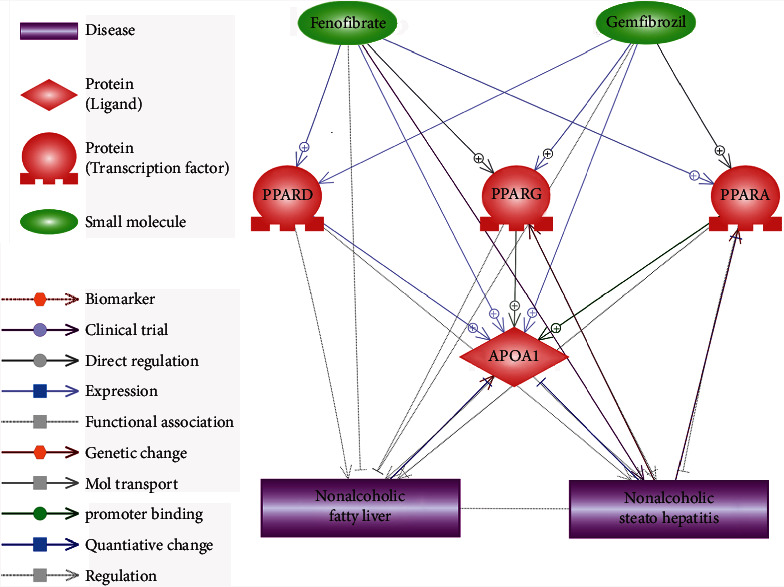
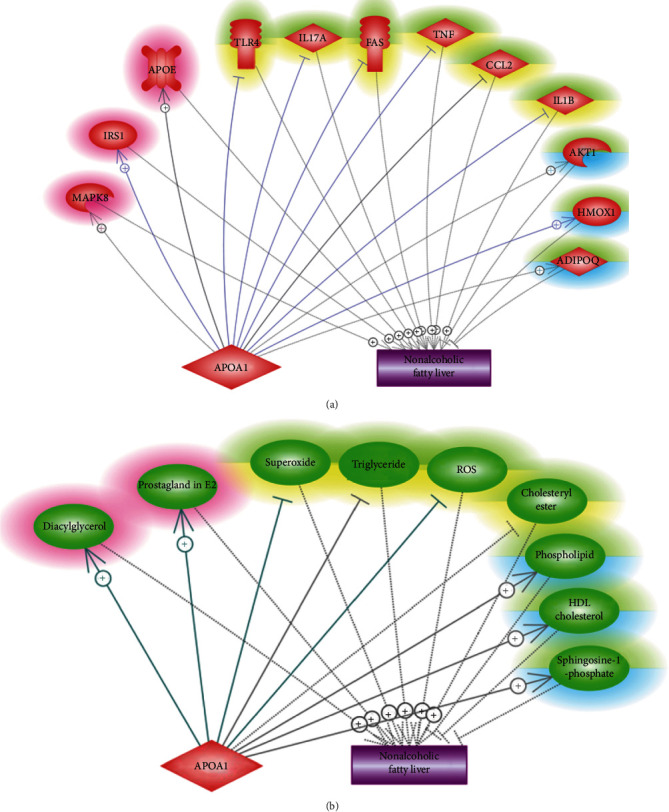
Peroxisome proliferator-activated receptors (PPARs) have been suggested to play crucial roles in the pathology of NAFLD with a vague understanding of the underlying mechanism. Here, we integrated large-scale literature data and clinical data to explore the potential role of the PPAR-APOA1 signaling pathway in the pathology of NAFLD. First, the signaling pathway connecting PPARs, APOA1, and NAFLD was constructed. Then, we employed clinical data to explore the association between APOA1 levels and NAFLD. In addition, we built the APOA1-driven pathway analysis to explore the potential mechanism of the APOA1-NAFLD association. Pathway analysis showed that APOA1 serves as a hubprotein connecting PPARs and NAFLD through a beneficial modulation of 16 out of 21 NAFLD upstream regulators. Each relationship within the composed pathway was supported by results from multiple previous studies. Clinical data analysis showed that an increase of APOA1 level was associated with a significantly decreased NAFLD prevalence ( = 292.109; < 0.001). When other confounding factors were adjusted, serum APOA1 level was shown as an independent risk factor for the prevalence of NAFLD ( value<.0001; OR = 0.562). Our results suggested that the three PPARs (PPARA, PPARD, and PPARG) might promote the expression and molecular transportation of APOA1 to form a PPAR-APOA1 signaling pathway that demonstrated a beneficial role in the pathogenesis of NAFLD.
过氧化物酶体增殖物激活受体(PPARs)被认为在非酒精性脂肪性肝病(NAFLD)的病理过程中起关键作用,但其潜在机制尚不清楚。在此,我们整合了大规模文献数据和临床数据,以探讨PPAR-APOA1信号通路在NAFLD病理过程中的潜在作用。首先,构建了连接PPARs、APOA1和NAFLD的信号通路。然后,我们利用临床数据探讨APOA1水平与NAFLD之间的关联。此外,我们构建了APOA1驱动的通路分析,以探讨APOA1-NAFLD关联的潜在机制。通路分析表明,APOA1作为一种枢纽蛋白,通过对21个NAFLD上游调节因子中的16个进行有益调节,将PPARs与NAFLD连接起来。组成通路中的每一种关系都得到了多项先前研究结果的支持。临床数据分析表明,APOA1水平升高与NAFLD患病率显著降低相关(χ² = 292.109;P < 0.001)。当调整其他混杂因素时,血清APOA1水平被证明是NAFLD患病率的独立危险因素(P值<0.0001;OR = 0.562)。我们的结果表明,三种PPARs(PPARA、PPARD和PPARG)可能促进APOA1的表达和分子转运,形成一条在NAFLD发病机制中发挥有益作用的PPAR-APOA1信号通路。