Voice Angus T, Tresadern Gary, Twidale Rebecca M, van Vlijmen Herman, Mulholland Adrian J
Centre for Computational Chemistry, School of Chemistry, University of Bristol Cantock's Close Bristol BS8 1TS UK
Computational Chemistry, Janssen Research & Development, Janssen Pharmaceutica N. V. Turnhoutseweg 30 B-2340 Beerse Belgium.
Chem Sci. 2021 Jan 28;12(15):5511-5516. doi: 10.1039/d0sc06122k.
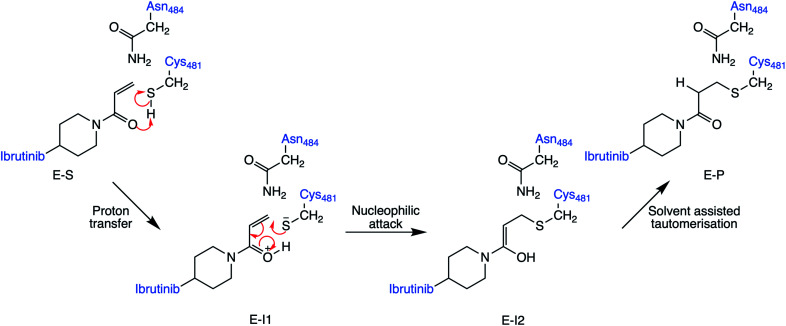
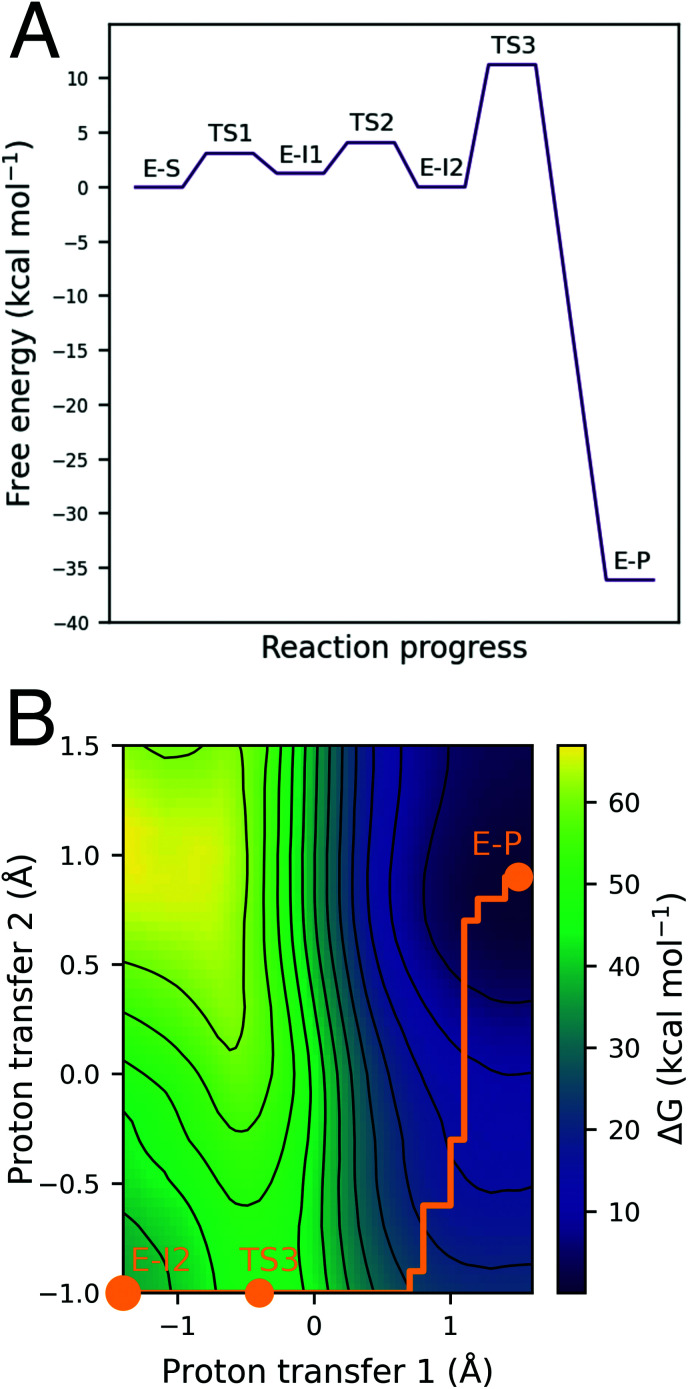
Ibrutinib is the first covalent inhibitor of Bruton's tyrosine kinase (BTK) to be used in the treatment of B-cell cancers. Understanding the mechanism of covalent inhibition will aid in the design of safer and more selective covalent inhibitors that target BTK. The mechanism of covalent inhibition in BTK has been uncertain because there is no appropriate residue nearby that can act as a base to deprotonate the cysteine thiol prior to covalent bond formation. We investigate several mechanisms of covalent modification of C481 in BTK by ibrutinib using combined quantum mechanics/molecular mechanics (QM/MM) molecular dynamics reaction simulations. The lowest energy pathway involves direct proton transfer from C481 to the acrylamide warhead in ibrutinib, followed by covalent bond formation to form an enol intermediate. There is a subsequent rate-limiting keto-enol tautomerisation step (Δ = 10.5 kcal mol) to reach the inactivated BTK/ibrutinib complex. Our results represent the first mechanistic study of BTK inactivation by ibrutinib to consider multiple mechanistic pathways. These findings should aid in the design of covalent drugs that target BTK and other similar targets.
依鲁替尼是首个用于治疗B细胞癌症的布鲁顿酪氨酸激酶(BTK)共价抑制剂。了解共价抑制机制将有助于设计更安全、更具选择性的靶向BTK的共价抑制剂。BTK中共价抑制的机制一直不明确,因为附近没有合适的残基可在共价键形成之前作为碱使半胱氨酸硫醇去质子化。我们使用量子力学/分子力学(QM/MM)分子动力学反应模拟研究了依鲁替尼对BTK中C481进行共价修饰的几种机制。能量最低的途径涉及质子从C481直接转移至依鲁替尼中的丙烯酰胺弹头,随后形成共价键以形成烯醇中间体。随后有一个限速的酮-烯醇互变异构步骤(Δ = 10.5千卡/摩尔)以达到失活的BTK/依鲁替尼复合物。我们的结果代表了对依鲁替尼使BTK失活的首个考虑多种机制途径的机理研究。这些发现应有助于设计靶向BTK和其他类似靶点的共价药物。