School of Chemistry and Institute for Life Sciences, University of Southampton, Southampton SO17 1BJ, U.K.
Cancer Sciences, Faculty of Medicine, University of Southampton, Southampton SO16 6YD, U.K.
J Med Chem. 2024 Aug 22;67(16):13572-13593. doi: 10.1021/acs.jmedchem.3c01927. Epub 2024 Aug 9.
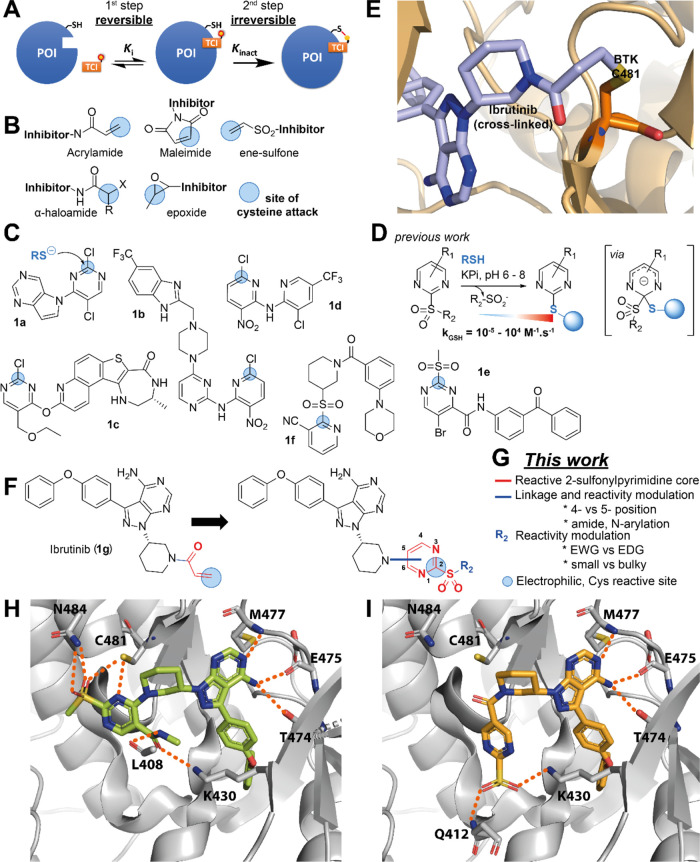
Targeted covalent inhibitors (TCIs) directing cysteine have historically relied on a narrow set of electrophilic "warheads". While Michael acceptors remain at the forefront of TCI design strategies, they show variable stability and selectivity under physiological conditions. Here, we show that the 2-sulfonylpyrimidine motif is an effective replacement for the acrylamide warhead of Ibrutinib, for the inhibition of Bruton's tyrosine kinase. In a few iterations, we discovered new derivatives, which inhibit BTK both and at low nanomolar concentrations, on par with Ibrutinib. Several derivatives also displayed good plasma stability and reduced off-target binding across 135 tyrosine kinases. This proof-of-concept study on a well-studied kinase/TCI system highlights the 2-sulfonylpyrimidine group as a useful acrylamide replacement. In the future, it will be interesting to investigate its wider potential for developing TCIs with improved pharmacologies and selectivity profiles across structurally related protein families.
靶向共价抑制剂(TCIs)靶向半胱氨酸,历史上依赖于一组狭窄的亲电“弹头”。虽然迈克尔受体仍然是 TCI 设计策略的前沿,但它们在生理条件下表现出可变的稳定性和选择性。在这里,我们表明 2-磺酰基嘧啶基序是伊布替尼丙烯酰胺弹头的有效替代品,可抑制布鲁顿酪氨酸激酶。经过几次迭代,我们发现了新的衍生物,它们以低纳摩尔浓度抑制 BTK 和 ,与伊布替尼相当。一些衍生物还表现出良好的血浆稳定性和降低的脱靶结合 ,跨越 135 种酪氨酸激酶。这项针对研究充分的激酶/TCI 系统的概念验证研究强调了 2-磺酰基嘧啶基团作为有用的丙烯酰胺替代品。将来,研究其在开发具有改善药理学和选择性特征的 TCIs 方面的更广泛潜力将是有趣的,这些 TCIs 跨越结构相关的蛋白质家族。