
包括氯喹和羟氯喹在内的抗感染化合物的心脏尖端扭转型室性心动过速风险分层建模。
Cardiac TdP risk stratification modelling of anti-infective compounds including chloroquine and hydroxychloroquine.
作者信息
Whittaker Dominic G, Capel Rebecca A, Hendrix Maurice, Chan Xin Hui S, Herring Neil, White Nicholas J, Mirams Gary R, Burton Rebecca-Ann B
机构信息
Centre for Mathematical Medicine and Biology, School of Mathematical Sciences, University of Nottingham, Nottingham, UK.
Department of Pharmacology, University of Oxford, Oxford, UK.
出版信息
R Soc Open Sci. 2021 Apr 13;8(4):210235. doi: 10.1098/rsos.210235.
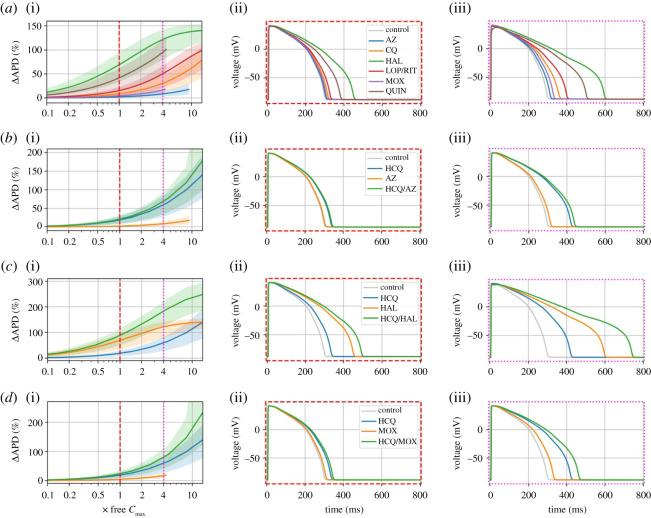
Hydroxychloroquine (HCQ), the hydroxyl derivative of chloroquine (CQ), is widely used in the treatment of rheumatological conditions (systemic lupus erythematosus, rheumatoid arthritis) and is being studied for the treatment and prevention of COVID-19. Here, we investigate through mathematical modelling the safety profile of HCQ, CQ and other QT-prolonging anti-infective agents to determine their risk categories for (TdP) arrhythmia. We performed safety modelling with uncertainty quantification using a risk classifier based on the qNet , a measure of the net charge carried by major currents during the action potential under inhibition of multiple ion channels by a compound. Modelling results for HCQ at a maximum free therapeutic plasma concentration (free ) of approximately 1.2 µM (malaria dosing) indicated it is most likely to be in the high-intermediate-risk category for TdP, whereas CQ at a free of approximately 0.7 µM was predicted to most likely lie in the intermediate-risk category. Combining HCQ with the antibacterial moxifloxacin or the anti-malarial halofantrine (HAL) increased the degree of human ventricular action potential duration prolongation at some or all concentrations investigated, and was predicted to increase risk compared to HCQ alone. The combination of HCQ/HAL was predicted to be the riskiest for the free values investigated, whereas azithromycin administered individually was predicted to pose the lowest risk. Our simulation approach highlights that the torsadogenic potentials of HCQ, CQ and other QT-prolonging anti-infectives used in COVID-19 prevention and treatment increase with concentration and in combination with other QT-prolonging drugs.
羟氯喹啉(HCQ)是氯喹啉(CQ)的羟基衍生物,广泛用于治疗风湿性疾病(系统性红斑狼疮、类风湿性关节炎),目前正在研究其对新型冠状病毒肺炎(COVID-19)的治疗和预防作用。在此,我们通过数学建模研究了HCQ、CQ及其他可延长QT间期的抗感染药物的安全性,以确定它们发生尖端扭转型室性心动过速(TdP)心律失常的风险类别。我们使用基于qNet的风险分类器进行了带有不确定性量化的安全性建模,qNet是一种衡量化合物在抑制多个离子通道时动作电位期间主要电流携带的净电荷的指标。对于HCQ,在最大游离治疗血浆浓度(游离 )约为1.2µM(疟疾给药剂量)时的建模结果表明,它最有可能处于TdP的高-中风险类别,而游离 约为0.7µM的CQ预计最有可能处于中风险类别。将HCQ与抗菌药物莫西沙星或抗疟药物卤泛群(HAL)联合使用,在某些或所有研究浓度下会增加人类心室动作电位持续时间的延长程度,并且预计与单独使用HCQ相比风险会增加。对于所研究的游离 值,HCQ/HAL组合预计风险最高,而单独使用阿奇霉素预计风险最低。我们的模拟方法强调,用于COVID-19预防和治疗的HCQ、CQ及其他可延长QT间期的抗感染药物的致尖端扭转电位会随着浓度增加以及与其他可延长QT间期的药物联合使用而增加。

 Zotero 插件