Meng Qi, Lu Yun-Xin, Ruan Dan-Yun, Yu Kai, Chen Yan-Xing, Xiao Min, Wang Yun, Liu Ze-Xian, Xu Rui-Hua, Ju Huai-Qiang, Qiu Miao-Zhen
State Key Laboratory of Oncology in South China, Collaborative Innovation Center for Cancer Medicine, Sun Yat-sen University Cancer Center, Guangzhou 510060, P.R. China.
Research Unit of Precision Diagnosis and Treatment for Gastrointestinal Cancer, Chinese Academy of Medical Sciences, Guangzhou 510060, P.R. China.
Mol Ther Nucleic Acids. 2021 Apr 3;24:695-710. doi: 10.1016/j.omtn.2021.03.023. eCollection 2021 Jun 4.
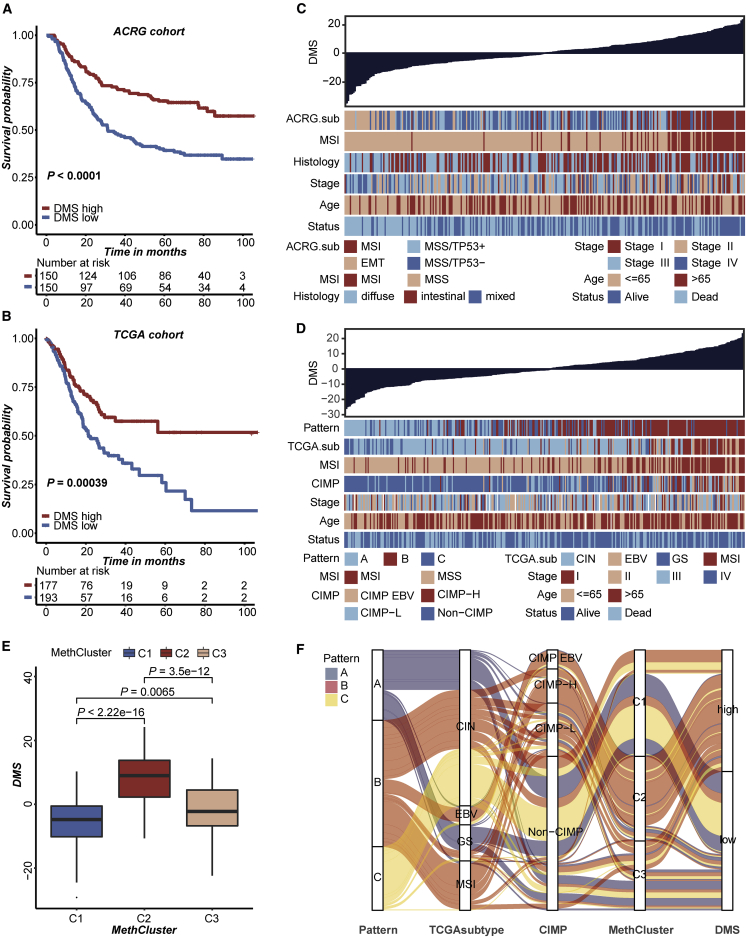
Growing evidence implies a link between DNA methylation and tumor immunity/immunotherapy. However, the global influence of DNA methylation on the characteristics of the tumor microenvironment and the efficacy of immunotherapy remains to be clarified. In this study, we systematically evaluated the DNA methylation regulator patterns and tumor microenvironment characteristics of 1,619 gastric cancer patients by clustering the gene expression of 20 DNA methylation regulators. Three gastric cancer subtypes that had different DNA methylation modification patterns and distinct tumor microenvironment characteristics were recognized. Then, a DNA methylation score (DMS) was constructed to evaluate DNA methylation modification individually. High DMS was characterized by immune activation status, increased tumor mutation burden, and tumor neoantigens, with a favorable prognosis. Conversely, activation of the stroma and absence of immune cell infiltration were observed in the low DMS group, with relatively poor survival. High DMS was also certified to be correlated with enhanced efficacy of immunotherapy in four immune checkpoint blocking treatment cohorts. In conclusion, the characterization of DNA methylation modification patterns may help to enhance our recognition of the tumor immune microenvironment of gastric cancer and guide more personalized immunotherapy strategies in the future.
越来越多的证据表明DNA甲基化与肿瘤免疫/免疫治疗之间存在联系。然而,DNA甲基化对肿瘤微环境特征和免疫治疗疗效的整体影响仍有待阐明。在本研究中,我们通过对20种DNA甲基化调节因子的基因表达进行聚类,系统评估了1619例胃癌患者的DNA甲基化调节因子模式和肿瘤微环境特征。识别出了三种具有不同DNA甲基化修饰模式和独特肿瘤微环境特征的胃癌亚型。然后,构建了一个DNA甲基化评分(DMS)来单独评估DNA甲基化修饰。高DMS的特征是免疫激活状态、肿瘤突变负担增加和肿瘤新抗原,预后良好。相反,在低DMS组中观察到基质激活和免疫细胞浸润缺失,生存率相对较低。在四个免疫检查点阻断治疗队列中,高DMS也被证实与免疫治疗疗效增强相关。总之,DNA甲基化修饰模式的特征可能有助于提高我们对胃癌肿瘤免疫微环境的认识,并在未来指导更个性化的免疫治疗策略。