Huang Xiaozhun, Wang Chunling, Ma Teng, Huang Zhangkan, Zhou Houhong, Xu Lin, Zhang Renjie, Zhao Jianjun, Zhang Yefan, Huang Zhen, Shao Lin, Wang Yang, Yang Fan, Che Xu
Department of Hepatobiliary Surgery, National Cancer Center/National Clinical Research Center for Cancer/Cancer Hospital and Shenzhen Hospital, Chinese Academy of Medical Sciences and Peking Union Medical College, Shenzhen, China.
Department of Hospital Acquired Infection Control, National Cancer Center/National Clinical Research Center for Cancer/Cancer Hospital and Shenzhen Hospital, Chinese Academy of Medical Sciences and Peking Union Medical College, Shenzhen, China.
Front Oncol. 2021 Apr 29;11:585983. doi: 10.3389/fonc.2021.585983. eCollection 2021.
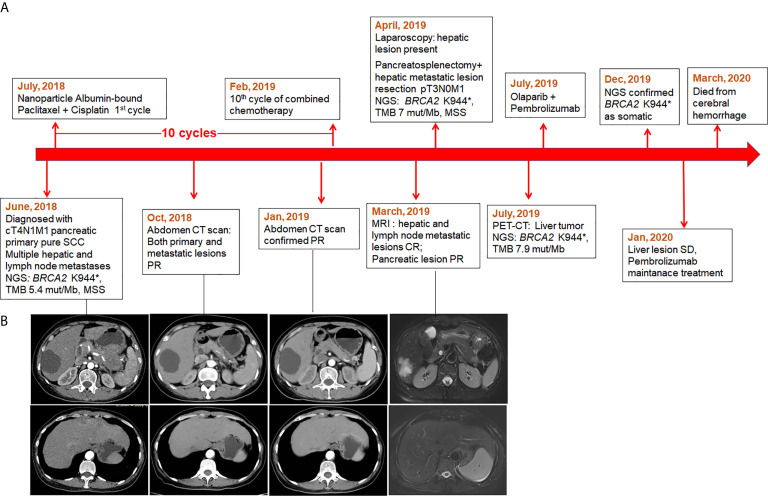
Pancreatic squamous cell carcinoma (SCC) is a rare primary pancreatic malignancy with a poor prognosis. The median overall survival (OS) for metastatic setting is only 4 months and the optimal management remains poorly defined. In the present study, we report a 52-year-old female patient with stage IV primary SCC of the pancreas harboring a deleteous somatic mutation. After 10 cycles of chemotherapy of cisplatin combined with nanoparticle albumin-bound paclitaxel, metastatic lesions in the liver and lymph nodes achieved radiographic complete responses and pancreatic lesion shrank from 5.7 to 1.5 cm in diameter. The patient subsequently underwent a posterior radical antegrade modular pancreatosplenectomy with R0 resection and residual liver lesions were also resected. After 3 months, a tumor relapsed in the liver. She was then treated with olaparib combined with pembrolizumab and achieved stable disease on the liver lesion. The patient eventually died from cerebral hemorrhage with a long OS of 21 months. Our case demonstrated a favorable clinical activity and survival advantage of the combined cisplatin and nanoparticle albumin-bound paclitaxel, which might serve as a therapeutic option for the patient with -mutant pancreatic SCC.
胰腺鳞状细胞癌(SCC)是一种罕见的原发性胰腺恶性肿瘤,预后较差。转移性患者的中位总生存期(OS)仅为4个月,最佳治疗方案仍不明确。在本研究中,我们报告了一名52岁的女性患者,患有IV期原发性胰腺SCC,伴有一个缺失性体细胞突变。在接受了10个周期的顺铂联合纳米白蛋白结合型紫杉醇化疗后,肝脏和淋巴结的转移病灶在影像学上达到完全缓解,胰腺病灶直径从5.7厘米缩小至1.5厘米。该患者随后接受了R0切除的后入路根治性顺行模块化胰脾切除术,残留的肝脏病灶也被切除。3个月后,肝脏出现肿瘤复发。随后她接受了奥拉帕利联合帕博利珠单抗治疗,肝脏病灶病情稳定。该患者最终死于脑出血,总生存期长达21个月。我们的病例显示了顺铂联合纳米白蛋白结合型紫杉醇具有良好的临床活性和生存优势,这可能是治疗携带 -突变的胰腺SCC患者的一种治疗选择。