Kaushik Parshant, Shakil Najam A, Rana Virendra S
Division of Agricultural Chemicals, ICAR-Indian Agricultural Research Institute, New Delhi, India.
Front Chem. 2021 Apr 30;9:636882. doi: 10.3389/fchem.2021.636882. eCollection 2021.
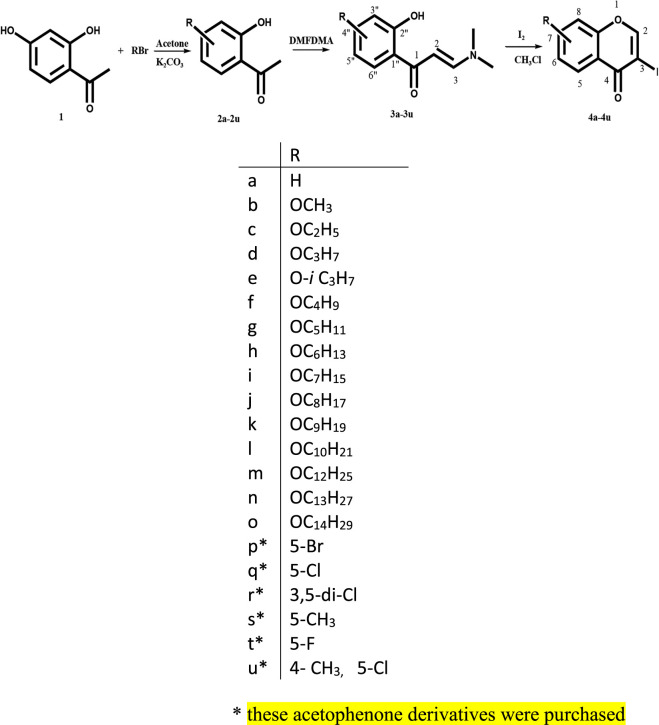
Despite the emergence of novel biotechnological and biological solutions, agrochemicals continue to play an important role in crop protection. Fungicide resistance is becoming a major problem; numerous cases of fungicide resistance have occurred worldwide in the last decade, resulting in the loss of several fungicides. The discovery of new molecules has therefore assumed critical importance in crop protection. In our quest for biologically active molecules, we herein report the synthesis of a series of twenty-one 3-Iodochromone derivatives (4a-4u), in a two-step process by condensation of 2-hydroxyacetophenone derivatives (2a-2u) with ,-dimethylformamidedimethylacetal yielding enaminones (3a-3u), followed by cyclization with iodine to corresponding 3-iodochromones. Characterization of these compounds was done by IR, H NMR, C NMR, and LC-HRMS techniques. All synthesized compounds were screened for their fungicidal activity against . Among these 6,8-Dichloro-3-iodochromone was found to be most active (ED = 8.43 mg L). 2D-Quantitative Structural Activity Relationship (2D-QSAR) analysis was also performed by generating three different models ., Multiple Linear Regression (MLR, Model 1), Principal Component Regression (PCR, Model 2), and Partial Least Squares (PLS, Model 3). Predictive power and statistical significance of these models were assessed with external and internal validation and leave one-out cross-validation was used for verification. In QSAR study, MLR (Model 1) was found to be best having correlation coefficient (r) 0.943, cross-validated correlation coefficient (q) 0.911 and rpred 0.837. It was observed that DeltaEpsilonC, T_2_Cl_6, T_2_F_6, T_T_F_3, and ZCompDipole are the major descriptors which influence the fungicidal activity of 3-Iodochromone derivatives. The physicochemical parameters were estimated by the VLifeMDS 4.6 software. The QSAR study results will be helpful for structure optimization to improve the activity.
尽管出现了新的生物技术和生物解决方案,但农用化学品在作物保护中仍继续发挥重要作用。杀菌剂抗性正成为一个主要问题;在过去十年中,全球范围内已出现大量杀菌剂抗性案例,导致几种杀菌剂失效。因此,发现新分子在作物保护中具有至关重要的意义。在我们对生物活性分子的探索中,本文报道了通过2-羟基苯乙酮衍生物(2a - 2u)与N,N-二甲基甲酰胺二甲基缩醛缩合生成烯胺酮(3a - 3u),然后用碘环化生成相应的3-碘色酮,分两步合成了一系列二十一种3-碘色酮衍生物(4a - 4u)。通过红外光谱(IR)、氢核磁共振(¹H NMR)、碳核磁共振(¹³C NMR)和液相色谱-高分辨质谱(LC-HRMS)技术对这些化合物进行了表征。对所有合成的化合物针对[具体真菌名称未给出]进行了杀菌活性筛选。在这些化合物中,6,8-二氯-3-碘色酮被发现活性最高(半数有效剂量ED₅₀ = 8.43 mg/L)。还通过生成三种不同模型进行了二维定量构效关系(2D-QSAR)分析,即多元线性回归(MLR, 模型1)、主成分回归(PCR, 模型2)和偏最小二乘法(PLS, 模型3)。通过外部和内部验证评估了这些模型的预测能力和统计显著性,并使用留一法交叉验证进行验证。在QSAR研究中,发现MLR(模型1)最佳,其相关系数(r)为0.943,交叉验证相关系数(q)为0.911,预测相关系数(rpred)为0.837。观察到ΔεC、T₂Cl₆、T₂F₆、T_T_F₃和ZCompDipole是影响3-碘色酮衍生物杀菌活性的主要描述符。理化参数通过VLifeMDS 4.6软件估算。QSAR研究结果将有助于进行结构优化以提高活性。