Hirata Kenji, Manabe Osamu, Magota Keiichi, Furuya Sho, Shiga Tohru, Kudo Kohsuke
Department of Diagnostic Imaging, Hokkaido University Graduate School of Medicine, Sapporo, Japan.
Department of Nuclear Medicine, Hokkaido University Hospital, Sapporo, Japan.
Front Med (Lausanne). 2021 Apr 28;8:647562. doi: 10.3389/fmed.2021.647562. eCollection 2021.
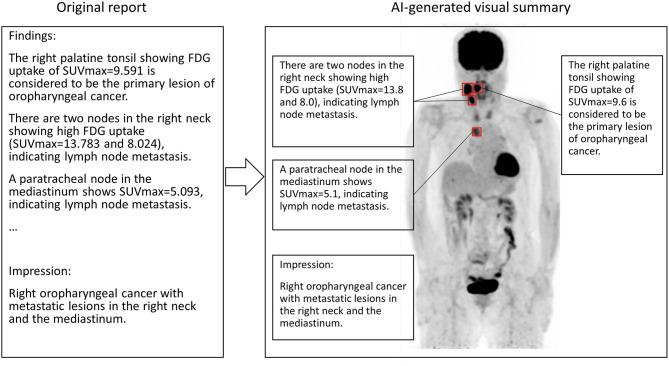
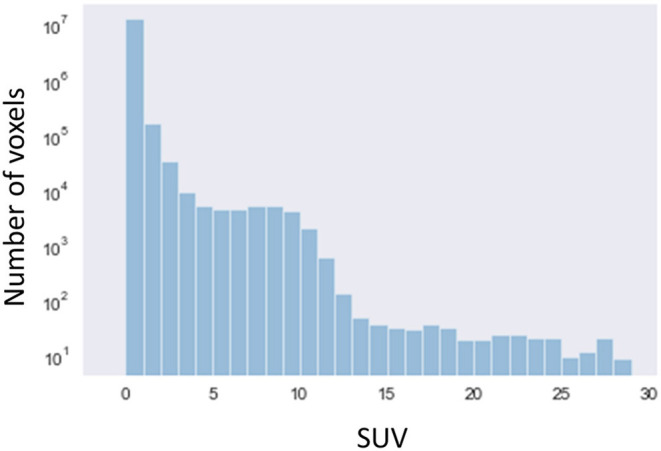
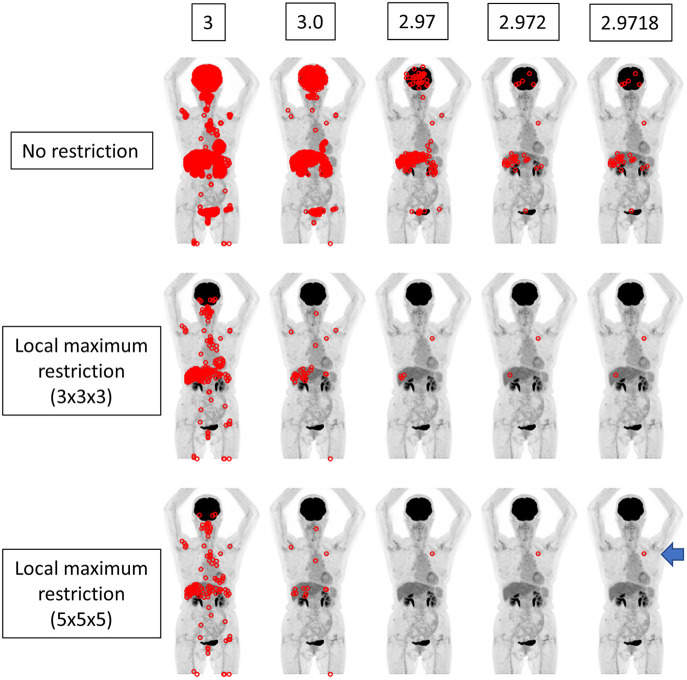
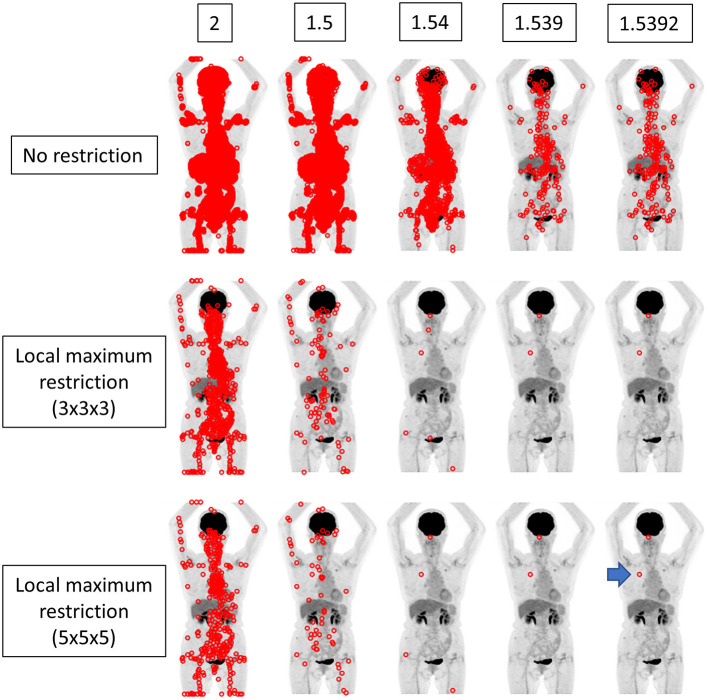
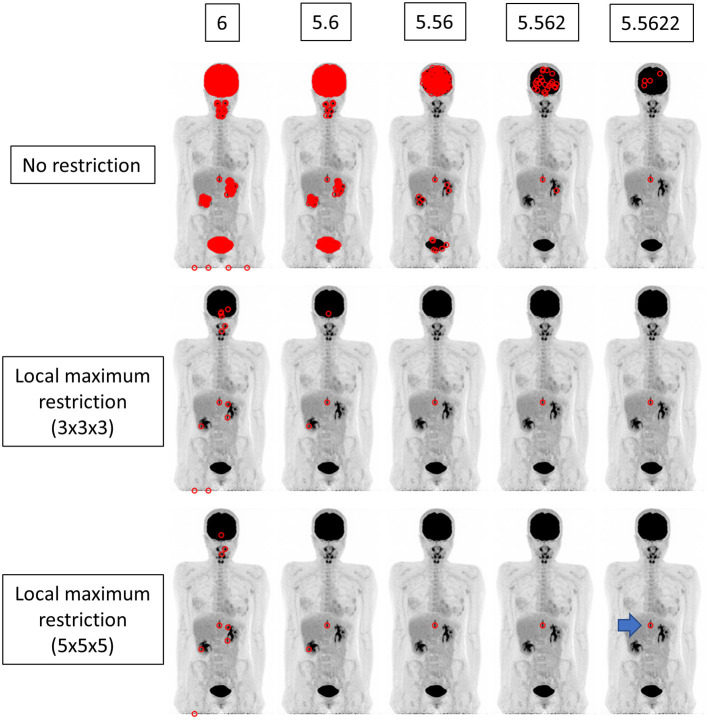
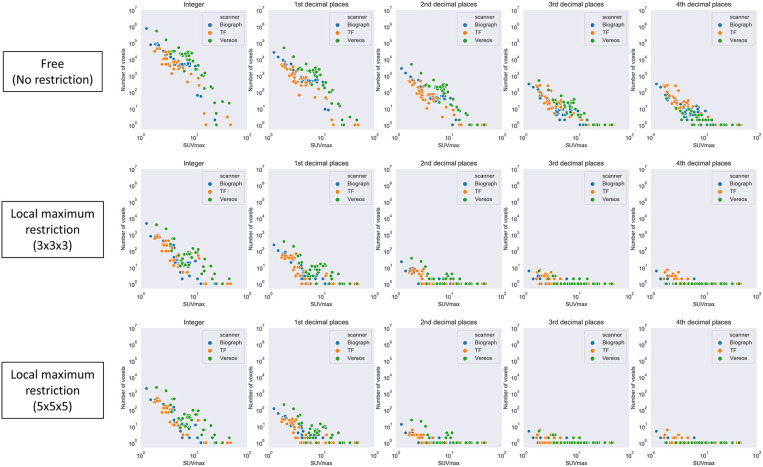
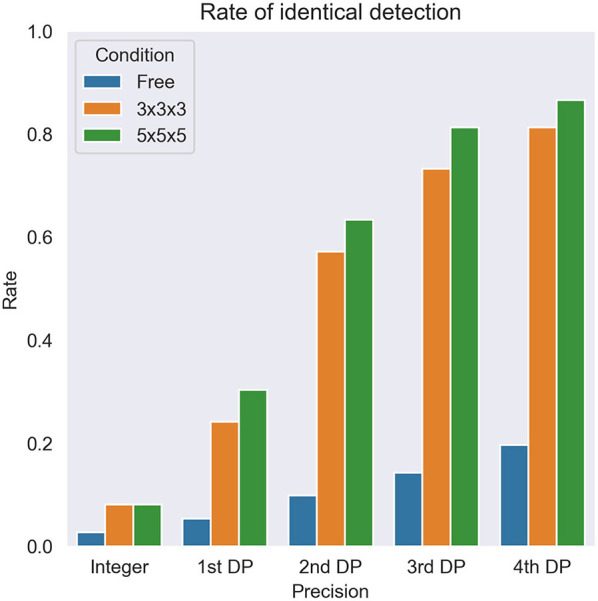
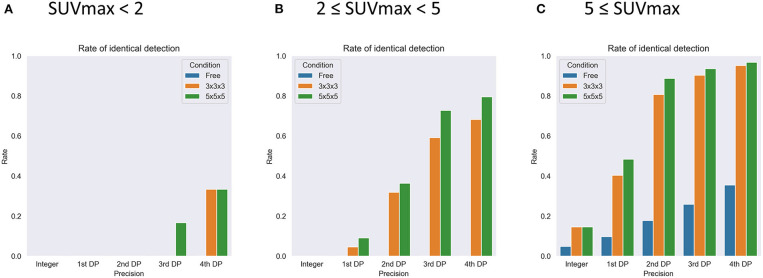
Diagnostic reports contribute not only to the particular patient, but also to constructing massive training dataset in the era of artificial intelligence (AI). The maximum standardized uptake value (SUVmax) is often described in daily diagnostic reports of [F] fluorodeoxyglucose (FDG) positron emission tomography (PET) - computed tomography (CT). If SUVmax can be used as an identifier of lesion, that would greatly help AI interpret diagnostic reports. We aimed to clarify whether the lesion can be localized using SUVmax strings. The institutional review board approved this retrospective study. We investigated a total of 112 lesions from 30 FDG PET-CT images acquired with 3 different scanners. SUVmax was calculated from DICOM files based on the latest Quantitative Imaging Biomarkers Alliance (QIBA) publication. The voxels showing the given SUVmax were exhaustively searched in the whole-body images and counted. SUVmax was provided with 5 different degrees of precision: integer (e.g., 3), 1st decimal places (DP) (3.1), 2nd DP (3.14), 3rd DP (3.142), and 4th DP (3.1416). For instance, when SUVmax = 3.14 was given, the voxels with 3.135 ≤ SUVmax < 3.145 were extracted. We also evaluated whether local maximum restriction could improve the identifying performance, where only the voxels showing the highest intensity within some neighborhood were considered. We defined that "identical detection" was achieved when only single voxel satisfied the criterion. A total of 112 lesions from 30 FDG PET-CT images were investigated. SUVmax ranged from 1.3 to 49.1 (median = 5.6). Generally, when larger and more precise SUVmax values were given, fewer voxels satisfied the criterion. The local maximum restriction was very effective. When SUVmax was determined to 4 decimal places (e.g., 3.1416) and the local maximum restriction was applied, identical detection was achieved in 33.3% (lesions with SUVmax < 2), 79.5% (2 ≤ SUVmax < 5), and 97.8% (5 ≤ SUVmax) of lesions. In this preliminary study, SUVmax of FDG PET-CT could be used as an identifier to localize the lesion if precise SUVmax is provided and local maximum restriction was applied, although the lesions showing SUVmax < 2 were difficult to identify. The proposed method may have potential to make use of diagnostic reports retrospectively for constructing training datasets for AI.
诊断报告不仅对特定患者有帮助,而且在人工智能(AI)时代有助于构建大规模训练数据集。最大标准化摄取值(SUVmax)常在[F]氟脱氧葡萄糖(FDG)正电子发射断层扫描(PET)-计算机断层扫描(CT)的日常诊断报告中描述。如果SUVmax可用作病变的标识符,将极大地帮助AI解读诊断报告。我们旨在阐明是否可以使用SUVmax字符串定位病变。机构审查委员会批准了这项回顾性研究。我们调查了用3种不同扫描仪获取的30张FDG PET-CT图像中的总共112个病变。基于最新的定量成像生物标志物联盟(QIBA)出版物从DICOM文件中计算SUVmax。在全身图像中详尽搜索显示给定SUVmax的体素并计数。SUVmax具有5种不同程度的精度:整数(例如,3)、保留1位小数(3.1)、保留2位小数(3.14)、保留3位小数(3.142)和保留4位小数(3.1416)。例如,当给出SUVmax = 3.14时,提取3.135≤SUVmax<3.145的体素。我们还评估了局部最大值限制是否可以提高识别性能,即仅考虑在某个邻域内显示最高强度的体素。我们定义当只有单个体素满足标准时实现“相同检测”。对30张FDG PET-CT图像中的总共112个病变进行了调查。SUVmax范围为1.3至49.1(中位数 = 5.6)。一般来说,当给出更大且更精确的SUVmax值时,满足标准的体素更少。局部最大值限制非常有效。当将SUVmax确定到4位小数(例如,3.1416)并应用局部最大值限制时,在SUVmax<2的病变中有33.3%、2≤SUVmax<5的病变中有79.5%以及5≤SUVmax的病变中有97.8%实现了相同检测。在这项初步研究中,如果提供精确的SUVmax并应用局部最大值限制,FDG PET-CT的SUVmax可以用作定位病变的标识符,尽管显示SUVmax<2的病变难以识别。所提出的方法可能有潜力回顾性地利用诊断报告来构建AI的训练数据集。