Bouredji Zineb, Hamoudi Dounia, Marcadet Laetitia, Argaw Anteneh, Frenette Jérôme
Centre Hospitalier Universitaire de Québec, Centre de Recherche du Centre Hospitalier de l'Université Laval (CHUQ-CHUL), Axe Neurosciences, Université Laval, Quebec City, QC G1V 4G2, Canada.
Département de Réadaptation, Faculté de Médecine, Université Laval, Quebec City, QC G1V 0A6, Canada.
Mol Ther Methods Clin Dev. 2021 Mar 29;21:559-573. doi: 10.1016/j.omtm.2021.03.022. eCollection 2021 Jun 11.
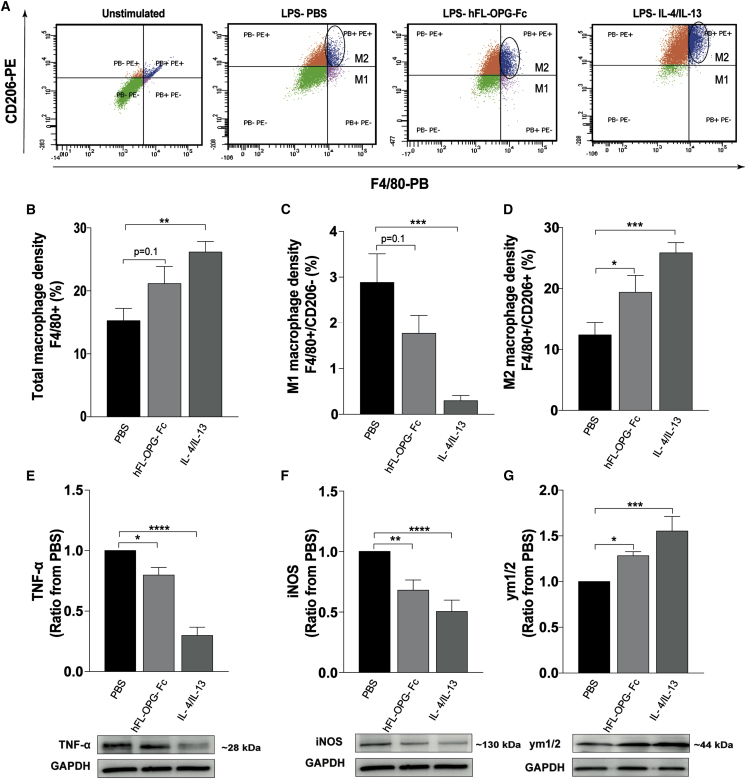
Although receptor-activator of nuclear factor κB (RANK), its ligand RANKL, and osteoprotegerin (OPG), which are members of the tumor necrosis factor (TNF) superfamily, were first discovered in bone cells, they are also expressed in other cells, including skeletal muscle. We previously showed that the RANK/RANKL/OPG pathway is involved in the physiopathology of Duchenne muscular dystrophy and that a mouse full-length OPG-Fc (mFL-OPG-Fc) treatment is superior to muscle-specific RANK deletion in protecting dystrophic muscles. Although mFL-OPG-Fc has a beneficial effect in the context of muscular dystrophy, the function of human FL-OPG-Fc (hFL-OPG-Fc) during muscle repair is not yet known. In the present study, we investigated the impacts of an hFL-OPG-Fc treatment following the intramuscular injection of cardiotoxin (CTX). We show that a 7-day hFL-OPG-Fc treatment improved force production of soleus muscle. hFL-OPG-Fc also improved soleus muscle integrity and regeneration by increasing satellite cell density and fiber cross-sectional area, attenuating neutrophil inflammatory cell infiltration at 3 and 7 days post-CTX injury, increasing the anti-inflammatory M2 macrophages 7 days post-CTX injury. hFL-OPG-Fc treatment also favored M2 over M1 macrophage phenotypic polarization . We show for the first time that hFL-OPG-Fc improved myotube maturation and fusion and reduced cytotoxicity and cell apoptosis. These findings demonstrate that hFL-OPG-Fc has therapeutic potential for muscle diseases in which repair and regeneration are impaired.
尽管核因子κB受体激活剂(RANK)、其配体RANKL和骨保护素(OPG)是肿瘤坏死因子(TNF)超家族的成员,最初在骨细胞中被发现,但它们也在包括骨骼肌在内的其他细胞中表达。我们之前表明,RANK/RANKL/OPG通路参与了杜氏肌营养不良症的病理生理过程,并且在保护营养不良性肌肉方面,小鼠全长OPG-Fc(mFL-OPG-Fc)治疗优于肌肉特异性RANK缺失。尽管mFL-OPG-Fc在肌肉营养不良的背景下具有有益作用,但人全长OPG-Fc(hFL-OPG-Fc)在肌肉修复过程中的功能尚不清楚。在本研究中,我们研究了肌肉注射心肌毒素(CTX)后hFL-OPG-Fc治疗的影响。我们发现,7天的hFL-OPG-Fc治疗改善了比目鱼肌的力量产生。hFL-OPG-Fc还通过增加卫星细胞密度和纤维横截面积、减轻CTX损伤后3天和7天的中性粒细胞炎性细胞浸润、增加CTX损伤后第7天的抗炎M2巨噬细胞,改善了比目鱼肌的完整性和再生。hFL-OPG-Fc治疗还促进了M2巨噬细胞而非M1巨噬细胞的表型极化。我们首次表明,hFL-OPG-Fc改善了肌管的成熟和融合,并降低了细胞毒性和细胞凋亡。这些发现表明,hFL-OPG-Fc对修复和再生受损的肌肉疾病具有治疗潜力。